What Does Auto Insurance Actually Cover? A Driver’s Guide
You have auto insurance. You pay your premium. You keep your insurance card in your glove compartment.
But here’s a question:
Do you actually know what your auto insurance covers?
Most drivers understand that auto insurance is important. But many don’t realize how different coverages work together—or what happens when they’re involved in an accident.
For example:
- What if you cause an accident and someone gets hurt?
- What if another driver hits you and doesn’t have insurance?
- What if a tree falls on your vehicle?
- What if your car is totaled?
- What if someone else is driving your vehicle?
The answers depend on the coverages you’ve selected, your policy limits, deductibles, and the circumstances surrounding the loss.
Let’s break it down.
Key Takeaways
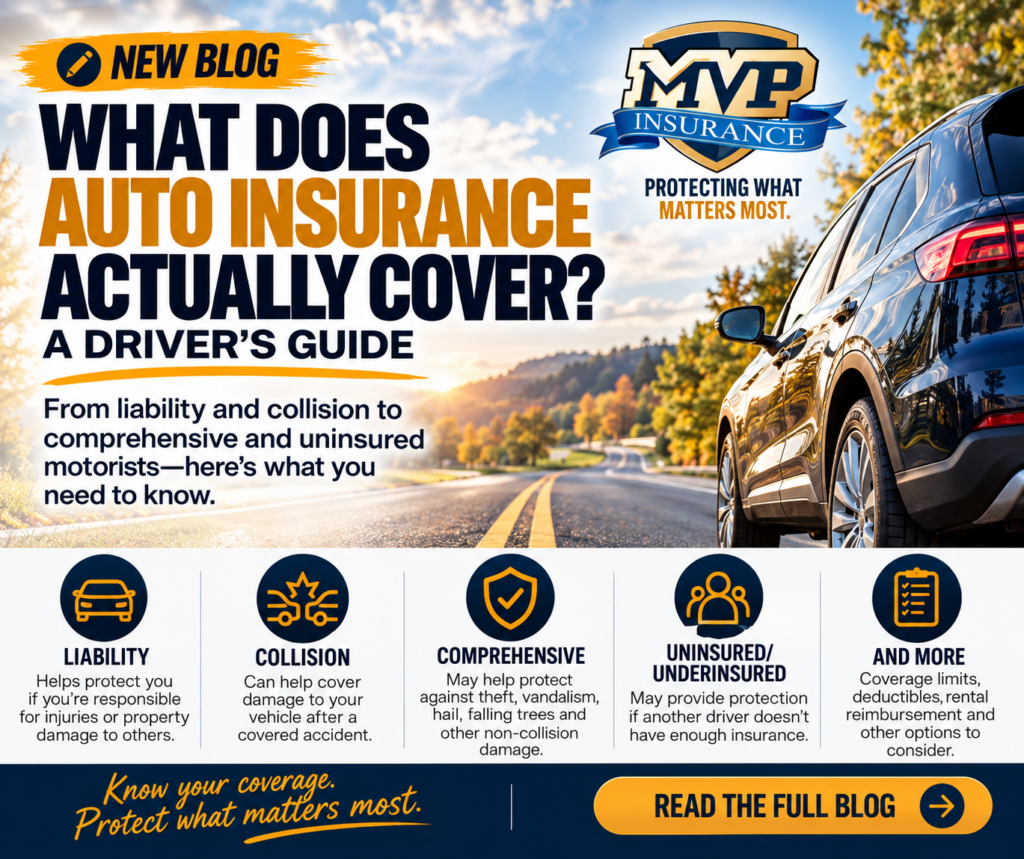
- Auto insurance isn’t one single coverage. It’s a combination of different protections.
- Liability insurance generally helps protect you financially when you’re legally responsible for injuries or property damage to others.
- Collision and comprehensive coverage can help protect your own vehicle against different types of covered damage.
- Uninsured and underinsured motorist coverage may provide important protection when another driver lacks sufficient insurance.
- Your coverage limits and deductibles can be just as important as your premium.
- The best way to understand your protection is to review your policy with your insurance agent.
What Is Auto Liability Insurance?
Liability coverage is one of the most important parts of an auto insurance policy.
If you cause an accident and are legally responsible for injuries or property damage to someone else, liability insurance may help cover certain expenses, subject to your policy limits and terms.
There are generally two primary components.
Bodily Injury Liability
Bodily injury liability may help pay for covered expenses arising from injuries to other people when you’re legally responsible for an accident.
Depending on the circumstances, this could include medical expenses, lost wages, and legal defense costs.
Property Damage Liability
Property damage liability generally helps cover damage you cause to someone else’s property.
For example, if you accidentally rear-end another vehicle, this coverage may help pay for the other driver’s vehicle damage.
But here’s something important:
Having liability insurance doesn’t necessarily mean you have enough liability insurance.
If the damages exceed your policy limits, you could be personally responsible for the remaining amount.
That’s why choosing appropriate liability limits deserves more consideration than simply purchasing the minimum required by your state.
What Is Collision Coverage?
Collision coverage generally helps pay for covered damage to your own vehicle when it collides with another vehicle or object, regardless of who caused the accident, subject to your deductible and policy terms.
For example:
You slide on an icy road and hit a guardrail.
Or you accidentally back into a pole.
Collision coverage may help pay to repair or replace your vehicle after a covered loss.
Without collision coverage, you may need to pay for damage to your own vehicle yourself unless another responsible party’s insurance pays.
What Is Comprehensive Coverage?
Comprehensive coverage generally helps protect your vehicle against certain covered losses that aren’t collisions.
Examples may include:
- Theft
- Vandalism
- Hail damage
- Fire
- Falling trees or branches
- Certain weather-related damage
- Hitting an animal
Imagine walking outside after a storm and discovering a large tree branch has fallen onto your parked vehicle.
That would generally be a comprehensive auto insurance situation rather than a homeowners insurance claim for damage to the vehicle.
If you want to better understand how these coverages work together, read our existing article, What Is Full Coverage Auto Insurance? What It Really Means.
Read the MVP Full Coverage Auto Insurance Guide
What Does “Full Coverage” Auto Insurance Mean?
This is one of the most misunderstood phrases in insurance.
“Full coverage” isn’t a specific insurance coverage or a guarantee that everything is covered.
People commonly use the term to describe a combination of liability, collision, and comprehensive coverage.
But two drivers who both say they have full coverage may have very different protection.
One driver may carry higher liability limits.
Another may have lower limits, different deductibles, or fewer optional coverages.
That’s why we encourage drivers to ask:
“What exactly does my auto insurance policy cover?”
That’s a much better question than simply asking whether you have full coverage.
What Is Uninsured and Underinsured Motorist Coverage?
Imagine you’re injured in an accident caused by another driver.
Now imagine that driver either doesn’t have insurance or doesn’t carry enough insurance to cover the damages.
That’s where uninsured and underinsured motorist coverage may become important.
Uninsured Motorist Coverage
Depending on the policy and applicable state law, uninsured motorist coverage may help protect you and other insured individuals for certain injuries caused by an uninsured or qualifying hit-and-run driver.
Underinsured Motorist Coverage
Underinsured motorist coverage may help when an at-fault driver has liability insurance, but the available coverage isn’t sufficient to compensate for covered damages.
Availability, requirements, covered damages, and limits vary by state and policy.
This is an important coverage discussion because you can’t control how much insurance another driver carries.
What About Medical Payments Coverage?
Depending on your state and policy, auto insurance may include or offer medical payments coverage, personal injury protection, or other first-party injury benefits.
These coverages can help with certain medical expenses or other qualifying costs following an auto accident, regardless of fault in some circumstances.
The benefits and requirements vary significantly by state.
Your insurance agent can explain which coverages apply to your policy and how they work alongside health insurance.
Does Auto Insurance Cover Someone Else Driving My Car?
Sometimes.
But don’t assume that anyone who gets behind the wheel of your vehicle is automatically covered.
Coverage can depend on several factors, including:
- Whether the driver had permission
- Whether the driver lives in your household
- Whether the driver regularly uses your vehicle
- Whether the driver is excluded from your policy
- Your insurance company’s underwriting requirements
- Applicable state law
We’ve already covered this in more detail in our article:
Does Car Insurance Cover Someone Else Driving Your Car?
Before regularly allowing someone else to drive your vehicle, call your insurance agent and discuss the situation.
What Is Rental Reimbursement Coverage?
Imagine your vehicle is damaged in a covered accident and needs to spend several days in a repair shop.
How will you get to work?
Rental reimbursement coverage may help pay certain transportation expenses while your vehicle is unavailable because of a covered loss, subject to policy limits and terms.
This coverage is often optional.
And it’s important to understand that it generally doesn’t mean your insurance pays for a rental car whenever you want one.
The circumstances of the loss and the coverage you’ve purchased matter.
What About Roadside Assistance?
Some auto insurance policies offer optional roadside assistance or towing coverage.
Depending on the policy, these benefits may help with situations such as:
- Towing after a breakdown
- Dead batteries
- Flat tires
- Lockouts
- Certain emergency roadside services
Coverage and service limits vary.
If you already pay for a separate roadside assistance membership, it’s worth reviewing whether you have overlapping benefits.
How Do Auto Insurance Deductibles Work?
Your deductible is generally the amount you’re responsible for paying toward a covered physical damage claim before insurance pays the remaining covered amount, subject to policy terms.
For example:
Suppose your vehicle sustains $4,000 in covered collision damage and your deductible is $500.
You would generally be responsible for the first $500, with insurance paying the remaining $3,500 of covered repairs.
A higher deductible may reduce your premium, but it also means accepting more out-of-pocket expense after a covered loss.
The right deductible depends on your financial situation and comfort with risk.
For more information, read our article:
Should You Raise Your Insurance Deductible?
What Happens When You Pay Off Your Car?
Once your vehicle is paid off, you may have more flexibility in deciding whether to maintain collision and comprehensive coverage.
But that doesn’t automatically mean you should remove them.
Ask yourself:
“If my vehicle were totaled tomorrow, could I comfortably afford to replace it?”
If the answer is no, maintaining physical damage coverage may still make sense.
Your vehicle’s value, deductibles, premium, and financial circumstances should all factor into the decision.
How Much Auto Insurance Do I Really Need?
There’s no single answer that works for every driver.
Your insurance needs may depend on factors such as:
- The value of your vehicle
- Your financial assets
- Your household drivers
- Your driving habits
- Your liability exposure
- Your ability to pay unexpected expenses
- Whether your vehicle is financed or leased
This is also a good time to discuss whether an umbrella insurance policy could provide additional liability protection above certain underlying insurance limits.
The goal shouldn’t simply be to purchase the cheapest policy.
The goal should be to understand your risks and select coverage that makes sense for your situation.
What Should I Do After an Auto Accident?
First, make sure everyone is safe.
If anyone is injured or there’s an immediate danger, contact emergency services.
When it’s safe and appropriate, document the accident, exchange necessary information, and follow applicable reporting requirements.
Then:
Call your insurance agent.
Your agent can help explain your coverage, deductible, claim-reporting obligations, and the appropriate next steps.
You shouldn’t have to guess about what your insurance covers during an already stressful situation.
And that’s one of the reasons having an insurance agent matters.
The MVP Approach
At MVP Insurance, we believe auto insurance should be about more than getting the lowest possible price.
We want you to understand:
What you’re protecting. What your limits are. What your deductible is. And where potential gaps may exist.
That doesn’t mean everyone needs the same policy.
It means your coverage should reflect your individual situation.
And when something happens, you should have someone you can call to help you understand your options.
No pressure. No confusing insurance jargon. Just practical advice to help you protect what matters most.
Frequently Asked Questions
Does liability insurance cover damage to my own car?
Generally, no. Liability insurance is primarily designed to protect against covered injuries or property damage you cause to others. Collision or comprehensive coverage may be needed to protect your own vehicle.
Is full coverage auto insurance required?
There isn’t a universal coverage called “full coverage.” State laws generally require certain coverages, and lenders or leasing companies may require comprehensive and collision coverage. Requirements vary.
Does comprehensive insurance cover hitting a deer?
Generally, hitting an animal is treated as a comprehensive claim, subject to policy terms and deductible. Other circumstances involving an animal may be handled differently.
Does auto insurance cover a rental car?
It depends on whether you’re renting a vehicle, seeking reimbursement for a rental after a covered claim, or using a temporary substitute vehicle. Your existing coverage and rental agreement matter.
Should I increase my auto insurance liability limits?
It’s worth discussing with your agent, especially if your assets, income, household circumstances, or potential liability exposure have changed.
Final Thought
You don’t need to become an insurance expert.
But you should understand what you’re paying for.
Auto insurance isn’t simply a card you keep in your glove compartment or a bill you pay every month.
It’s a collection of protections designed to help you manage certain financial risks.
And the time to understand those protections is before you need them.
If you’re unsure what your current auto policy covers, call your insurance agent and ask for a review.
It’s one of the most valuable conversations you can have about your insurance.
Have Questions About Your Auto Insurance?
MVP Insurance can help you review your current auto insurance, understand your coverage, and compare your options.
Request an Auto Insurance Quote
Already insured? You can securely share your current policy information with MVP Insurance through Canopy Connect.
MVP Insurance — Protecting What Matters Most.