
You’re shopping for auto insurance and someone asks:
“Do you want full coverage?”
It sounds simple.
You either have full coverage or you don’t… right?
Not exactly.
Here’s something many drivers are surprised to learn:
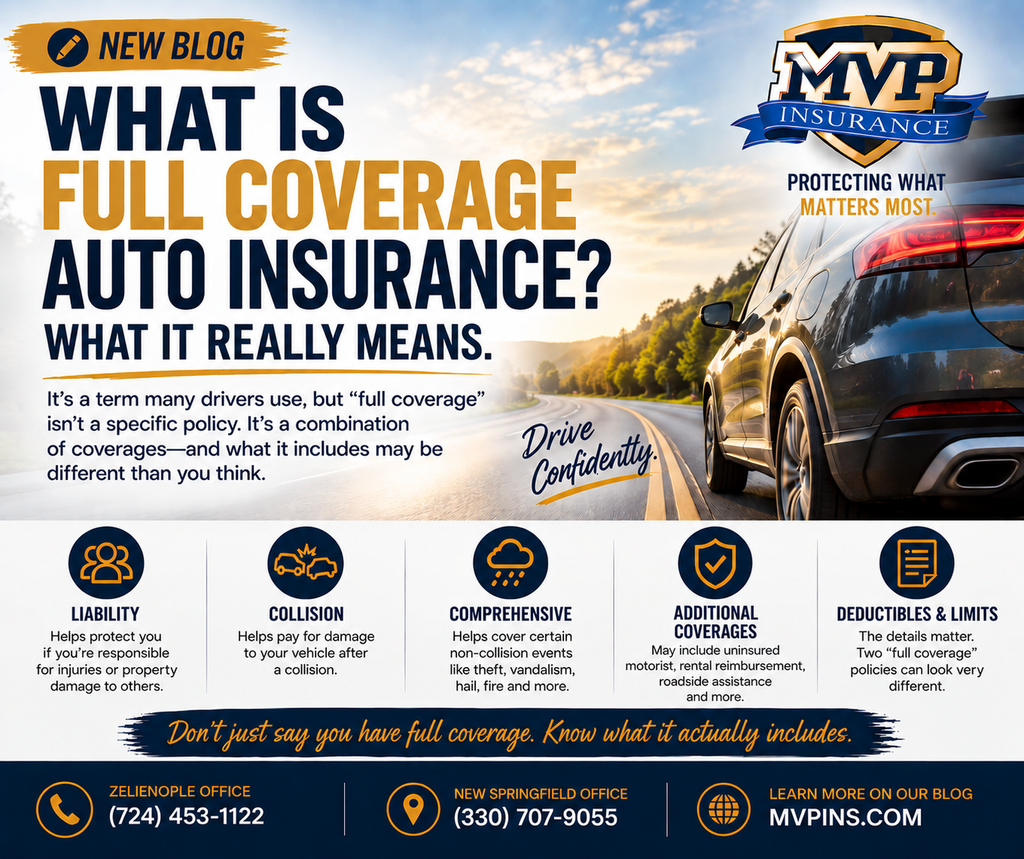
“Full coverage” generally isn’t a specific insurance coverage you can find listed on your policy.
It’s an informal phrase people often use to describe a combination of auto insurance coverages.
And what one person considers “full coverage” may be very different from what someone else has.
So, what are you actually buying?
What Does “Full Coverage” Usually Include?
When someone refers to full coverage auto insurance, they’re often talking about a policy that includes:
- Liability coverage
- Collision coverage
- Comprehensive coverage
But even having all three doesn’t necessarily mean you’re protected against every possible loss.
Let’s look at what each one does.
Want to better understand what your policy protects? Liability, collision, and comprehensive are just the beginning. We break down uninsured motorist protection, deductibles, rental reimbursement, and other important coverages in our complete guide to what auto insurance actually covers
Liability Coverage
Liability coverage can help protect you financially if you’re legally responsible for an accident that injures another person or damages their property, subject to your policy limits and terms.
This is one of the most important parts of your auto policy.
And the amount of liability coverage matters.
Two people can both say they have “full coverage” while carrying dramatically different liability limits.
That’s why simply asking whether someone has full coverage doesn’t tell the whole story.
Collision Coverage
Collision coverage generally helps pay for covered damage to your vehicle resulting from a collision, subject to your deductible and policy terms.
For example, you might:
- Hit another vehicle
- Back into an object
- Hit a guardrail
- Be involved in a single-vehicle accident
Collision coverage is about damage to your vehicle from a covered collision.
Comprehensive Coverage
Comprehensive coverage generally applies to certain types of damage to your vehicle that aren’t caused by a collision.
Depending on your policy, examples may include:
- Theft
- Vandalism
- Hail
- Falling objects
- Fire
- Animal collisions
- Certain weather-related losses
Like collision coverage, comprehensive typically has a deductible.
But Is That Really “Full” Coverage?
Here’s where the phrase can become misleading.
Even if you have liability, comprehensive, and collision, there may be other important coverages worth considering.
Depending on your policy and state, those could include:
- Uninsured/underinsured motorist coverage
- Medical payments or similar coverage
- Rental reimbursement
- Roadside assistance
- Loan or lease-related protection
- Higher liability limits
Simply saying “I have full coverage” doesn’t tell you whether you have any of these.
Your Deductible Matters Too
Suppose two drivers have comprehensive and collision coverage.
Driver A has a $500 deductible.
Driver B has a $2,000 deductible.
Both might say they have “full coverage.”
But their out-of-pocket responsibility after certain claims could be very different.
That’s why it’s important to understand not only which coverages you have, but also the limits and deductibles attached to them.
What If You Have a Loan on Your Vehicle?
If you’re financing or leasing a vehicle, your lender or leasing company will generally require certain physical damage coverages.
But satisfying your lender’s requirements doesn’t necessarily mean you’ve selected all the protection that’s appropriate for you.
The lender is primarily interested in protecting its financial interest in the vehicle.
You also need to think about protecting your financial situation.
What Happens When You Pay Off Your Car?
Once your vehicle is paid off, you may have more flexibility regarding comprehensive and collision coverage.
That doesn’t automatically mean you should remove them.
Consider:
If this vehicle were totaled tomorrow, could I comfortably replace it myself?
The value of the vehicle, cost of coverage, deductibles, and your financial situation should all be part of the decision.
Stop Asking for “Full Coverage”
Instead, ask:
“What exactly does my auto insurance cover?”
That’s a much better question.
Review:
- Your liability limits
- Comprehensive and collision
- Your deductibles
- Uninsured/underinsured motorist protection
- Rental coverage
- Roadside assistance
- Any other endorsements or optional coverages
You may discover you’re better protected than you thought.
Or you may uncover a gap you didn’t know existed.
The MVP Approach
At MVP Insurance, we don’t think “full coverage” tells you enough.
Our job isn’t simply to check a box and tell you that you’re covered.
We want you to understand what you’re buying, what your limits are, what your deductibles are, and how your coverage may respond when something happens.
Price matters.
But knowing what you’re getting for that price matters too.
No pressure. No confusing insurance jargon.
Just practical advice to help you protect what matters most.
Final Thought
So, what is full coverage auto insurance?
There isn’t one universal definition.
It’s a convenient phrase—but it can create a false sense of security if you don’t understand what’s actually included in your policy.
The next time someone asks whether you have full coverage, take it one step further:
Do you know what your auto insurance actually covers?
That’s the question that matters.
Want a Second Opinion on Your Auto Insurance?
MVP Insurance can review your current auto policy, explain your coverage, and help you understand your options.
Request an insurance quote from MVP Insurance
https://www.mvpins.com/quotes/
Already have insurance? Securely send us your current policy information:
https://app.usecanopy.com/c/MVPINSURANCE
“Think you might be overpaying?
Get a fast quote here: https://www.mvpins.com/quotes/”