
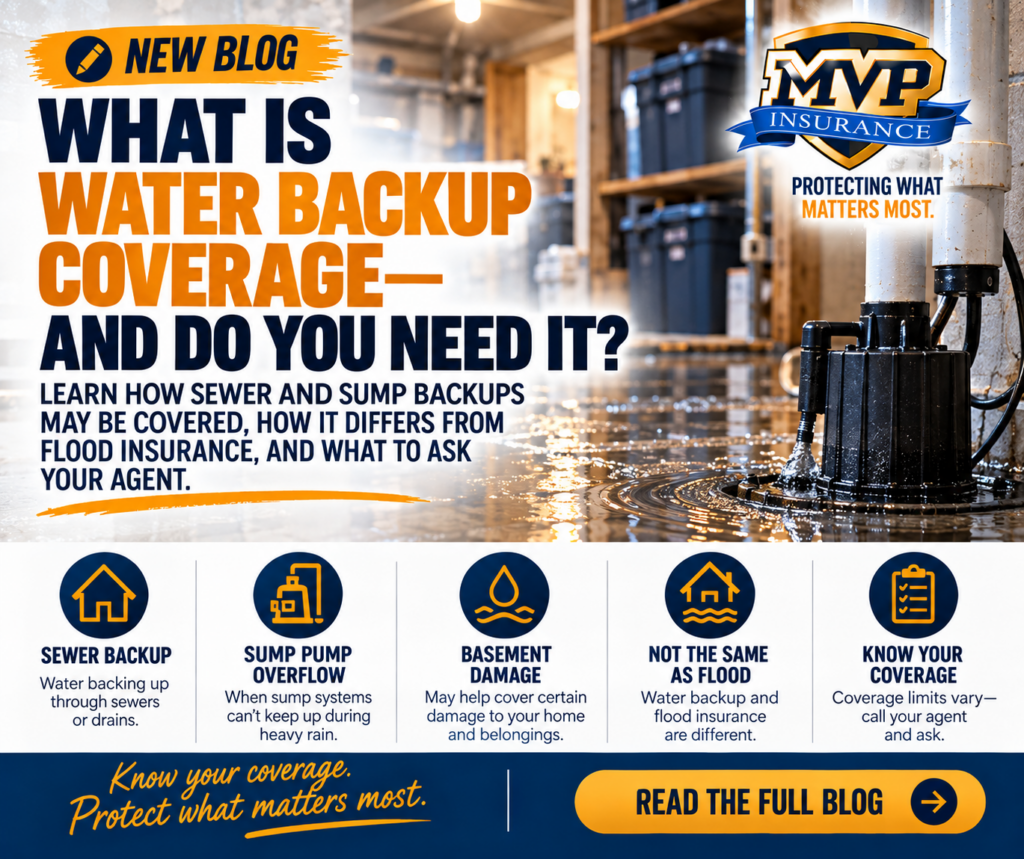
You walk downstairs and discover water covering the basement floor.
Your first thought might be:
“I have homeowners insurance. This should be covered… right?”
Not necessarily.
One of the most misunderstood areas of homeowners insurance involves water that backs up through a sewer, drain or sump system.
A standard homeowners policy may not automatically provide the protection you expect for this type of loss. That’s where water backup coverage can become important.
Key Takeaways
- Water backup coverage may help protect you when water backs up through certain sewers or drains or overflows from certain sump systems, subject to the specific policy language.
- This protection may not automatically be included in a standard homeowners policy.
- Water backup and flood insurance are not the same thing.
- Coverage limits can vary significantly, so simply having the endorsement doesn’t necessarily mean you have enough protection.
- Finished basements can make water backup coverage especially important to discuss.
- If you’re unsure whether you have this coverage, call your insurance agent and ask.
What Is Water Backup Coverage?
Water backup coverage is generally an endorsement—or additional coverage—that can be added to certain homeowners insurance policies.
Depending on the policy, it may provide protection for certain damage caused when water backs up through a sewer or drain or overflows from a sump or similar system.
Imagine your sump pump can’t keep up during a heavy rainstorm.
Water backs up into your finished basement and damages flooring, drywall, furniture and other belongings.
Without the appropriate coverage, you may discover that your standard homeowners policy doesn’t respond the way you expected.
That’s why it’s important to understand the difference between having homeowners insurance and understanding what your homeowners insurance actually covers.
Isn’t All Water Damage Covered by Homeowners Insurance?
No.
And this is where homeowners insurance can get confusing.
Different types of water losses can be treated very differently.
A sudden burst pipe may be handled differently than a sewer backup.
A sewer backup may be handled differently than rising floodwater.
And a sudden water loss may be treated differently than a leak that has been occurring gradually over a long period of time.
We’ve previously broken down several of these situations in Does Homeowners Insurance Cover Water Damage?
The important lesson is:
Don’t focus only on the fact that there’s water. The source and cause of the water matter.
Water Backup vs. Flood: What’s the Difference?
This is an especially important distinction.
People sometimes use terms like flooding, water backup and water damage interchangeably.
Insurance policies generally don’t.
Water Backup
Water backup generally involves water backing up through certain sewers or drains or overflowing from certain sump systems, depending on the policy language.
Flood
Flood generally involves water accumulating on normally dry land from an external source and is typically not covered by a standard homeowners insurance policy.
Flood insurance is generally purchased separately.
That means having water backup coverage doesn’t necessarily mean you’re protected against flooding—and having flood insurance doesn’t necessarily eliminate the need to consider water backup coverage.
They address different risks.
What Could Water Backup Coverage Pay For?
Coverage depends on the specific policy, endorsement, limits and circumstances surrounding the loss.
When coverage applies, it may help pay for certain covered damage to your home and belongings caused by a qualifying water backup.
For example, imagine a backup damages:
- Finished basement flooring
- Drywall
- Furniture
- Electronics
- Personal belongings
- Other covered property
The cost can add up quickly.
And that’s why the coverage limit deserves just as much attention as whether the endorsement exists.
How Much Water Backup Coverage Do I Have?
This is a question worth asking your insurance agent.
Don’t simply ask:
“Do I have water backup coverage?”
Also ask:
“How much water backup coverage do I have?”
A policy might provide a specific dollar limit for this coverage.
Think about what you have in your basement.
Is it unfinished and primarily used for storage?
Or is it a finished living space with flooring, drywall, furniture, televisions, appliances, a home office or other valuable property?
Those are very different exposures.
The appropriate amount of coverage will depend on your home, your policy and your individual situation.
Do I Need Water Backup Coverage If I Have a Sump Pump?
Having a sump pump doesn’t mean the risk disappears.
Sump systems can fail for many reasons.
There could be a mechanical problem.
The system could become overwhelmed.
There could be a power outage.
A discharge line could become blocked or frozen.
That’s why homeowners with sump systems should understand how their particular homeowners policy treats water backup and sump-related losses.
Depending on your home and policy, you may also want to discuss preventative options such as battery backups, alarms or other systems with an appropriate professional.
Prevention and insurance can work together.
What If My Basement Isn’t Finished?
An unfinished basement doesn’t automatically mean there’s nothing to protect.
Think about what’s stored downstairs.
Holiday decorations.
Tools.
Exercise equipment.
Appliances.
Furniture.
Boxes of personal belongings.
Mechanical systems.
Even an unfinished basement can contain thousands of dollars of property.
This is also a good reminder of why maintaining a home inventory can be valuable after a significant loss.
Is Water Backup Coverage Expensive?
The cost varies by insurance company, coverage amount, property and other underwriting factors.
Rather than deciding based solely on price, I’d look at the potential exposure.
Ask yourself:
“If several inches of contaminated water backed up into my basement tomorrow, what could it cost me?”
Then compare that potential loss with the coverage available to you.
Insurance decisions shouldn’t be based only on finding the cheapest premium.
They should be based on understanding what you’re protecting and what risks you’re comfortable assuming yourself.
What Should I Ask My Insurance Agent?
You don’t need to become an insurance expert.
That’s what your agent is there for.
I’d ask:
Do I currently have water backup coverage?
What situations does my policy’s coverage apply to?
What is my water backup limit?
What deductible applies?
Would my finished basement and belongings be adequately protected?
Is additional coverage available?
Those five minutes could reveal a coverage gap you didn’t know existed.
What Should I Do If I Discover Water in My Basement?
First, protect yourself and your family. Water around electrical systems, contaminated water and structural damage can create safety hazards.
Take reasonable steps to prevent additional damage when it is safe to do so, and document what happened with photographs or video.
Then:
Call your insurance agent.
Don’t assume something is covered—or excluded—based on what a friend, neighbor or social media post tells you.
Your agent can help you understand your particular policy, discuss what happened and help determine the appropriate next steps.
That’s one of the reasons having an insurance agent matters.
The MVP Approach
At MVP Insurance, we’d rather have a conversation about water backup coverage before there’s water in your basement.
Our goal isn’t simply to sell you a homeowners policy.
We want you to understand what you’re protecting, where your coverage applies and where potential gaps may exist.
And when something does happen, you should have someone you can call to help you understand your policy.
No pressure. No confusing insurance jargon. Just practical advice to help you protect what matters most.
Frequently Asked Questions
Is sewer backup covered by homeowners insurance?
Not necessarily. Coverage for water or sewage backing up through certain sewers or drains may require additional water backup coverage or an endorsement. Policy language varies, so check your particular policy.
Is sump pump failure covered by homeowners insurance?
It depends on the policy and cause of the loss. Certain sump-related water losses may require water backup coverage. Ask your insurance agent how your specific policy handles this exposure.
Is water backup coverage the same as flood insurance?
No. Water backup and flood are generally different insurance exposures. Standard homeowners insurance typically doesn’t cover flood, and water backup coverage shouldn’t be considered a substitute for flood insurance.
How much water backup coverage should I have?
There isn’t one amount that’s appropriate for every homeowner. Consider whether your basement is finished, the property you keep there, potential cleanup and repair costs, and the coverage options available under your policy.
Final Thought
Water damage is a perfect example of why “I have homeowners insurance” doesn’t necessarily answer the most important question.
The better question is:
“Do I understand how my homeowners insurance responds to the risks around my home?”
If you don’t know whether you have water backup coverage—or don’t know how much you have—call your insurance agent and ask.
It’s a much better conversation to have today than while standing in a basement full of water.
Have Questions About Your Homeowners Insurance?
MVP Insurance can help you review your current homeowners policy and understand how your coverage works.
Request an insurance quote from MVP Insurance
https://www.mvpins.com/quotes/
Already have insurance? Securely send us your current policy information:
https://app.usecanopy.com/c/MVPINSURANCE