

Modernizing Home Systems for Lower Risk
Pennsylvania still offers homeowners insurance below the national average, but recent increases have been steep, and Western PA homeowners have felt it through storms and rising rebuilding costs. Your location sets the starting point. Your deductible, your roof and home systems, and how you use your policy decide much of the rest.
The most useful step is seeing real numbers side by side instead of accepting a single renewal at face value. MVP Insurance is an independent agency with offices in Zelienople, PA and New Springfield, OH, and the team compares multiple carriers so you don't have to. When you're ready, start your quote here and get a clearer picture of what your home should cost to insure.
MVP Insurance is licensed in Ohio (license #37714) and Pennsylvania (license #519263), NPN 10588293.
Defense costs are the part of a lawsuit nobody budgets for. Attorneys, expert witnesses, accident reconstructionists, and depositions add up fast, and a contested injury case can take a couple of years to resolve.
Most umbrella policies pay defense costs in addition to the policy limit, rather than eating into it, though wording varies by carrier. Many also provide defense for certain claims your underlying policy doesn't cover at all, such as some libel, slander, or false arrest allegations. That's a detail worth reviewing line by line before you buy, because it's often where two seemingly similar policies differ most.
Risk Rating 2.0 changed how Pennsylvania flood insurance is priced. Your bill now reflects your own house: its elevation, foundation, rebuild cost, and exposure to several kinds of flooding. River towns along the Susquehanna, Allegheny, and Monongahela are feeling it most, though the annual cap keeps increases gradual for most primary homes. The smart move is to understand your full risk-based rate, keep your policy active, and see whether private coverage fits your situation.
If your renewal jumped or you're buying near water, you can start your quote with MVP Insurance. We're an independent agency with offices in Zelienople, PA and New Springfield, OH, and we'll compare NFIP and private options for you. MVP Insurance is licensed in Ohio (#37714) and Pennsylvania (#519263), NPN 10588293.
OSHA's long-standing guidance for outdoor workers rests on a simple message: water, rest, shade. In practice, a crew plan should include:
- Water: Cool water within easy reach of the work area, not back at the shop. On roofs, that means getting coolers up top or right at the ladder base.
- Rest: Scheduled breaks that increase as the heat index climbs. Don't leave them to individual judgment.
- Shade: Pop-up canopies, trucks with running AC, or tree cover. A cab with the engine off doesn't count.
- Buddy system: No one works alone in high heat. Pair landscapers on remote properties.
- Emergency plan: Every crew knows the site address, the nearest hospital, and how to start cooling someone down.
Keep a simple daily log noting the heat index and the break schedule used. It takes two minutes and answers the first question both OSHA and your adjuster will ask.
Protecting Your Personal Policy Premium
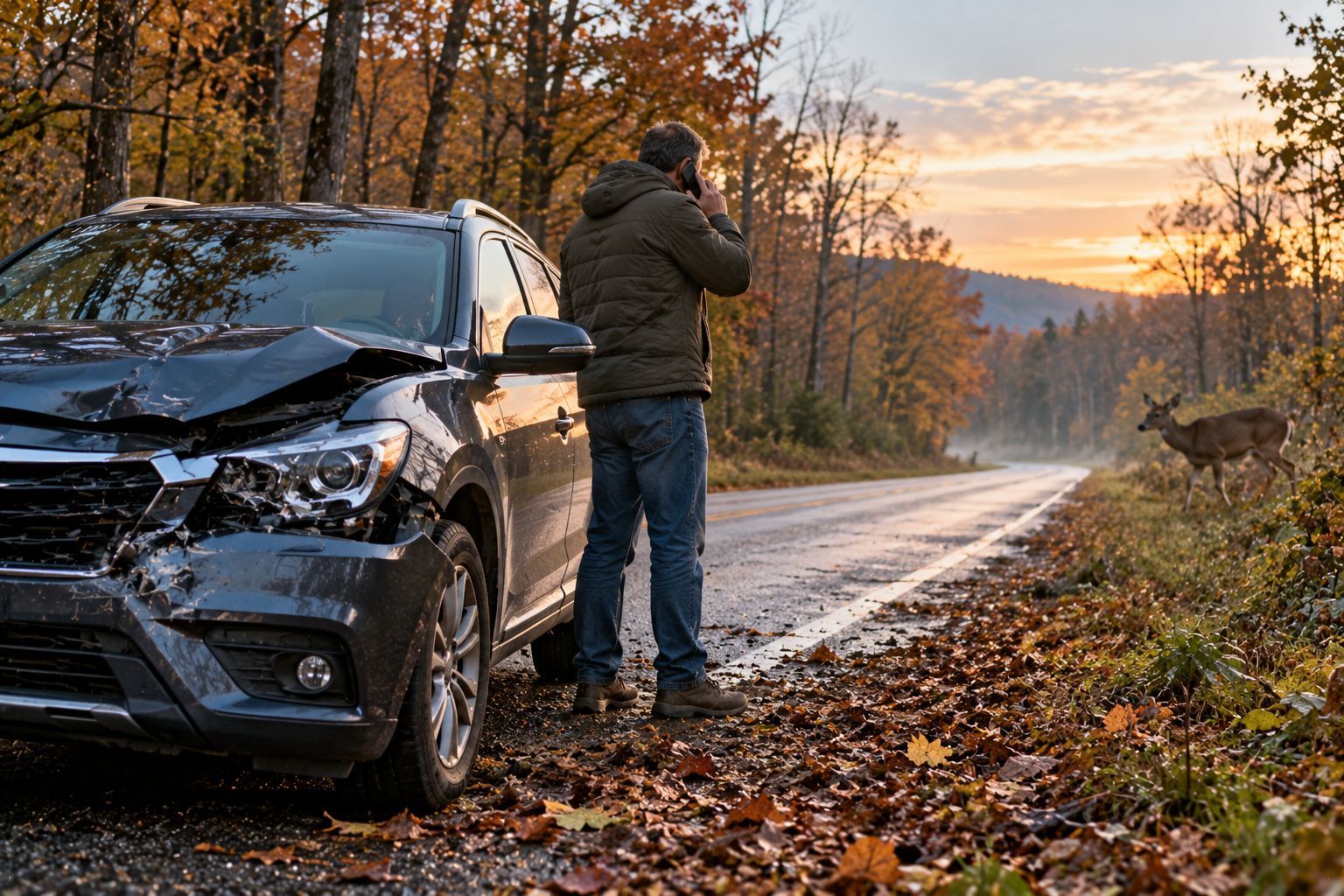
Yes. In Pennsylvania, hitting a deer is covered if your policy includes comprehensive coverage. Insurers treat it as an "other than collision" loss, so they pay for repairs minus your comprehensive deductible. If you only carry liability, the policy won't pay to fix your own car. Swerving into something else changes the picture, which we'll get to.
August is when many Pennsylvania drivers start thinking about deer again. Shorter evenings and the fall rut push animals onto back roads in Butler, Beaver, Lawrence, and every county in between. The numbers back up that worry. Pennsylvania leads the nation in total animal-collision claims, with an estimated 141,300 incidents industry-wide between July 2025 and June 2026. The odds of a Pennsylvania driver hitting an animal in 2026 sit at about 1 in 64, the fourth highest risk in the country.
Coverage type, swerving, surcharges, and what you do in the first ten minutes after impact all shape how a deer claim plays out. Here's how each one works.
Does Car Insurance Cover Hitting a Deer in Pennsylvania?
It does, as long as comprehensive coverage is on your policy. A direct deer strike is classified as an "other than collision" event. That means your insurer pays the repair bill after you cover your comprehensive deductible. If your deductible is $500 and the body shop quotes $3,200 for a crushed grille, radiator, and headlight, you pay $500 and the carrier pays the rest.
The catch is that comprehensive is optional in Pennsylvania. The state only requires liability and first-party medical benefits, so a bare-minimum policy leaves you paying for every repair yourself. The Pennsylvania Insurance Department says it plainly: a deer-related crash is handled under an optional coverage called comprehensive coverage. Drivers who dropped comprehensive to save on an older car are the ones who get the unpleasant surprise.
A few details matter more than people expect:
- Total losses: If the deer damage exceeds the car's value, the payout for a vehicle destroyed in the collision must include applicable sales tax.
- Loans and leases: Lenders almost always require comprehensive, so financed cars are usually protected.
- Rental reimbursement: This is a separate add-on. Without it, you could be without a car during a two-week repair wait.
Comprehensive vs Collision Coverage for Animal Encounters
The type of contact decides which coverage pays. If your car hits the deer directly, it's a comprehensive claim. If you swerve and hit a tree, guardrail, or ditch instead, it becomes a collision claim, even though a deer started the whole thing.
That split surprises many drivers. Picture two people on the same stretch of Route 19 at dusk. One hits a doe square in the bumper. The other jerks the wheel, misses the doe, and slides into a utility pole. Both cars need $4,000 in repairs, but the first driver files under comprehensive and the second files under collision. That can mean different deductibles and different rating treatment.
| Situation | Coverage That Pays | Typical Deductible |
|---|---|---|
| Car strikes the deer | Comprehensive | Your comp deductible |
| Deer runs into your parked or moving car | Comprehensive | Your comp deductible |
| You swerve and hit a tree or pole | Collision | Your collision deductible |
| You swerve into another vehicle | Collision plus liability | Collision deductible |
Many people set a higher collision deductible than comprehensive deductible to keep premiums down, so the swerve scenario often costs more out of pocket. Carrying both coverages, with deductibles you can actually afford on short notice, closes that gap. MVP Insurance works with carriers like Erie, Westfield, and Progressive as an independent agent, and comparing how each structures these coverages makes it easier to choose sensible pennsylvania car insurance limits.
What Happens if You Swerve to Avoid the Deer?
Swerving usually turns the incident into a collision claim. When you leave your lane and hit a stationary object or another car, carriers typically treat it as a single-vehicle or multi-vehicle crash rather than an animal strike. Insurers like Liberty Mutual or GEICO may view it as an at-fault accident, and that can affect your premium in ways a direct hit would not.
The reasoning is simple from the insurer's side. The damage came from contact with the tree, not the animal. In many cases the deer runs off untouched, leaving no physical evidence it was ever there. Without fur, blood, or a dent shaped like a deer, the adjuster sees a car that left the road.
Swerving also creates far more danger than a direct strike. A deer impact at 45 mph is ugly and expensive, but a sudden swerve can roll an SUV, send you into oncoming traffic, or put you head-on into an oak. Most driving safety guidance tells drivers to brake firmly, stay in the lane, and keep control. That advice protects your body first, and your insurance record benefits as well.
If you do swerve and hit another vehicle, your liability coverage pays the other driver's damage and injuries. Your collision coverage handles your car. Give the adjuster an honest account of the deer, mention any witnesses, and photograph tracks or hair if you find any. Those details won't always change the classification, but they help your side of the story.
Pennsylvania Surcharge Rules for Deer Accidents
Pennsylvania insurers generally cannot surcharge you or raise your rate for a comprehensive claim like hitting a deer. State law prohibits surcharges or premium increases solely because a driver hit a deer or other wildlife. The state's message to drivers is direct: your premium should not increase because of a deer-related crash.
That protection has been in place for years, and deer collisions don't affect premiums in PA the way at-fault crashes can. Still, the rule protects the comprehensive claim specifically. Once the loss shifts to collision because you swerved into something, a surcharge may apply depending on your carrier's rules and how fault is assigned.
Pennsylvania also sets a dollar threshold for accident surcharges. As of this writing, the Insurance Department raised the accident surcharge threshold to $2,350, effective July 1, 2026. In general terms, an at-fault accident whose payout stays below that threshold shouldn't trigger a surcharge under this rule. A swerve that results in a $1,800 fender repair may not count against you, while a $6,000 front-end rebuild could.
One mistake we see often is drivers assuming any deer-related incident is surcharge-proof. The protection depends on how the claim is coded. Before you file, ask how your carrier will classify it so nothing surprises you at renewal.
Comparing PA Deer Claim Coverage Options
Comprehensive is what covers a deer strike, but the policy around it determines how complete that protection is. The table below shows how common setups handle the same deer encounter.
| Policy Setup | Direct Deer Hit | Swerve Into Tree | Rental Car While Repaired |
|---|---|---|---|
| Liability only | Not covered | Not covered | Not covered |
| Liability + comprehensive | Covered minus deductible | Not covered | Only with rental add-on |
| Liability + comp + collision | Covered minus deductible | Covered minus deductible | Only with rental add-on |
| Full coverage + rental reimbursement | Covered | Covered | Covered up to daily limit |
The second row is the trap. A driver with comprehensive but no collision is protected only when the animal is actually hit. One swerve leaves them paying for the entire repair. That setup can make sense for a paid-off car worth $3,000, but it's a gamble on anything newer.
Deductible choice matters more in Pennsylvania than in most states because deer claims are so frequent. A $250 comprehensive deductible costs more per year than $1,000, yet many drivers in rural western PA file a deer claim every few years. If you drive Route 422 or I-79 at night regularly, a lower comp deductible often pays for itself.
Rental reimbursement is the other piece people skip. Deer repairs often involve radiators, sensors, and headlight assemblies that can take weeks to arrive, and a few days of rental fees quickly exceed the annual cost of the add-on.
What to Do at the Scene After Hitting a Deer
Get yourself and your passengers out of danger first, then worry about the car and the claim. The first few minutes after a deer strike are confusing, and many injuries happen after the impact, when drivers stand in a dark lane or approach a wounded animal. Use this sequence:
- Pull over safely. Move to the shoulder or a parking lot if the car is drivable, and turn on your hazard lights.
- Check for injuries. Call 911 immediately if anyone is hurt.
- Stay off the roadway. Other drivers may not see you or the deer, especially at dusk.
- Call local or state police if needed. Do this if the deer is blocking traffic, the car can't be driven, or anyone is injured.
- Document everything. Take photos before anything is moved.
- Inspect before driving. Look for leaking fluid, broken lights, a hood that won't latch, or a damaged radiator.
- Report the claim promptly. Contact your carrier or agent the same day if possible.
Documenting the Incident for Your Carrier
Good documentation keeps the claim in comprehensive, where it belongs. Photograph the damage from several angles, including close-ups of fur, blood, or hair caught in the grille. Take wider shots that show the road, the location, and the deer if it's still there. Write down the time, road name, nearest mile marker, and weather.
Carriers like Western Reserve or Frederick Mutual will ask the same basic questions: where it happened, whether the deer was struck, and whether police responded. Having photos on your phone answers most of those questions right away. If you get a police report or incident number, save it with your photos.
Handling the Deer and Law Enforcement
Never touch an injured deer. A frightened animal can kick hard enough to break bones, so stay in or near your car and let police handle it. Pennsylvania drivers aren't required to report a deer collision to the Game Commission unless they intend to claim the carcass. If you want to keep the deer, contact the Game Commission so the claim is handled properly.
To report a dead deer for removal from a state-maintained road,
call 1-800-FIX-ROAD. For local or township roads, contact the municipality.
Frequently Asked Questions About Deer Accidents in PA
Do I have to pay a deductible for hitting a deer?
Yes, in most cases. A direct deer strike falls under comprehensive coverage, so you pay your comprehensive deductible and your insurer pays the remaining covered repair cost.
Should I call the police for a deer hit in PA?
Call the police if anyone is hurt, your car can't be driven, or the deer is blocking traffic. For minor damage on a quiet road, a police report isn't always required, but having one can help support your claim.
Will my rates go up if I hit a deer?
Not for a direct hit filed under comprehensive. Pennsylvania law bars insurers from raising your premium for that. If you swerved and hit something else, the claim may be treated as collision and could affect your rate depending on your carrier and the claim amount.
Before the Next Deer Season Hits
Most deer claims in Pennsylvania come down to one detail: whether comprehensive is on your policy. Without it, you pay for the damage yourself. With it, you pay your deductible and your rates stay protected under state law. The trouble starts with swerving, liability-only policies, and deductibles set too high to cover on short notice.
August is a good time to pull up your declarations page, before the fall rut. Check that comprehensive and collision are both active, that your deductibles make sense for how often you drive at night, and that rental reimbursement is included.
If you'd like a second set of eyes, MVP Insurance compares coverage across multiple carriers from offices in Zelienople, PA and New Springfield, OH. You can
start a quote and see how your current setup holds up against deer season. MVP Insurance is licensed in Ohio (#37714) and Pennsylvania (#519263), NPN 10588293.
Search
Recent Posts



MVP Insurance is a local, independent agency, licensed to serve individuals and businesses across Ohio and Pennsylvania.
We serve clients from our offices in New Springfield, Ohio and Zelienople, Pennsylvania and throughout Northeast Ohio and Western Pennsylvania, working with multiple carriers to help contractors, landlords and real estate investors, restaurants, retail shops, auto repair shops, professional offices and many other personal and commercial clients find coverage that fits.
Our Owners
Two friends who started an agency
Owner
Joshua Medure
I am a Penn State marketing graduate with more than ten years in insurance. My childhood friend David and I started MVP Insurance in Northeast Ohio because we wanted the people around us to have an agency that gives honest advice, real choices and someone who picks up the phone. I lead the agency’s insurance strategy, which means I read the policies so our clients do not have to. Away from the office, I coach youth football.


About the Author
David Varrati
Owner, MVP Insurance
I started MVP Insurance with my childhood friend Josh because we wanted people in Northeast Ohio and Western Pennsylvania to have an agency that explains things plainly and picks up the phone. I studied Political Science at Slippery Rock University and have spent more than ten years helping families and individuals protect what matters to them. When I am not in the office, you will find me coaching youth sports.