
The practical takeaway: a furnished lake house you use every summer probably belongs in the middle column. An inherited house waiting on probate, with the furniture gone, fits the right column. Putting either one in the left column is how coverage gaps happen.
The Ohio Valley sits in a corridor where warm, humid air from the south meets colder systems from the west. The result is a steady run of thunderstorms, straight-line winds, hail, and heavy downpours that overwhelm older storm drains. For homeowners, that translates into very specific claims: shingles peeled off in a wind event, siding dented by hail, trees through the roof, and basements flooded by sewer backup.
Sewer backup is a gap we see catch people off guard constantly. A standard policy usually excludes water that backs up through drains unless you've added a specific endorsement, and in a hillside neighborhood with aging municipal lines, one heavy storm can leave several inches of water in a finished basement. Carriers have watched these losses pile up across the region and priced accordingly.
Misclassification is the most common expensive mistake we see. A business gets lumped into one high-rated code, even though half the staff works in an office. Pennsylvania generally rates a business by its governing classification, but separate codes can apply when operations meet the PCRB's rules for division.
Take a small HVAC company where the owner's spouse handles billing full time. That clerical payroll may qualify for a far lower code than the field technicians' code. Review the classification page of your policy every year. If the description doesn't match what your people actually do, ask questions before the audit.
Your experience modifier compares your claims history to that of similar businesses. A 1.00 mod is average. A 0.85 mod cuts your premium by 15%, and a 1.25 mod raises it by 25%. Mods generally use three years of claims, excluding the most recent year, so today's injury affects your bill for years.
Frequency hurts more than severity. Five small medical-only claims often damage a mod more than one larger claim. Pennsylvania offers medical-only claim handling, but small injuries still need to be reported properly, so check how claims are counted before you decide how to handle minor incidents.
Frequently Asked Questions About PA Workers Comp Costs
Payroll" for workers comp means more than base wages. It generally includes overtime pay (with the premium portion often excluded), bonuses, commissions, holiday and vacation pay, and certain other compensation. Business owners often miscount this, and the error shows up at audit.
Corporate officers follow special rules. For policies effective April 1, 2026, officer payroll ranges from $70,044 to $280,800 per year for rating purposes. An officer who pays themselves very little still gets rated at the minimum, and high earners get capped at the maximum. That ceiling rose sharply this year, so owners who pay themselves well may see more of their salary counted than they did in past years.
Have this ready before the auditor calls:
- Certificates of insurance for every sub, with workers comp coverage dates that match the dates they worked for you
- Written contracts for each independent contractor, signed before work began
- 1099 list and payment totals that tie back to your general ledger
- Payroll records broken out by class code, including overtime
- Exemption documentation for any sole proprietor or partner claiming they're not required to carry coverage
Get the COIs directly from the sub's agent when you can. A certificate emailed by the sub themselves is easier to doctor or let lapse without notice.
Successful Pennsylvania winterization comes down to matching the house, the plumbing and the policy. Choose heat or drain (or both), keep a real inspection log, file your Act 29 information if it applies, and make sure your policy reflects how the home is actually used. The owners who struggle after a loss are rarely the ones who skipped a step on the checklist. They are the ones whose coverage never fit the property in the first place.
If you are not sure your current policy holds up through a long empty winter, now is the time to find out, before the first hard freeze. MVP Insurance, with offices in Zelienople, PA and New Springfield, OH, can compare seasonal and vacant home options across multiple carriers for you. Start your quote and get answers before you lock the door for the season.
MVP Insurance is licensed in Ohio (license #37714) and Pennsylvania (license #519263), NPN 10588293.
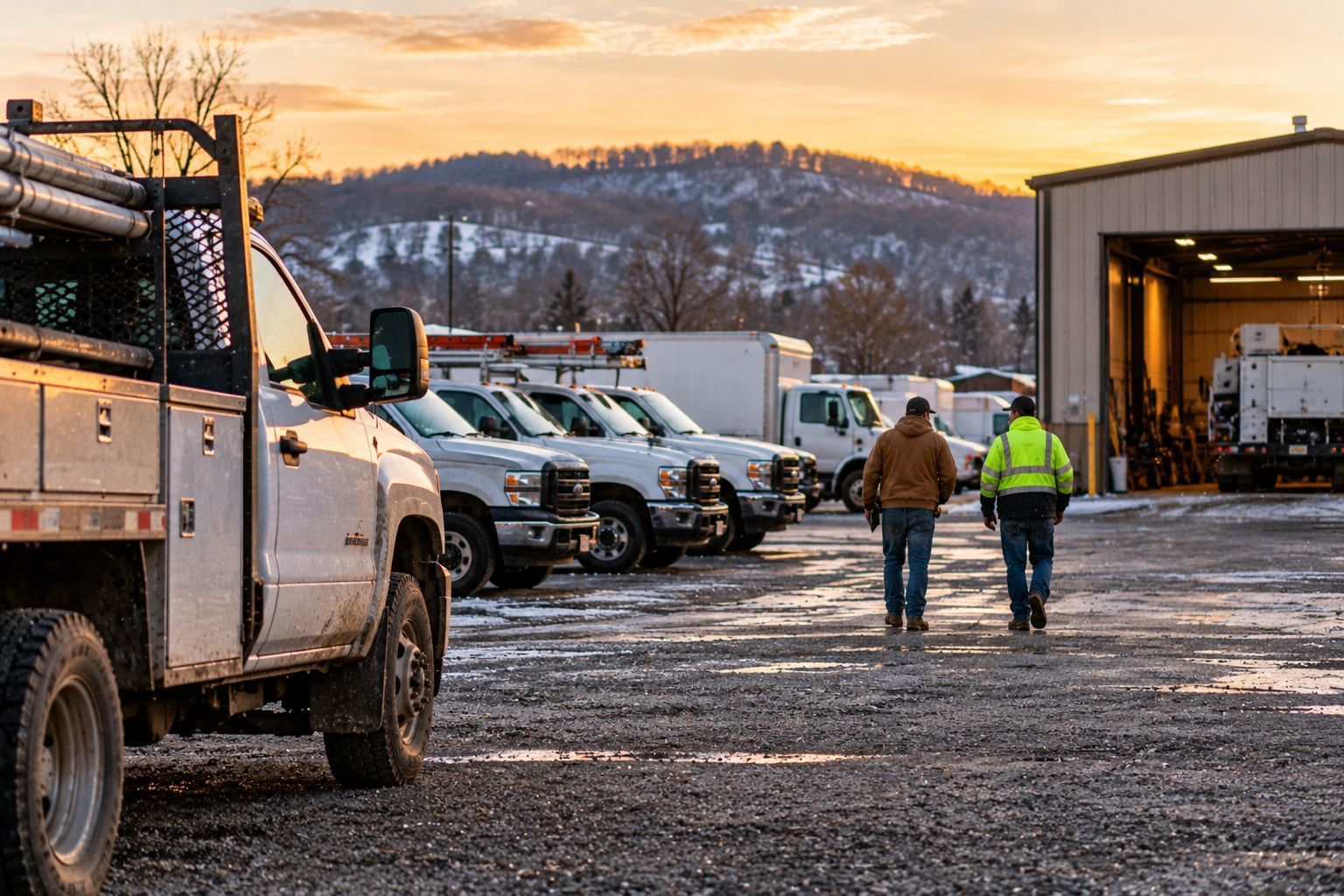
Commercial auto rates in Pennsylvania keep climbing because carriers pay more on every claim. Courtroom awards have grown, especially in Philadelphia. Repairs now involve sensors and cameras, and experienced drivers are harder to hire. Since the state requires approval before carriers change rates, each increase reflects losses insurers can document, not a guess about the future.
If you run a plumbing company in Butler County, a landscaping crew in Lancaster, or a delivery operation near Pittsburgh, you have probably watched your renewal go up even with no claims. That is frustrating, but it is not random. Your premium reflects the market around you: what juries award, what body shops charge, and how drivers across the Commonwealth behave behind the wheel. Some of those forces are out of your hands. Others, especially who you put behind the wheel and how you track their driving, are well within your control. The sections below cover both, so you can spend your energy on the parts that change your price.
Why Commercial Auto Rates in Pennsylvania Are Increasing
Commercial auto rates in Pennsylvania are rising because of higher litigation costs, nuclear jury verdicts, and more expensive vehicle repairs. Inflation plays a part, but the Commonwealth's legal climate and its shortage of drivers push carriers like Erie and Progressive to raise premiums so they can pay claims and stay solvent.
A few points explain why Pennsylvania feels different from neighboring markets. The state keeps commercial auto under tight regulatory control. Under Notice 2026-07, issued April 11, 2026, Pennsylvania loosened filing rules for many property and casualty lines, but commercial auto still requires prior approval for rate changes. The Insurance Department says plainly that its review team works to make sure rates are not inadequate. In practice, that means a carrier has to show regulators its losses support a higher price before it can charge one.
That oversight works in both directions. It slows sudden spikes, but it also means approved increases tend to stick, because the department has already agreed the old rate could not cover the claims. The state kept commercial auto inside the filing net on purpose, to keep rates adequate while other lines were deregulated.
Repair costs add pressure that most business owners notice only after a claim. A minor rear-end collision on a newer work van used to mean a bumper and some paint. Now it often includes recalibrating parking sensors, cameras, and lane-assist systems, along with a longer rental period while parts arrive. On the personal auto side, regulators raised the accident surcharge threshold from $2,250 to $2,350 effective July 1, 2026. That is a small sign of how far typical claim amounts have moved.
The Impact of Large Jury Verdicts on Pennsylvania Premiums
Large jury verdicts raise everyone's premiums, not just the premiums of the businesses that get sued. When a jury awards $15 million or $40 million after a truck crash, the carrier pays it out of the same pool funded by every policyholder in that class. One verdict like that can wipe out years of premium from hundreds of small fleets, and the carrier's next rate filing reflects it.
Philadelphia is the main driver here. The Court of Common Pleas there ranks fifth nationally on the 2025-2026 "Judicial Hellhole" list, largely because of how often it produces "nuclear verdicts" above $10 million. Commercial vehicle cases attract these awards because jurors see a company, an insurer, and a large vehicle on one side and an injured person on the other.
You might think a contractor in Cranberry Township never drives into Philadelphia, so the city's courts do not matter. They still do. Venue rules can allow cases to be filed in Philadelphia when a business has enough connection to the county, and carriers price statewide exposure, not just your home ZIP code. Even settlements reflect the threat: defense attorneys settle higher when they know a Philadelphia jury might award ten times more.
The most common gap we see is a business carrying a $1 million liability limit and nothing above it. A single serious injury crash can blow past that limit fast, leaving the business owner exposed for the rest. A commercial umbrella policy costs a fraction of what that uncovered judgment would.
Social Inflation and Legal Trends in the Commonwealth
"Social inflation" describes claim costs rising faster than ordinary inflation because of legal and cultural shifts. Those shifts include aggressive attorney advertising, litigation funding, jurors who distrust corporations, and plaintiff strategies built around "anchoring" juries to enormous numbers. None of these are about the crash itself, but all of them raise what the crash costs.
Pennsylvania's courts send mixed signals. On October 19, 2026, the Pennsylvania Supreme Court upheld a $250,000 statutory damages cap for state agencies like SEPTA, even where actual damages reached $7 million. That ruling protects government entities, but private businesses get no such cap. Plaintiffs facing a limited recovery from a public agency may look harder at any private company involved in the same accident, such as a contractor working near the scene or a vehicle that shared fault.
How Driver Selection Influences Your Insurance Costs
Your drivers are the single biggest factor you control. Carriers like Westfield and Liberty Mutual underwrite commercial auto largely on the motor vehicle records (MVRs) of everyone listed on the policy. A fleet of clean drivers earns better pricing and more carrier options, while one or two bad records can raise the whole policy or get it declined outright.
Underwriters look for patterns, not just individual tickets. A single speeding ticket from four years ago rarely matters much. A DUI, a reckless driving charge, a license suspension, or several at-fault accidents in three years often will. Some carriers will exclude a specific driver rather than decline the account, which sounds helpful until that excluded employee drives a company truck anyway and causes a crash with no coverage behind it.
The common mistake we see is hiring first and checking records later. A business owner brings on a new driver in a busy season, puts him in a truck that week, and sends the MVR to the agent at renewal. By then the risk has already been on the road for months, and the carrier may surcharge or exclude retroactively at audit. Checking the record before the offer letter avoids that entire problem.
Establishing a Formal Hiring and Safety Protocol
Underwriters reward businesses that can show a written process, not just good intentions. A simple, consistent protocol gives you something to hand a carrier at renewal and something to point to if a lawsuit ever questions how you vetted a driver. Here is what a workable version looks like for a small Pennsylvania fleet:
- Pull an MVR before hiring. Set written standards for what disqualifies a candidate, and apply them to everyone.
- Re-check records every year. Licenses get suspended and tickets pile up after hire. Annual pulls catch problems before your carrier does.
- Set a minimum experience level. Many carriers prefer drivers with a few years of licensed driving and are cautious about very young drivers in heavy vehicles.
- Write a vehicle use policy. Spell out personal use, passengers, phone rules, and who may drive which vehicles.
- Document training and incidents. Keep a file for each driver showing orientation, any coaching, and how near-misses were handled.
That paper trail does double duty. It helps your pricing today, and it gives your defense attorney evidence against a negligent hiring claim, which is exactly the type of allegation that turns an ordinary crash into a large verdict.
Utilizing Telematics Programs to Control Costs
Telematics gives you data that proves your drivers are safe, and some carriers will price your policy based on that data. Devices or apps track speed, hard braking, rapid acceleration, phone handling, and time of day. Programs offered through carriers such as Progressive and NEXT let small businesses share that driving data and earn performance-based rate adjustments when the results are good.
The appeal for a small fleet is fairness. Without data, a carrier prices your three-truck HVAC company mostly on vehicle type, location, and MVRs, meaning you pay partly for the habits of similar businesses. With telematics, your own driving counts. A crew that drives steadily during daylight hours and avoids harsh braking looks much better than the class average, and pricing can follow.
Be realistic about the tradeoffs before enrolling. Program terms vary by carrier and change over time, so ask exactly what is measured, how long the evaluation period runs, and whether poor driving can raise your rate rather than simply failing to lower it. Some employees also push back on being tracked, so explain why you are doing it and how the data will be used. Introducing it as a safety tool, not a surveillance tool, tends to get better buy-in.
Benefits of Real-Time Fleet Monitoring
The premium adjustment is often the smaller benefit. Real-time monitoring helps you run a safer operation every day, and that reduces claims, which affects your rates for years. Fleet owners who use these tools typically point to a handful of practical wins:
- Coaching with specifics. "You braked hard 14 times on Route 19 this week" lands better than a vague reminder to drive carefully.
- Faster claim response. GPS and event data show where and when a crash happened, which helps your carrier reach the scene facts quickly.
- Defense evidence. Speed data showing your driver was going the limit can undercut an inflated liability claim.
- Theft recovery and misuse alerts. You see when a vehicle moves after hours or leaves your service area.
- Lower fuel and maintenance costs. Smoother driving and less idling save money that never shows up on an insurance bill.
Comparing Pennsylvania Commercial Auto Coverage Options
A commercial auto policy is a bundle of separate coverages, and knowing what each piece does helps you spot gaps before a claim does. Pennsylvania requires liability coverage and first-party medical benefits at state minimums, but those minimums are far below what a serious crash costs. Most contracts with general contractors, municipalities, and larger clients require limits well above what the state does.
| Coverage | What it pays for | Required in PA? | Common choice for small fleets |
|---|---|---|---|
| Liability | Injuries and damage you cause to others | Yes, at state minimums | $1 million combined single limit |
| First-party benefits | Medical bills for your driver and occupants | Yes, at state minimums | Higher than minimum where budget allows |
| Uninsured/underinsured motorist | Your injuries when the at-fault driver lacks enough coverage | Offered; can be rejected in writing | Match your liability limit |
| Collision | Damage to your vehicle in a crash | No, but lenders usually require it | Deductible you can pay without strain |
| Comprehensive | Theft, hail, fire, deer strikes | No, but lenders usually require it | Same as collision |
| Hired and non-owned auto | Liability when employees use rented or personal vehicles for work | No | Add if staff ever run errands in their own cars |
| Commercial umbrella | Liability above your auto limit | No | $1 million to $5 million, depending on contracts |
Two lines in that table cause the most trouble. Hired and non-owned coverage gets skipped by businesses that "don't have company vehicles," then an office manager rear-ends someone on a bank run and the claim lands on the business. Uninsured motorist coverage gets rejected to save a few dollars, then a driver gets hit by someone with no insurance and the business has nothing to pay medical costs beyond basic benefits.
Deer deserve their own mention in Pennsylvania. Comprehensive claims from deer strikes run heavy in the fall, which is exactly when many renewals arrive. Dropping comprehensive on an older truck can make sense, but do the math on what a deer collision would cost you first.
Navigating the PA Commercial Auto Market with an Independent Agency
An independent agency can compare multiple carriers for you, which matters most when rates are rising and underwriting is tightening. Shopping pennsylvania commercial auto insurance takes specialized knowledge: carriers have different appetites for vehicle types, radius of operation, driver profiles, and industries, and the state's prior-approval rules mean each carrier's pricing moves on its own schedule.
MVP Insurance is an independent agency founded in 2008 by Josh Medure and David Varrati, with offices in Zelienople, PA and New Springfield, OH. As an independent agent, MVP works with carriers such as Frederick Mutual and Western Reserve, along with others including Erie, Westfield, Progressive, and Liberty Mutual. MVP is not the insurance company on any of these policies. The agency's job is to represent the business owner, compare what each carrier offers, and explain the differences in plain terms.
That matters because the right carrier for a landscaper with pickup trucks is often different from the right one for a contractor running box trucks across county lines. A carrier that declines one account may welcome the next, and pricing for the same fleet can differ widely between companies. An agent who sees those differences every week can match your fleet to a carrier that wants it, then re-shop at renewal if your current carrier files a large increase.
Commercial auto pricing in the Commonwealth comes down to three things: the legal climate you cannot change, the drivers you hire, and the data you can collect to prove they are safe. Big verdicts and tighter rate filings will keep pushing premiums, but a business with clean MVRs, written safety rules, telematics data, and the right limits stays in a much stronger position at every renewal. If your renewal just went up and you want a second set of eyes,
start your quote with MVP Insurance and see how your fleet compares across carriers. MVP Insurance is licensed in Ohio (license #37714) and Pennsylvania (license #519263), NPN 10588293.
Frequently Asked Questions About PA Commercial Auto Rates
Why is my commercial auto insurance so expensive in PA?
Pennsylvania has a tough legal climate, with frequent large jury verdicts, especially in Philadelphia, and repair costs for modern vehicles keep rising. Carriers must get state approval for rate changes, so increases reflect actual claim losses across the state, not just your own record.
Can telematics actually lower my business insurance premium?
Yes, it can. Programs through carriers like Progressive and NEXT can adjust your rate based on how your drivers actually perform, so safe habits like steady speeds and gentle braking can earn better pricing. Ask each carrier how its program works before enrolling, since terms vary.
Does my driver's personal record affect my commercial policy?
Yes. Carriers review the motor vehicle record of every driver listed on your policy, and personal tickets, accidents, or suspensions count even if they happened off the job. One driver with a poor record can raise your premium or lead the carrier to exclude that driver.
Search
Recent Posts


MVP Insurance is a local, independent agency, licensed to serve individuals and businesses across Ohio and Pennsylvania.
We serve clients from our offices in New Springfield, Ohio and Zelienople, Pennsylvania and throughout Northeast Ohio and Western Pennsylvania, working with multiple carriers to help contractors, landlords and real estate investors, restaurants, retail shops, auto repair shops, professional offices and many other personal and commercial clients find coverage that fits.
Our Owners
Two friends who started an agency
Owner
Joshua Medure
I am a Penn State marketing graduate with more than ten years in insurance. My childhood friend David and I started MVP Insurance in Northeast Ohio because we wanted the people around us to have an agency that gives honest advice, real choices and someone who picks up the phone. I lead the agency’s insurance strategy, which means I read the policies so our clients do not have to. Away from the office, I coach youth football.

About the Author
David Varrati
Owner, MVP Insurance
I started MVP Insurance with my childhood friend Josh because we wanted people in Northeast Ohio and Western Pennsylvania to have an agency that explains things plainly and picks up the phone. I studied Political Science at Slippery Rock University and have spent more than ten years helping families and individuals protect what matters to them. When I am not in the office, you will find me coaching youth sports.