
Pennsylvania teens move from a learner's permit to a junior license to a senior license. Each step requires a minimum amount of time, practice, or clean driving before the next one unlocks. Here's what each stage actually requires and what it means at home.
CG 20 37: Coverage After the Project is Finished
Can my 16-year-old drive their friends home from school in Pennsylvania? During the first six months of a junior license, they can carry only one passenger under 18 who isn't an immediate family member, unless a parent or guardian is in the car. After that window, the limit eases if your teen has stayed violation-free.
Does a teen with a learner's permit need to be on my car insurance? It depends on the carrier. Some require permit holders to be listed, and others don't rate them until they're licensed. Tell your agent when the permit is issued so there's no gap if something happens.
Can a junior license holder drive home from work after 11 PM? Yes. Pennsylvania's curfew includes an exception for travel to and from employment. Your teen should keep proof of their work schedule in the car in case they're stopped.
Pennsylvania's licensing rules work because they ease teens into risk instead of handing them full privileges on day one. Supervised hours, passenger caps, and the overnight curfew all target the situations where new drivers get hurt most. For families, those same rules shape the insurance conversation. A clean junior year, solid liability limits, and the right car assignment can keep your teen safer and your premium more manageable.
If your teen's road test is coming up, now is a good moment to see how different carriers would price your household. MVP Insurance is an independent agency with offices in Zelienople, PA and New Springfield, OH. We compare policies across multiple carriers so you don't have to. When you're ready, you can start your quote here, and we'll walk you through the options. MVP Insurance is licensed in Ohio (license #37714) and Pennsylvania (license #519263), NPN 10588293.
Pennsylvania still offers homeowners insurance below the national average, but recent increases have been steep, and Western PA homeowners have felt it through storms and rising rebuilding costs. Your location sets the starting point. Your deductible, your roof and home systems, and how you use your policy decide much of the rest.
The most useful step is seeing real numbers side by side instead of accepting a single renewal at face value. MVP Insurance is an independent agency with offices in Zelienople, PA and New Springfield, OH, and the team compares multiple carriers so you don't have to. When you're ready, start your quote here and get a clearer picture of what your home should cost to insure.
MVP Insurance is licensed in Ohio (license #37714) and Pennsylvania (license #519263), NPN 10588293.
Pennsylvania follows modified comparative negligence. You can recover damages from other drivers as long as your share of fault isn't greater than theirs combined. Your recovery is reduced by your own percentage. If you're found 30% at fault for a $10,000 loss, you'd typically recover $7,000 from the other side. Once you cross 50%, you can't recover from them at all.
Icy-road claims are full of split percentages. Say one driver was following too closely and another changed lanes abruptly on packed snow. Fault might land at 60/40 or 70/30. In a pileup, three or four drivers might each carry a slice. These percentages shape your claim history too, which is why it's worth disputing a split you think is wrong before it becomes final.
These two get confused all the time, and they pay for different situations.
- Emergency roadside service (sometimes called towing and labor) covers breakdowns: dead batteries on a zero-degree morning, flat tires, lockouts, or a winch-out when you've slid into a snowbank without damaging the car. It typically has a per-incident limit and is a low-cost add-on.
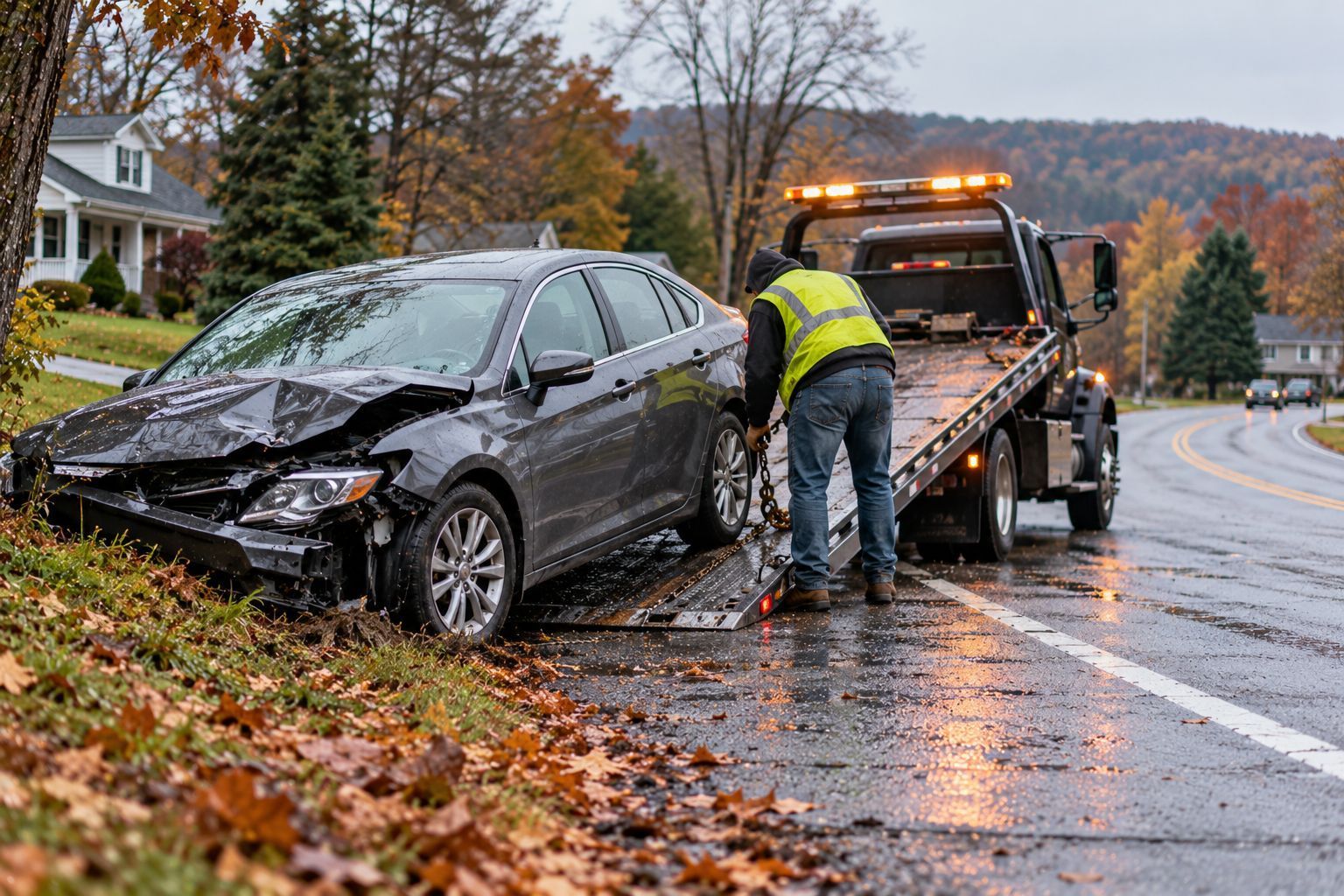
- Collision towing is part of your collision claim. When your car is damaged in a crash, the tow to a shop and reasonable storage are usually paid as part of the loss, subject to your deductible.
- Comprehensive can cover towing tied to non-collision losses, such as a tree limb crushing your hood during an ice storm.
A common mistake is assuming roadside service covers a crash tow, or that collision covers a simple winch-out. Check which one applies before you call, especially if you belong to an auto club as well.
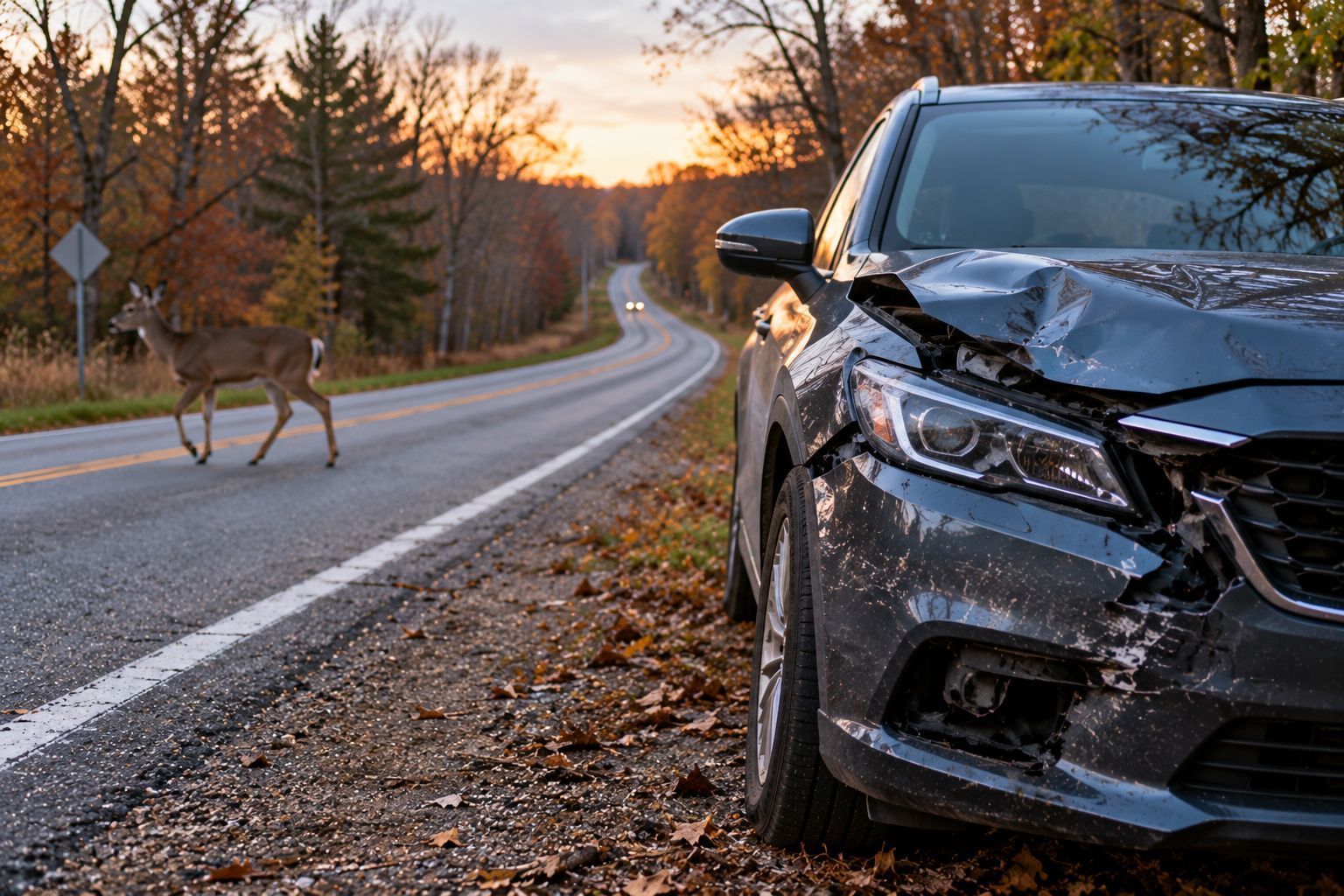
Yes, car insurance covers hitting a deer in Ohio, but only if your policy includes comprehensive coverage. Ohio's minimum liability policy won't pay to fix your own car after an animal strike. With comprehensive on your policy, your insurer pays for repairs or replacement, minus your deductible.
That one detail separates a $500 inconvenience from a $6,000 out-of-pocket repair bill. And in this part of Ohio, deer strikes are a real, recurring risk for anyone who drives Route 11, Route 46, or the back roads around New Springfield after dark. Below, you'll find how the coverage actually works, why the swerve matters more than most drivers realize, and what a deer claim does (and doesn't) do to your premium.
Does Car Insurance Cover Hitting a Deer in Ohio?
The direct answer: yes, as long as you carry comprehensive coverage. Ohio law only requires drivers to carry liability insurance, which pays for injuries and property damage you cause to other people. Liability never pays to repair your own vehicle, so a liability-only policy leaves you holding the entire bill after a deer strike.
Comprehensive coverage is the piece that steps in. When your car makes direct contact with a deer, comprehensive typically pays to repair the damage or, if the repair cost exceeds the car's value, pays out the actual cash value of the vehicle. You pay your chosen deductible first, whether that's $250, $500, or $1,000, and the insurer covers the rest up to the limits of your policy.
Here's where we see people get caught. Someone pays off their car loan, drops comprehensive and collision to lower their premium, and forgets about it. Two years later, a buck comes out of a cornfield on a November evening and crushes the hood, the radiator, and a headlight assembly. At that point there's no claim to file, because the coverage simply isn't there anymore.
If you financed or leased your vehicle, your lender almost certainly requires comprehensive, so you likely already have it. Drivers who own older cars outright are the ones most often exposed. Before you decide to drop the coverage, compare the annual cost of comprehensive against what you could realistically afford to pay for a front-end repair tomorrow.
How Comprehensive Coverage Works for Animal Collisions
Comprehensive coverage handles deer strikes because insurers treat them as events largely outside your control. That's why many policies label it "other than collision" coverage. It's the specific part of an auto policy built for damage that doesn't come from crashing into another car or object while driving.
Think of comprehensive as the coverage for things that happen to your car rather than things you drive into. Hail, falling tree limbs, theft, vandalism, flooding, fire, and animal strikes all sit under this umbrella. Hitting a deer feels like a collision in the everyday sense of the word, but insurers classify it as an "other than collision" loss. Striking a deer is typically covered under comprehensive when the vehicle makes direct contact with the animal.
That classification matters for a few practical reasons. Comprehensive deductibles are often lower than collision deductibles on the same policy. Comprehensive claims are also generally viewed as not-at-fault losses, which has real consequences for your rates down the road (more on that later).
Repair costs are another reason the coverage matters more than it used to. The average cost of deer-vehicle collision repairs keeps climbing because modern vehicles pack sensors, cameras, and radar units right into the front bumper and grille. A strike that once meant a new bumper cover can now mean recalibrating adaptive cruise control and lane-keeping systems. On a newer SUV or pickup, even a moderate hit can run into the thousands.
Comparing Ohio Auto Insurance Coverage Types
| Coverage type | Required in Ohio? | Pays for deer strike damage? | What it covers |
|---|---|---|---|
| Liability | Yes | No | Injuries and damage you cause to others |
| Comprehensive | No (lenders usually require it) | Yes, on direct contact | Animal strikes, theft, hail, fire, falling objects |
| Collision | No (lenders usually require it) | Yes, if you swerve and hit something else | Crashes with vehicles, trees, guardrails, ditches |
| Medical payments | No | Covers injuries to you and passengers | Medical bills regardless of fault |
| Uninsured/underinsured motorist | Must be offered | No | Costs when an at-fault driver lacks enough coverage |
If you want the full picture of minimums and optional coverages, our guide to ohio car insurance walks through each piece in more detail.
Peak Deer Season Hazards in Mahoning County
Mahoning County sees heavy deer activity, and the risk peaks during the fall breeding season in October and November. The area around New Springfield, with its mix of farmland, woodlots, and two-lane rural roads, is classic deer country. Bucks chase does across roads during the rut, often with little regard for headlights.
The numbers back up what local drivers already sense. Statewide, November is the highest single month for vehicle-deer crashes, and Ohio drivers face a 1 in 108 chance of filing an animal collision claim during the 2025-2026 period, which places the state 20th in the nation. Nationwide, drivers filed an estimated 1.65 million animal collision claims between July 2025 and June 2026.
A few patterns show up again and again in this region:
- Dawn and dusk are the danger windows. Deer move most between roughly sunset and a few hours after, and again before sunrise. In November, that evening window lines up with the commute home.
- Where there's one, there are more. A doe crossing the road is often followed by one or two others a few seconds later.
- Field edges and creek crossings are hotspots. Stretches where woods meet open fields, or where roads cross streams, funnel deer onto pavement.
- Deer crossing signs mean something. They're placed where crashes have already happened.
The state is working on the problem too. The Ohio Department of Transportation has built 9 deer passages in high-risk districts, and those wildlife passages are reporting "high usage" in areas with specific bridge designs. Still, crossings like these cover only a small fraction of roads, so your own driving habits remain the main line of defense through the fall.
The Financial Impact of Swerving to Avoid a Deer
If you swerve and hit a tree, guardrail, mailbox, or ditch instead of the deer, the claim usually falls under collision coverage, not comprehensive. That shift surprises a lot of people, and it can cost real money. The deer caused the problem, but your car never touched it, so the insurer treats the loss as a single-vehicle collision.
Swerving creates three financial problems at once. First, collision deductibles are often higher than comprehensive deductibles, so you might pay $1,000 instead of $500 out of pocket. Second, if you dropped collision coverage on an older car, there may be no coverage at all for the damage. Third, a single-vehicle collision claim can be viewed as an at-fault accident, which carries more weight at renewal than a comprehensive claim.
Then there's the physical risk. Swerving at 55 mph on a two-lane road can send you into oncoming traffic or roll you into a ditch. A deer hit is usually a property damage event, while a rollover or head-on crash can turn into a serious injury claim. Many safety experts advise drivers to brake firmly, hold the wheel straight, and stay in their lane rather than jerking the wheel.
We've seen this play out in claims more than once. A driver avoids a deer on a dark road, clips a utility pole, and ends up with a bigger repair bill, a higher deductible, and an at-fault mark, all for an animal they never touched. Nobody plans their reaction in that split second, but deciding ahead of time to brake and stay straight can protect both your safety and your wallet.
It also helps to carry both coverages. Pairing comprehensive with collision means you're protected whichever way the moment goes, whether you hit the deer or hit something trying to miss it.
Will Your Insurance Rates Go Up After Hitting a Deer in Ohio?
A single comprehensive claim for a deer strike typically won't cause a significant rate increase. Insurers generally classify animal strikes as not-at-fault losses, since there's little a driver could reasonably do to prevent a deer from jumping in front of the car. That's very different from rear-ending someone at a stoplight.
That said, "typically" isn't "never." A few situations can move your premium:
- Multiple claims in a short window. Two or three comprehensive claims within a few years can signal higher risk to an insurer, even if none were your fault.
- Losing a claims-free discount or credit. Some policies reward drivers who go several years without any claims. A deer claim might reset that clock, and the lost credit can feel like a rate increase.
- The swerve scenario. If the claim lands under collision because you hit something else, it may be treated as at-fault.
- Broader market changes. As of this writing, repair costs for modern vehicles are rising, and premiums across the board can climb at renewal regardless of your personal claims history.
The scale of these losses helps explain why insurers watch them closely. One major national insurer paid out roughly $1.9 billion in animal collision costs between July 2025 and June 2026. When losses run that high, carriers factor regional deer activity into pricing for everyone in high-risk areas.
Some drivers ask whether they should skip filing a small claim to protect their record. If the damage is only slightly above your deductible, paying out of pocket can make sense. For anything substantial, especially damage to sensors or safety systems, filing is usually the smarter move. An independent agent can talk through how a claim might affect your specific policy before you decide.
Ohio Carriers Offering Comprehensive Protection
Several well-established carriers write comprehensive coverage for Ohio drivers, and MVP Insurance works with them as an independent agent. That means we're not tied to one company's pricing or claim rules. We shop multiple carriers to find coverage that fits how and where you drive.
Carriers MVP Insurance works with for Ohio auto coverage include:
- Erie: A regional carrier with a long presence in Ohio and Pennsylvania, frequently considered by drivers who want strong local service.
- Westfield: An Ohio-based carrier that offers auto policies with comprehensive and collision options through independent agents.
- Progressive: A national carrier with a wide range of deductible choices and policy add-ons.
- Western Reserve: An Ohio carrier with deep roots in the region and a focus on independent agency relationships.
- GEICO, Liberty Mutual, and Dairyland: Additional options depending on your vehicle, driving record, and coverage needs.
Each carrier handles comprehensive deductibles, glass coverage, and claims-free credits a little differently. One might offer a lower comprehensive deductible option, while another might treat claims history more favorably at renewal. Those differences matter a lot for someone in Mahoning County who drives rural roads every fall.
Because MVP works for the client rather than any single carrier, we can compare these options side by side. If your current policy has a high comprehensive deductible or you dropped the coverage years ago, a comparison can show what it would cost to add it back across multiple carriers at once.
Steps to Take After a Deer Collision in Mahoning County
Your first priority after hitting a deer is safety, followed by documentation, then starting the claim. The moments right after a strike are disorienting, so having a mental checklist helps.
- Pull over safely. Move to the shoulder if the car is drivable, turn on your hazard lights, and stay buckled until you're sure traffic is clear.
- Check everyone for injuries. Call 911 if anyone is hurt or if the car is blocking the road.
- Stay away from the deer. An injured deer can kick hard enough to cause serious harm. Don't try to move it or help it.
- Call local law enforcement. Contact the Mahoning County Sheriff or local police, especially if there's significant damage. A police report strengthens your claim and confirms the animal strike.
- Document the scene. Take photos of the damage, the road, any deer hair or blood on the vehicle, and the animal if it's safe to do so. These details help show direct contact, which keeps the claim under comprehensive.
- Don't drive a damaged car. Leaking fluids, broken headlights, or a crushed radiator can make the car unsafe. Arrange a tow if needed.
- Contact your agent to start the claim. Reach out to an independent agent at MVP Insurance, who can help you report the loss to your carrier and explain your deductible and coverage. MVP offers 24/7 claims service, so you can get help even after a late-night strike.
- Keep records. Save receipts for towing, rental cars, and repairs, along with your claim number and adjuster contact information.
One common mistake: waiting days to report the strike. Delays make it harder to connect the damage to a deer and can slow the whole process. Report it as soon as you're safe.
If you're not sure your current policy would cover a deer strike tonight, now is a good time to find out. MVP Insurance, an independent agency with offices in Zelienople, PA and New Springfield, OH, can compare comprehensive options from several carriers for you. You can start your quote here and have a clearer picture before the fall rut arrives. MVP Insurance is licensed in Ohio (license #37714) and Pennsylvania (license #519263), NPN 10588293.
Common Questions About Ohio Deer Accident Claims
Is hitting a deer considered an at-fault accident in Ohio? Generally, no. Insurers usually treat a direct deer strike as a not-at-fault comprehensive claim, though swerving into another object can shift the claim to collision and may be viewed as at-fault.
Do I need comprehensive coverage if my car is paid off? Ohio doesn't require it, but without comprehensive you'll pay the full cost of deer damage yourself. Weigh the yearly cost of the coverage against what a front-end repair would cost you today, especially if you drive rural roads in the fall.
What if the deer runs off and I can't photograph it? You can still file a claim. Photos of the damage, any hair or blood on the vehicle, and a police report usually provide enough evidence to show the car made direct contact with a deer.
Search
Recent Posts
MVP Insurance is a local, independent agency, licensed to serve individuals and businesses across Ohio and Pennsylvania.
We serve clients from our offices in New Springfield, Ohio and Zelienople, Pennsylvania and throughout Northeast Ohio and Western Pennsylvania, working with multiple carriers to help contractors, landlords and real estate investors, restaurants, retail shops, auto repair shops, professional offices and many other personal and commercial clients find coverage that fits.
Our Owners
Two friends who started an agency
Owner
Joshua Medure
I am a Penn State marketing graduate with more than ten years in insurance. My childhood friend David and I started MVP Insurance in Northeast Ohio because we wanted the people around us to have an agency that gives honest advice, real choices and someone who picks up the phone. I lead the agency’s insurance strategy, which means I read the policies so our clients do not have to. Away from the office, I coach youth football.
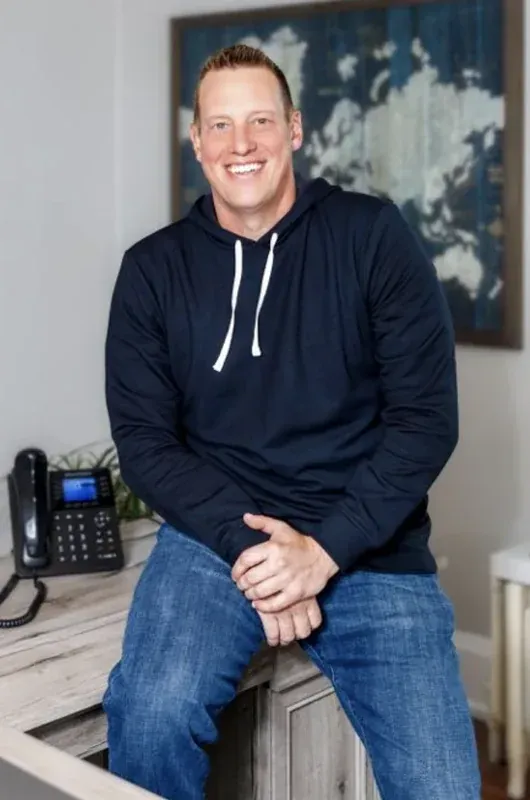

About the Author
David Varrati
Owner, MVP Insurance
I started MVP Insurance with my childhood friend Josh because we wanted people in Northeast Ohio and Western Pennsylvania to have an agency that explains things plainly and picks up the phone. I studied Political Science at Slippery Rock University and have spent more than ten years helping families and individuals protect what matters to them. When I am not in the office, you will find me coaching youth sports.