

Frequently Asked Questions About Mine Subsidence
Raising your deductible is the fastest lever you have. Moving a standard deductible from $500 to $1,000 or $2,500 can reduce your premium by up to 25%. On a $1,600 annual premium, that could mean saving a few hundred dollars a year.
The trade-off is simple: you take on more of the small losses. Before raising it, ask yourself whether you could write a check for the new deductible tomorrow without touching credit cards. If yes, a higher deductible usually pays off within a few claim-free years. Also check whether your policy has a separate wind or hail deductible, sometimes set as a percentage of dwelling coverage, since that can be much larger than the flat amount you remember choosing.
How does credit score affect my PA rate?
Pennsylvania allows insurers to use a credit-based insurance score when setting rates, and stronger credit generally means a lower premium. Paying bills on time and keeping balances low can help your rate over time.
Does my location near a fire station matter?
Yes. Homes closer to a staffed fire station and a working hydrant usually get better pricing because fire damage tends to be less severe when help arrives quickly.
How often should I review my policy limits?
Review them at every renewal and any time you renovate, add a big purchase, or finish a basement. With rebuilding costs rising, a limit that fit three years ago may now fall short.
Coverage through the association is not unlimited. As of this writing, most property and casualty claims are typically capped at $300,000 per claim [https://govt.westlaw.com/pac/Document/N92524E00342611DA8A989F4EECDB8638?viewType=FullText&originationContext=documenttoc&transitionType=CategoryPageItem&contextData=(sc.Default)]. Workers' compensation is the big exception, with no cap on covered benefits.
That $300,000 figure catches people off guard [https://govt.westlaw.com/pac/Document/N92524E00342611DA8A989F4EECDB8638?viewType=FullText&originationContext=documenttoc&transitionType=CategoryPageItem&contextData=(sc.Default)]. Picture a homeowner with a $550,000 dwelling limit whose house burns down a week after their insurer is ordered into liquidation. Their policy promised more than half a million dollars, but the guaranty association will typically pay up to its cap. The rest becomes a claim against the failed insurer's estate, which may pay a portion years later, or nothing.
A few other rules shape what you'll actually receive:
- Unearned premium refunds are limited. If you prepaid for months of coverage you never got, the return of that premium is capped at $10,000 per policy.
- Large businesses face exclusions. PPCIGA excludes first-party claims from any insured whose net worth exceeded $25 million as of December 31 of the year before the insolvency. Bigger companies are expected to absorb losses themselves.
- Duplicate recovery isn't allowed. If another policy covers the same loss, you generally have to pursue that coverage first.
For most families, the cap is high enough to handle a typical auto accident or a burst pipe claim. The pain shows up with total losses on higher-value homes, serious injury liability claims, and commercial property losses.
| Requirement | Motorized Boats & PWCs | Non-Motorized (Kayak, Canoe, SUP) | Insurance Impact |
|---|---|---|---|
| Registration | Required for all | Required at PFBC or state park access (or launch permit) | Proof often needed to bind a policy |
| Safety Certificate | Required for PWCs; motorboats over 25 hp if born 1982 or later | Not required | Can help eligibility and may earn credits |
| Age Limits | No PWC or 25+ hp boat at 11 or younger | No state minimum | Underage operation can complicate claims |
| BAC Limit | 0.08% (0.02% under 21) | Same limits apply | BUI can lead to cancellation or non-renewal |
| Accident Reporting | 48 hours for injury/death; 10 days for $2,000+ damage | Same rules apply | Late reporting can weaken your claim |
| Typical Coverage Need | Liability, physical damage, towing | Liability, theft | Lenders and marinas often require coverage |
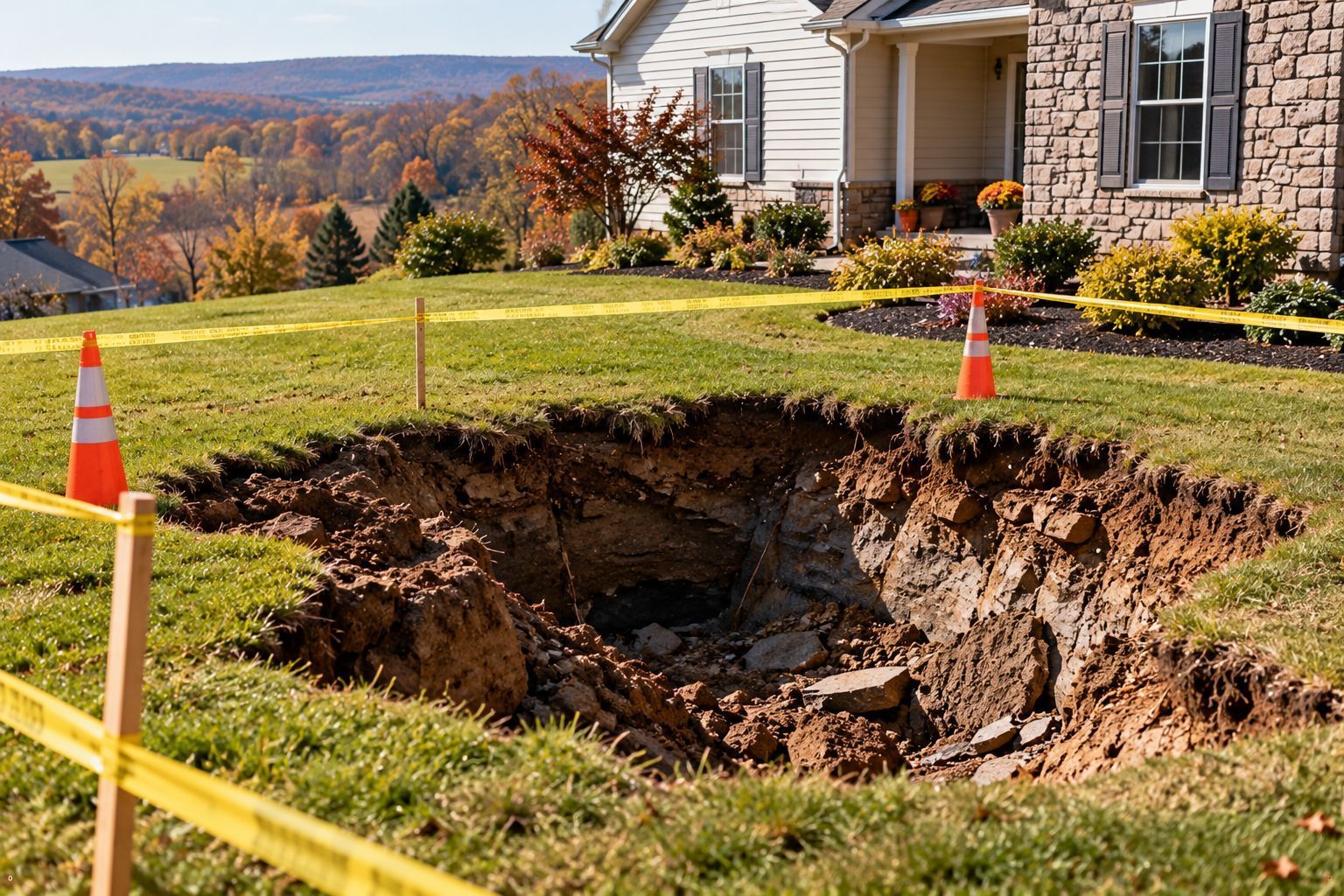
Most standard Pennsylvania homeowners policies do not cover sinkholes. Sinkhole damage typically falls under the "earth movement" exclusion, along with landslides and earthquakes. To be covered, you usually need a separate sinkhole endorsement for natural sinkholes, or state-backed Mine Subsidence Insurance if your home sits above old coal workings.
That answer surprises a lot of people, especially those who bought homes in the Lehigh Valley or near State College without ever hearing the word "karst." Pennsylvania has two very different ground problems. One is natural: limestone dissolving under your yard. The other is man-made: abandoned coal mines collapsing decades after the last miner left. Each has its own insurance solution, and mixing them up is one of the most expensive mistakes a homeowner can make.
The gap matters because ground failure rarely does minor damage. A cracked foundation, a sagging slab, or a porch pulling away from the house can quickly become a structural repair that eats into savings or forces a refinance. Lawmakers in Harrisburg have noticed, and the issue has moved from a niche rural concern to a statewide policy debate. Below, we break down how the exclusion works, how mine subsidence differs from a sinkhole, where the risk is highest, and what coverage options exist.
Does Homeowners Insurance Cover Sinkholes in Pennsylvania?
No, not under a standard policy. Pennsylvania homeowners forms treat sinkhole collapse as earth movement, and earth movement is excluded unless you add specific coverage. If you want protection, you typically need a sinkhole endorsement for natural collapse or a separate Mine Subsidence Insurance policy for damage from old mine voids.
The common forms here are the HO-3 and HO-5. Both typically exclude earth movement, including sinkholes, landslides, and earthquakes, unless the movement leads to a covered peril such as fire. So if the ground drops and ruptures a gas line that starts a fire, the fire damage may be paid, but the foundation damage from the drop usually is not.
Here's where people get tripped up. Many assume a "comprehensive" or premium policy must include everything, and an HO-5 is broader than an HO-3 in many ways. But the earth movement exclusion appears in both. Paying more for an upgraded form does not fix this gap on its own.
The practical takeaway is simple. Pull your declarations page and look for any endorsement mentioning sinkhole collapse, earth movement, or mine subsidence. If none appear, assume you have no coverage for ground collapse, and talk to your agent before you need to file.
Understanding Earth Movement Exclusions
An earth movement exclusion means your insurer will not pay for damage caused by the ground shifting, sinking, rising, or sliding. Without an endorsement, you pay the full repair bill yourself, whether that's $8,000 for polyurethane foam injection or far more for foundation replacement.
Standard policies from carriers like Erie and Westfield include this kind of exclusion, and it is written broadly. It usually covers earthquakes, landslides, mudflows, sinkholes, and general settling. Some versions apply "regardless of cause," meaning they exclude movement whether nature or a broken water main triggered it.
That last point leads to a real policy nuance. Some property claims hinge on the efficient proximate cause doctrine, which can require coverage if a covered peril is the dominant cause of the loss. For example, if a sudden pipe burst washes out soil and the house settles, the argument becomes whether the pipe or the earth movement truly caused the damage. Outcomes depend heavily on policy wording, and insurers often draft language specifically to limit this argument.
Common claim situations that get denied under this exclusion include:
- Foundation cracks that appear after a depression forms in the yard
- Driveway or patio collapse over a newly opened void
- Settling walls in a home built on fill soil
- Hillside slippage after heavy rain
If any of these sound familiar for your property, the exclusion is your real risk, not the wording on the front page of the policy.
Mine Subsidence vs Sinkholes
A sinkhole is natural: water dissolves soluble rock underground until the surface collapses. Mine subsidence is man-made: the ground sinks into voids left by underground mining, mostly coal. The distinction matters because the insurance products are completely different.
Western and northeastern Pennsylvania sit over vast networks of abandoned coal mines, many dug long before modern mapping. Pillars left to hold up the roof deteriorate over time, and homes above can crack, tilt, or drop years after mining ended. This risk follows the coal fields, which is why it shows up in places like Allegheny, Washington, Westmoreland, and Lackawanna counties.
Private carriers often do not cover man-made mine voids, so the Pennsylvania Department of Environmental Protection runs a dedicated Mine Subsidence Insurance (MSI) program. MSI is purchased directly through the state, separate from your regular homeowners policy, and it covers damage to your structure caused by mine collapse. It does not cover natural sinkholes.
Natural sinkholes are a separate problem with a separate fix. A sinkhole endorsement from a private carrier usually addresses natural collapse but specifically excludes mine-related subsidence. The mistake we see: a homeowner in a coal region buys a sinkhole endorsement thinking they're protected, or a homeowner in limestone country buys MSI. Each one is covered for the wrong risk. Know which type of ground lies under your home before choosing.
Karst Areas in Central Pennsylvania
Karst areas are regions built on limestone and dolomite, rocks that slowly dissolve in slightly acidic groundwater. That process creates caves, channels, and voids, and those voids are what produce natural sinkholes. Central and eastern Pennsylvania have some of the most active karst in the Northeast.
The limestone valleys run through the Great Valley and parts of the Ridge and Valley region. Lehigh, Berks, and Centre counties are particularly prone, along with surrounding areas like Lancaster, Cumberland, and Franklin counties. Allentown, Reading, and the State College area have all dealt with sinkholes swallowing roads, parking lots, and occasionally yards.
What triggers a collapse? Water is usually the culprit. Heavy rain, a leaking storm drain, a broken water line, or redirected runoff from new construction can wash soil into existing voids. Officials have warned that these risks are growing across the state due to more frequent flooding and extreme weather, which means homes that never had trouble could see it in the future.
Warning signs include:
- Circular depressions or soft spots in the lawn
- New cracks in foundations, walls, or driveways
- Doors and windows that suddenly stick
- Pooling water in places that used to drain
- Fence posts or trees tilting
If you live in a karst county and notice any of these, document them with photos and dates. That record helps both with repairs and with any future coverage questions.
Comparing Coverage Options and Limits
You have three main paths: rely on your standard policy (which means no ground collapse coverage), add a sinkhole endorsement, or buy Mine Subsidence Insurance through the state. Many homeowners in mixed regions may need to think about more than one.
| Feature | Standard Policy (Earth Movement Exclusion) | Sinkhole Endorsement | Mine Subsidence Insurance |
|---|---|---|---|
| Natural sinkholes | Not covered | Covered | Not covered |
| Mine collapse | Not covered | Usually not covered | Covered |
| Dwelling | Excluded for earth movement | Covered | Covered |
| Detached structures | Excluded for earth movement | Varies by carrier | Varies by policy terms |
| Personal property | Excluded for earth movement | Often included | Typically limited |
| Land repair or fill | Not covered | Typically not covered | Typically not covered |
| Deductible | N/A | Often separate, sometimes percentage-based | Set by program terms |
| Where to buy | Built into your policy | Private carrier add-on | PA DEP program |
One detail deserves extra attention. Sinkhole endorsements typically cover structures and personal property, not the land itself. Stabilizing the void, grouting, or filling the hole may remain your expense even after a claim is approved.
There's also movement at the state level. House Bill 589 would create a state-run program offering up to $150,000 in coverage for natural sinkholes and landslides, started with a $10 million General Fund appropriation and intended to become self-sustaining through premiums. As of this writing, the bill remained under consideration in the Senate after passing the House in September 2025. Supporters described it as recognizing that the commercial insurance industry is not stepping up to cover these costs, and the proposal would offer premium credits to communities that adopt mitigation practices.
Carrier Specific Endorsements
Sinkhole add-ons aren't offered everywhere, and terms differ quite a bit between companies. Some carriers limit the endorsement to "sinkhole collapse," meaning an actual abrupt fall of the ground, while slow settling remains excluded. Others cap the payout or apply a higher separate deductible.
Because availability changes by county and by carrier, an independent agency like MVP Insurance can look for sinkhole options through carriers such as Progressive, Liberty Mutual, or Frederick Mutual, and compare the wording side by side. MVP works with these carriers as an independent agent rather than being the insurer, so the comparison is about finding terms that match your property's actual risk. When reviewing your options, ask three questions: Does it cover collapse only, or settling too? What is the deductible? Are detached garages and other structures included?
If you're reviewing your pennsylvania homeowners insurance and aren't sure whether your home sits over karst, coal, or neither, it helps to have someone pull the details together for you. MVP Insurance, with offices in Zelienople, PA and New Springfield, OH, can compare endorsements across multiple carriers and point you toward state MSI if mines are the concern. When you're ready, you can start your quote here. MVP Insurance is licensed in Ohio (#37714) and Pennsylvania (#519263), NPN 10588293.
Frequently Asked Questions About PA Sinkholes
How do I check if my Pennsylvania home is at risk for sinkholes? Look at geologic maps from the Pennsylvania Geological Survey to see if your property sits on limestone or dolomite, and check DEP mine maps for nearby underground mining. Local municipal offices in karst counties often track past sinkhole reports too.
How much does a sinkhole endorsement cost in Pennsylvania? Pricing varies widely based on your location, home value, carrier, and deductible, with homes in karst counties typically paying more. An agent can compare quotes from several carriers to show you real numbers for your address.
Are detached garages covered for sinkhole damage? Not under a standard policy, since the earth movement exclusion applies to all structures. With an endorsement or MSI, it depends on the policy terms, so ask specifically whether other structures are included before you buy.
Search
Recent Posts


MVP Insurance is a local, independent agency, licensed to serve individuals and businesses across Ohio and Pennsylvania.
We serve clients from our offices in New Springfield, Ohio and Zelienople, Pennsylvania and throughout Northeast Ohio and Western Pennsylvania, working with multiple carriers to help contractors, landlords and real estate investors, restaurants, retail shops, auto repair shops, professional offices and many other personal and commercial clients find coverage that fits.
Our Owners
Two friends who started an agency
Owner
Joshua Medure
I am a Penn State marketing graduate with more than ten years in insurance. My childhood friend David and I started MVP Insurance in Northeast Ohio because we wanted the people around us to have an agency that gives honest advice, real choices and someone who picks up the phone. I lead the agency’s insurance strategy, which means I read the policies so our clients do not have to. Away from the office, I coach youth football.


About the Author
David Varrati
Owner, MVP Insurance
I started MVP Insurance with my childhood friend Josh because we wanted people in Northeast Ohio and Western Pennsylvania to have an agency that explains things plainly and picks up the phone. I studied Political Science at Slippery Rock University and have spent more than ten years helping families and individuals protect what matters to them. When I am not in the office, you will find me coaching youth sports.