

The Ohio Valley sits in a corridor where warm, humid air from the south meets colder systems from the west. The result is a steady run of thunderstorms, straight-line winds, hail, and heavy downpours that overwhelm older storm drains. For homeowners, that translates into very specific claims: shingles peeled off in a wind event, siding dented by hail, trees through the roof, and basements flooded by sewer backup.
Sewer backup is a gap we see catch people off guard constantly. A standard policy usually excludes water that backs up through drains unless you've added a specific endorsement, and in a hillside neighborhood with aging municipal lines, one heavy storm can leave several inches of water in a finished basement. Carriers have watched these losses pile up across the region and priced accordingly.
Private flood products fill many of the NFIP's gaps: higher limits, additional living expenses if you're displaced, and sometimes replacement cost on contents. In lower-risk areas, a private policy may also come in under the NFIP price. Franklin Flood and American Bankers write flood coverage, and carriers like Erie, Westfield and Progressive are part of the broader mix an independent agent can access when building a full home insurance program. Coverage availability varies by carrier and address.
As an independent agent, MVP works with these carriers rather than for any one of them. That means comparing NFIP and private quotes side by side instead of defaulting to whichever product is easiest to write.
The NFIP's biggest drawback is its caps. Rebuilding a larger home in Sewickley or Chester County can easily cost more than the federal building limit, and the difference comes out of your pocket unless you add excess flood coverage. Basements are another sore spot. NFIP policies cover essentials like furnaces, water heaters and electrical panels below grade, but generally exclude finished walls, carpeting and most belongings stored there. For Pennsylvania homes with finished basements, that's a painful surprise after a claim.
There's also a policy-stability question. Congress has to reauthorize the program periodically. As of this writing, the NFIP is authorized through December 11, 2026. Past lapses have briefly halted new policy sales, and FEMA tracks the program's congressional reauthorization history for anyone who wants the details.
Maximum Policy Limits for Residential Properties
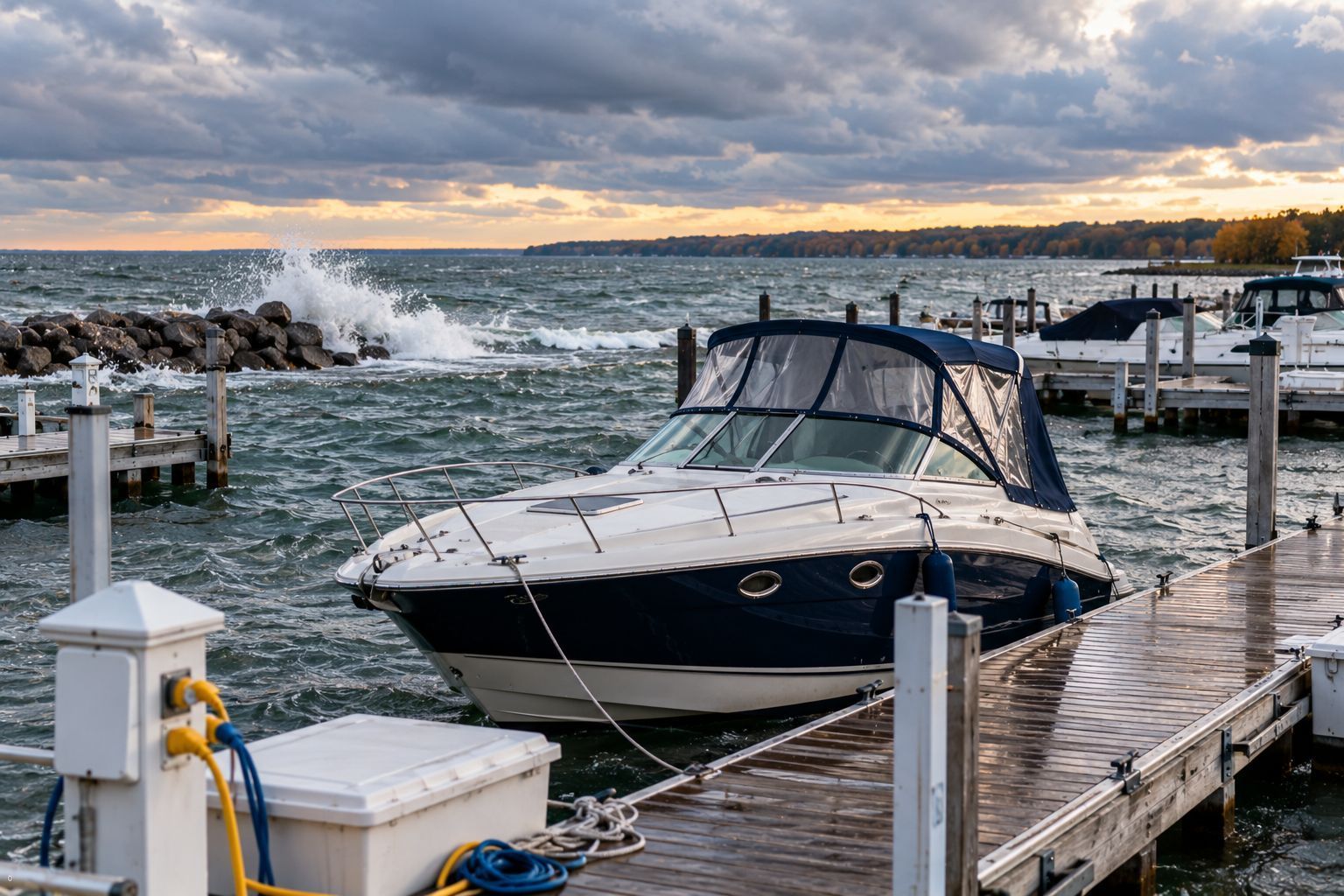
Insuring a boat on Lake Erie as a Pennsylvania boater means getting more than a basic watercraft policy. You need coverage that matches where you actually run, handles the lake's fast-building storms, satisfies your marina's liability demands, and pays for towing and salvage when things go wrong offshore. Miss any one of those pieces and a single bad afternoon can cost you thousands.
Lake Erie looks friendly from Presque Isle on a calm July morning. Anyone who has watched a northeast wind stack up whitecaps within an hour knows better. The policy that worked fine for a pontoon on Lake Arthur may not be built for this water.
Essential Considerations for Insuring a Boat on Lake Erie
The short answer: your policy has to be written for Great Lakes use, not inland lakes. That means confirming your navigation territory, checking how storm damage and lay-up periods are handled, meeting your marina's liability and naming requirements, and carrying towing and salvage coverage that reflects what offshore help actually costs.
A solid foundation of pennsylvania boat insurance gives you hull and liability protection, but Lake Erie adds layers that many standard policies treat as optional. The most common mistake we see is a boater who bought coverage for a small inland lake, moved up to a 26-footer docked in Erie, and never told the carrier. The policy might still say "Pennsylvania inland waters" on the declarations page. That's a gap you only discover when you file a claim.
Think of the four big issues this way:
- Where you go (navigation limits)
- What the weather can do (storm exposure and lay-up)
- Who else wants proof of coverage (marinas)
- What happens after the breakdown or grounding (towing and salvage)
Each one deserves its own conversation with your agent before the season starts.
Understanding Navigation Limits and Boundary Restrictions
Most boat policies define exactly where coverage applies, and Lake Erie trips can easily cross those lines. If you leave the covered territory without an endorsement, a claim that happens out there may be denied outright.
The big one for Erie boaters is Canada. The international border runs right down the middle of the lake, and a run toward Long Point or a fishing trip chasing walleye can put you in Ontario waters faster than you'd think. Some policies cover the U.S. and Canadian Great Lakes automatically. Others limit you to U.S. waters unless you add coverage.
East-west limits matter too. A policy might cover Lake Erie but exclude the Niagara River, the Welland Canal, or travel into Lake Ontario or Lake Huron. Boaters who plan a summer cruise to the Lake Erie islands off Ohio or a run up the Detroit River should confirm those areas are included before they cast off.
Here's what to look for on your declarations page or policy form:
- The written navigation territory (for example, "Great Lakes and connecting waters")
- Whether Canadian waters are named specifically
- Any exclusions for rivers, canals, or locks
- Distance-from-shore restrictions, which some carriers apply to smaller boats
If the wording is vague, ask for clarification in writing. A two-minute email now beats an argument with an adjuster later.
Managing Storm Exposure and Seasonal Storage Requirements
Lake Erie is the shallowest of the Great Lakes, and that's exactly why it turns ugly so quickly. Shallow water doesn't absorb wind energy the way deep water does, so waves build steep and close together. A forecast calling for a moderate breeze can turn into short, punishing chop that swamps a low-freeboard boat or tears a vessel off a poorly secured mooring.
From an insurance standpoint, storm losses on Erie tend to fall into a few patterns: boats damaged at the dock when lines chafe through, vessels swamped while anchored, and groundings when skippers run for shelter in unfamiliar water. Most hull coverage handles these, but the details vary. Some policies carry a separate, higher deductible for named storms or wind events, so read that section closely.
Seasonal rules are the other piece. Carriers such as Erie, Progressive, and American Modern may require a lay-up period, typically covering the late fall through early spring months, when the boat must be winterized and out of the water. If your boat is still in a slip in December and ice damage occurs, the claim could be in jeopardy.
A few habits help keep your coverage intact:
- Know the exact lay-up dates on your policy, not just "winter"
- Keep winterization receipts from your marina or mechanic
- Ask about a lay-up endorsement if you plan to fish late into fall
Meeting Marina Liability and Insurance Requirements
Yes, most marinas in Erie, PA will want proof of insurance before you tie up. Expect to show a certificate of liability coverage, and many docks will ask to be listed as an additional interest or additional insured on your policy.
Why do they care? Marinas carry their own insurance, and that coverage often protects dock infrastructure if a boater's vessel causes damage. They want your policy, not theirs, to respond first when your boat drifts into a piling or your fuel spill fouls the slip next door. Some agreements also require you to carry salvage and wreck removal coverage so the marina isn't stuck paying to raise a sunken boat.
Requirements differ from dock to dock, so ask for the marina's agreement before renewal season. Here's how the common requests usually compare:
| Requirement | Seasonal Slip | Transient Dock | Winter Storage Yard |
|---|---|---|---|
| Proof of liability | Almost always | Usually | Almost always |
| Liability limit | Set minimum in contract | Often lower or flexible | Set minimum in contract |
| Named as additional interest | Common | Less common | Common |
| Wreck removal coverage | Often required | Rarely asked | Sometimes |
| Fuel spill liability | Often required | Sometimes | Sometimes |
| Certificate timing | Before launch | At check-in | Before haul-out |
The specific dollar minimums live in your slip contract, so match your liability limit to that number rather than guessing.
The Necessity of Towing and Salvage Coverage
Towing and salvage are not the same thing, and the difference can be enormous on your bill. Towing is help for a boat that broke down. Salvage is a rescue of a boat that's in danger of being lost.
Towing is the familiar scenario: dead battery, fouled prop, out of fuel. As of this writing, professional towing on Lake Erie typically runs $150 to $250 per hour, and a tow from well offshore can take several hours. That adds up fast, but it's manageable.
Salvage is a different animal. Because towing and salvage are legally distinct, a salvor responding to a vessel in peril isn't billing by the hour. The line between the two can be thin, too. A soft ungrounding with a single line is usually towing, but bringing in a second boat or a diver can reclassify the job as salvage. After a summer squall pushes a boat onto the rocks near the Erie breakwall, that reclassification happens a lot.
The cost difference is the reason to care. Salvage awards typically land around 10% to 20% of the boat's total value. On a $120,000 cruiser, that's potentially $12,000 to $24,000. Salvors usually work on a "no cure, no pay" basis, meaning they collect only when the boat is saved, but when they succeed, the bill is real. Local recovery companies in the Erie region handle exactly these jobs, which is why your policy needs to be ready to pay them.
Wreck Removal and Environmental Liability
When a boat sinks, the owner's problems don't end at the waterline. You may have a legal obligation to raise and remove the vessel, especially if it's blocking a channel or sitting in a marina basin. Raising a sunken boat often requires divers, lift bags, cranes, and disposal, which can exceed what the boat itself was worth.
Fuel is the other headache. A sinking or hull breach can release gas or diesel into the lake, and cleanup costs fall on the owner. Specialized marine policies usually address this with separate wreck removal coverage and pollution liability, sometimes with their own limits outside your hull value. Check that both appear on your policy and that the limits are high enough to satisfy your marina agreement.
Selecting the Right Carrier for Pennsylvania Boaters
The right carrier is the one whose underwriting fits your boat, your slip, and how far you actually travel on the lake. Not every insurer views Lake Erie the same way, and that's where an independent agent earns their keep.
At MVP Insurance, our agents work with carriers like Westfield, Hagerty, and Foremost as an independent agency, along with others such as Erie, Progressive, and American Modern. Each has a different appetite. One carrier may welcome an older fishing boat that runs to Canadian waters, while another prefers newer cruisers with set lay-up periods. Some are stricter about distance from shore, and some price wreck removal more generously. Because we work for you rather than any single company, we can compare those differences side by side instead of forcing your boat into one carrier's mold.
A good agent should also help with the practical stuff: issuing marina certificates quickly, adding a Canadian navigation endorsement before a trip, and answering the phone when a claim happens at 2 a.m. MVP Insurance offers 24/7 claims support for exactly that reason.
If you're reviewing coverage before launch, start a quote with our team in Zelienople, PA or New Springfield, OH, and we'll shop your boat across multiple carriers. MVP Insurance is licensed in Ohio (#37714) and Pennsylvania (#519263), NPN 10588293.
Frequently Asked Questions About Lake Erie Boat Insurance
Do I need insurance to boat on Lake Erie?
Pennsylvania doesn't generally require boat insurance by law for recreational boaters, but most marinas and lenders do. If you keep your boat in an Erie slip or still owe money on it, you'll almost certainly need to show proof of coverage.
Does my policy cover me in Canadian waters?
It depends on your navigation territory. Some policies include U.S. and Canadian Great Lakes waters automatically, while others need an endorsement, so check your declarations page before crossing the border.
What is the difference between actual cash value and agreed value for my boat?
Actual cash value pays what your boat is worth at the time of the loss, after depreciation. Agreed value pays an amount you and the carrier settle on when the policy is written, so you know your payout ahead of time.
Search
Recent Posts



MVP Insurance is a local, independent agency, licensed to serve individuals and businesses across Ohio and Pennsylvania.
We serve clients from our offices in New Springfield, Ohio and Zelienople, Pennsylvania and throughout Northeast Ohio and Western Pennsylvania, working with multiple carriers to help contractors, landlords and real estate investors, restaurants, retail shops, auto repair shops, professional offices and many other personal and commercial clients find coverage that fits.
Our Owners
Two friends who started an agency
Owner
Joshua Medure
I am a Penn State marketing graduate with more than ten years in insurance. My childhood friend David and I started MVP Insurance in Northeast Ohio because we wanted the people around us to have an agency that gives honest advice, real choices and someone who picks up the phone. I lead the agency’s insurance strategy, which means I read the policies so our clients do not have to. Away from the office, I coach youth football.


About the Author
David Varrati
Owner, MVP Insurance
I started MVP Insurance with my childhood friend Josh because we wanted people in Northeast Ohio and Western Pennsylvania to have an agency that explains things plainly and picks up the phone. I studied Political Science at Slippery Rock University and have spent more than ten years helping families and individuals protect what matters to them. When I am not in the office, you will find me coaching youth sports.