
Every Pennsylvania driver chooses between limited tort and full tort, and that choice affects your right to sue after an accident. It is one of the most misunderstood checkboxes on the application.
With limited tort, you can still recover medical bills and lost wages from an at-fault driver. What you give up is the right to sue for pain and suffering unless your injury meets the state's definition of a serious injury. Limited tort usually costs less, which is why many people choose it without realizing what they waived.
Full tort lets you seek compensation for pain and suffering without meeting a specific injury threshold. That matters for injuries like whiplash, a broken wrist, or a concussion that heals but disrupts your life for months. These injuries often fall short of "serious" under limited tort rules.
A quick comparison:
- Limited tort: lower premium, pain and suffering claims only for serious injuries
- Full tort: higher premium, full right to sue for pain and suffering
- Who chooses it: the selection usually applies to everyone covered under your policy, including family members
If you aren't sure which one you picked, look at your declarations page. People are often surprised to find limited tort selected years ago by default.
| Coverage | What It Pays For | Typical PA Limit Example |
|---|---|---|
| Dwelling (A) | Rebuilding the house itself | $300,000 (full rebuild cost) |
| Other Structures (B) | Detached garage, fence, shed | 10% of dwelling: $30,000 |
| Personal Property (C) | Furniture, clothes, electronics | 50% to 70% of dwelling: $150,000 to $210,000 |
| Loss of Use (D) | Hotel and meals while displaced | 20% to 30% of dwelling: $60,000 to $90,000 |
| Personal Liability (E) | Injuries or damage you cause others | $300,000 to $500,000 |
| Medical Payments (F) | Minor guest injuries, regardless of fault | $1,000 to $5,000 |
Every carrier licensed in Pennsylvania must meet the same 15/30/5 liability and $5,000 first party benefit minimums, but they differ in how they price coverage, package options, and handle tort selection. That's why comparing carriers matters more than comparing the minimum itself.
Erie has deep roots in Pennsylvania and tends to bundle auto with home coverage in ways that appeal to families. Progressive offers a wide range of options and is often a fit for drivers with a varied record or those who want to adjust coverage online. Westfield, a regional carrier, works through independent agents and frequently fits households looking for solid auto and home packages. None is right for everyone. Your driving history, vehicle, zip code, and credit-based insurance factors all shift which carrier comes in more favorably.
MVP Insurance's independent agents work with carriers like Erie, Progressive, and Westfield to find policies that meet Pennsylvania's state mandates and fit your situation. As an independent agency, MVP works with these carriers on your behalf rather than acting as the carrier itself. That means one conversation can produce several quotes to compare side by side, including how each handles first party benefits, tort options, and higher liability limits.
A few things worth asking any agent when you review quotes:
- What does it cost to raise liability to 100/300/100 compared with the minimum?
- How much more is full tort on this policy?
- What would $25,000 in first party benefits add?
- Does the carrier offer uninsured and underinsured motorist coverage at matching limits?
That last question is important. Plenty of drivers on Pennsylvania roads carry only the minimum, or nothing at all. Uninsured and underinsured motorist coverage protects you when the other driver can't pay. For a deeper look at coverage options across the state, see our guide to pennsylvania car insurance.
Meeting the state's minimum car insurance requirements is the starting line, not the finish. Liability at 15/30/5, $5,000 in medical benefits, a current ID card, and no lapses will keep you legal. Whether that is enough protection is a separate question, and for most households with a home, savings, or a steady paycheck, the answer is no.
If you'd like a second set of eyes on your current policy or want to compare options from several carriers at once, you can start your quote here with MVP Insurance. The team has offices in Zelienople, PA and New Springfield, OH, and serves drivers across both states. MVP Insurance is licensed in Ohio (license #37714) and Pennsylvania (license #519263), NPN 10588293.
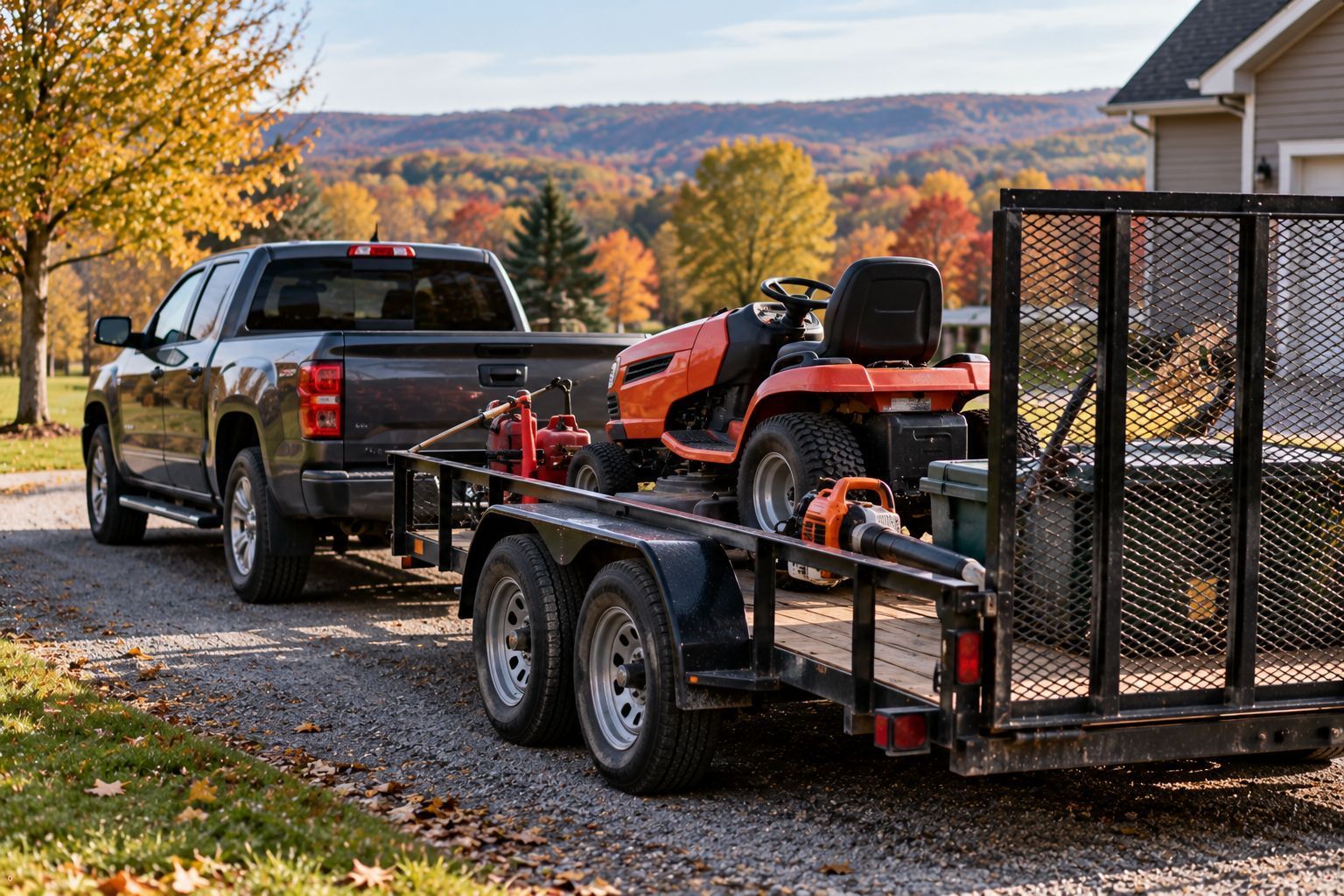
Does car insurance cover a trailer in Pennsylvania? Partly. Your auto liability usually follows you onto the road while a trailer is hitched. Damage to the trailer itself, theft and the gear inside it are separate matters, and those need specific coverage. Most trailer owners discover that gap only after something goes wrong.
The gap usually shows up at a bad moment. Someone backs a jon boat trailer into a fence at a Lake Arthur launch. A landscaper in Cranberry finds an empty space where a utility trailer was parked overnight. A family hauling furniture to a college in State College watches a strap fail on Route 322. Each case involves a different part of a policy, and the answers are not the same. The sections below explain how liability extends while towing, how physical damage works for utility and boat trailers, what happens to the contents, and how PennDOT's rules fit in.
Does Car Insurance Cover a Trailer in Pennsylvania?
Yes, for liability. When a trailer is attached to your insured vehicle, your auto liability typically covers injuries and property damage the rig causes to other people. Comprehensive and collision usually do not transfer to the trailer, though. Physical damage needs a trailer endorsement or a separate policy, and contents usually fall under homeowners or inland marine coverage.
That short answer settles the main question, but the details matter. "Covered" can mean very different things depending on who is hurt and what is damaged. Insurers split trailer exposure into three buckets:
- Harm you cause to others: usually handled by your tow vehicle's liability
- Damage to the trailer itself: handled only if the trailer is scheduled with physical damage coverage
- Damage to what's inside: almost never handled by the auto policy
Most claim disputes happen because someone assumed all three buckets were filled when only the first one was.
How Liability Extension Works While Towing in PA
When a trailer is hitched to a covered car or truck, it is generally treated as part of that vehicle for liability purposes. If your trailer swings into the next lane on the Turnpike and sideswipes a sedan, the bodily injury and property damage limits on your pennsylvania car insurance policy are what respond. The same applies if the trailer detaches and rolls into a parked car while you're driving.
This matters because Pennsylvania's minimum limits are low compared with what a trailer accident can cost. A loaded utility trailer that jackknifes can involve several vehicles, and a single set of limits has to cover all of them. Your liability does not double because you're pulling something. You get one set of limits for the whole rig. If you tow regularly, that is a strong reason to raise your liability limits or add an umbrella policy.
A few conditions apply to the extension:
- The trailer has to be connected. Once it's unhitched, many personal auto policies stop treating it as part of the car. More on that in the FAQ.
- Use matters. Personal policies usually exclude trailers used for business hauling. A contractor's trailer generally belongs on a commercial auto policy.
- Type matters. Some policies limit or exclude trailers designed for living quarters, such as travel trailers, or trailers above a certain size. Those often need RV coverage.
Pennsylvania's financial responsibility law also comes into play. Under 75 Pa.C.S. § 1786, registered motor vehicles must maintain financial responsibility, and enforcement has become more efficient. As of February 2026, officers can use an online verification system to check insurance status instantly. A lapse on your tow vehicle will be noticed quickly. Penalties can include a $300 fine and a three-month registration suspension, and a $500 civil penalty may be paid instead of suspension once every 12 months.
Physical Damage Coverage for Utility and Boat Trailers
Comprehensive and collision on your car do not automatically extend to your trailer. If the trailer is stolen from your driveway, crushed by a falling limb or rolled in a crash, the auto policy pays nothing toward repairing or replacing it unless you've added the trailer to the policy. Your liability may cover the other driver's car in that crash while your own trailer is a total loss with no payout.
Adding coverage is usually simple. You give your agent the year, make, VIN or serial number and value, and the insurer adds it to the policy, often with its own deductible. That is where a lot of people get caught: they had the trailer for years, never listed it, and assumed their full coverage auto policy covered it.
Theft is the most common uncovered claim we see with trailers in western Pennsylvania. Utility trailers are easy to hitch and drive off, many have no titles, and few owners record serial numbers. A wheel lock and photos of the VIN plate help, but without physical damage coverage, the loss falls entirely on you.
Insuring Specialized Watercraft Trailers
Boat trailers usually follow a different path. Physical damage for a boat trailer generally does not come from the car policy. It is typically handled through a dedicated boatowners policy that insures the hull, motor and trailer together. That arrangement makes sense, since the trailer's main job is supporting the boat, and one policy avoids disputes over which insurer pays when a launch goes wrong.
When you set up a boat policy, check that the trailer is listed with its own value rather than assumed to be included. Ask how the policy handles damage while launching or retrieving, because ramp incidents are a common claim. A trailer that slides off a wet ramp at Raystown Lake can damage the hull, the trailer and the dock in one event.
Utility Trailer Value and Deductiblesb
For personal-use utility trailers, adding physical damage is typically inexpensive. As of this writing, it usually runs about $8 to $25 per month in Pennsylvania, depending on value and the carrier. The bigger decision is the deductible. On a $2,000 single-axle trailer, a $1,000 deductible leaves very little coverage, so a $250 or $500 deductible often makes more sense.
Insure the trailer for what it would actually cost to replace, including add-ons such as ramps, side extensions, a new deck or upgraded tires. Insurers generally pay based on the value you declared and documented, not on what you later remember spending.
Comparing Coverage Options Across Pennsylvania Carriers
Most carriers that write personal auto in Pennsylvania offer some way to cover a trailer, but they differ in how they handle physical damage, specialty trailers and contents. As an independent agency, MVP works with these carriers as an agent rather than as the insurer, so the comparison below reflects common approaches and not a ranking. Eligibility and options can vary by policy and trailer type.
| Carrier | Liability While Towing | Trailer Physical Damage | Typical Fit |
|---|---|---|---|
| Erie | Extends from tow vehicle | Available when trailer is added to auto policy | Utility trailers kept with a PA household auto policy |
| Progressive | Extends from tow vehicle | Available by scheduling the trailer; separate options for boats and RVs | Owners who also need boat or travel trailer coverage |
| Westfield | Extends from tow vehicle | Available as an addition through independent agents | Households bundling home and auto |
| Foremost | Through tow vehicle's auto policy | Standalone specialty trailer coverage | Higher-value or specialty trailers |
| American Modern | Through tow vehicle's auto policy | Standalone specialty coverage | Horse, cargo and other specialty trailers |
The table is less useful for choosing a carrier and more useful for showing a pattern. Standard auto carriers are generally fine for an ordinary utility trailer that stays with your car. Once the trailer is worth more, carries specialized equipment or doesn't fit the usual "personal utility" category, specialty carriers start to make more sense.
Rates are the other factor, and they change. The same $3,500 landscape trailer can cost noticeably different amounts to insure depending on the carrier, your driving record and whether the auto policy is already bundled. That is why comparing several quotes usually beats renewing without questions.
Protecting the Contents Inside Your Trailer
Car insurance rarely covers what's inside your trailer. Physical damage coverage protects the trailer as a piece of equipment: axle, frame, deck and walls. Mowers, ATVs, furniture or tools strapped to it are usually considered personal property and are excluded from the auto policy.
For most families, contents fall under the personal property section of a homeowners or renters policy, which typically follows your belongings away from home. If you're moving a dorm room and the trailer catches fire on I-80, the homeowners policy is the likely source of payment, after its deductible. Some homeowners policies limit off-premises coverage or exclude certain items, such as motorized vehicles like ATVs and dirt bikes, so read those sections before you rely on them.
High-value items often need more targeted coverage:
- Inland marine endorsements or floaters for expensive equipment, tools or collectibles that travel
- Separate ATV, UTV or motorcycle policies for powered vehicles hauled on the trailer
- Contractor's equipment coverage for tools and machinery used in a business
Business owners should note one more rule. When you haul freight for others within Pennsylvania, the state requires cargo insurance of at least $5,000 per vehicle for loss or damage to that freight. That is a commercial requirement, and it reinforces the main point: a personal auto policy is not designed to cover what you carry.
A common mistake is assuming the trailer endorsement covers everything on the trailer. A client can insure a $4,000 enclosed trailer and keep $15,000 in tools inside it with no coverage for those tools. If the trailer is stolen, the claim may pay for the empty box and nothing else.
Pennsylvania Requirements for Trailer Registration and Insurance
PennDOT and your insurance company look at different things. PennDOT focuses on registration, titling, brakes and inspection, mainly based on weight. Your insurer focuses on value, use and who tows the trailer. Meeting one set of requirements does not mean you meet the other.
On the PennDOT side, registration is required for all trailers used on public roads, and the 3,000-pound mark is where most other requirements begin. Here's how the rules generally break down:
| Requirement | Under 3,000 lbs | Over 3,000 lbs |
|---|---|---|
| Registration | Required | Required |
| Title | Not mandatory | Required above 3,000 lbs GVWR |
| Annual safety inspection | Not required | Required |
| Own brakes and breakaway switch | Not required | Required |
| Two crossed safety chains | Required | Required |
As of this writing, registration for lighter trailers typically costs $7 per year or $35 for five years, while permanent registration for trailers over 10,000 pounds costs $223.
These rules also affect claims. If a heavy trailer without required brakes causes a crash, the insurer still has to handle the injured party's claim, but the violation can complicate the case and increase your personal exposure if the damages exceed your limits. Crossed safety chains and a working breakaway switch are legal requirements, and they also help keep you within your coverage limits.
Regulation affecting insurers has changed recently as well. In April 2026, the Pennsylvania Insurance Department eased certain property and casualty filing requirements, and some rate categories were removed from prior filing as of January 17, 2026. Insurers still must follow the Unfair Insurance Practices Act, but endorsement pricing and forms may change faster than before, which is another reason to review coverage at renewal.
When to Choose a Standalone Trailer Policy
A standalone policy is usually the better choice when the trailer is worth enough, or is specialized enough, that adding it to an auto policy creates gaps. Specialty carriers such as Foremost and American Modern build coverage around the trailer itself instead of treating it as an accessory to a car.
Consider a standalone policy if any of these apply:
- High value: a $20,000 aluminum car hauler or a custom enclosed trailer may exceed what an auto endorsement is designed to handle.
- Specialty use: horse trailers, concession trailers and toy haulers often need coverage for features and situations an auto add-on won't address.
- Multiple tow vehicles: if the trailer is towed by different trucks, some not on your policy, a policy attached to the trailer makes ownership of the coverage clearer.
- Long-term storage: trailers stored for months at a campground or storage lot face theft and weather risks that standalone policies tend to handle better.
- Attached equipment: some specialty policies can include permanently mounted equipment or custom interiors.
For an ordinary 5x8 utility trailer that stays behind the family SUV, a standalone policy is usually unnecessary. An endorsement on the auto policy is simpler, and one renewal date is easier to manage. The decision depends on value and use: the more the trailer is worth and the more unusual its role, the more a dedicated policy makes sense.
This is also where an independent agency is useful. Comparing an Erie endorsement with a Foremost standalone policy side by side shows the price difference and exactly what each one leaves out.
Frequently Asked Questions About PA Trailer Insurance
Do I need a separate plate and insurance for my trailer?
Yes for the plate: every trailer used on Pennsylvania roads must be registered, and trailers over 3,000 pounds also need a title. Insurance is less straightforward, because liability usually extends from your tow vehicle, but physical damage requires adding the trailer to a policy.
Is my boat trailer covered if it rolls away while unhitched?
Often not by your auto policy, because many personal auto policies stop treating a trailer as part of the car once it's disconnected. A boatowners policy that lists the trailer is usually what covers damage to the trailer and the boat, and liability for an unhitched trailer may fall under that policy or your homeowners coverage.
Does my insurance cover a rented U-Haul trailer?
Your auto liability generally extends to a rented trailer while it's hitched to your insured vehicle. Damage to the rental trailer itself and your belongings inside usually isn't covered by the auto policy, so many renters buy the rental company's damage protection and rely on homeowners or renters coverage for contents.
The pattern is the same across all these situations. Liability travels with your hitch, the trailer needs its own physical damage coverage, and the contents depend on your homeowners policy or a dedicated endorsement. Boat trailers belong with the boat, and high-value or specialty trailers often fit better with carriers built for them. Knowing which of these protections you actually have is what keeps a stolen trailer or a ramp accident from turning into an unexpected out-of-pocket bill.
If you want help sorting out your trailer coverage, MVP Insurance can compare options from several carriers and point out the gaps before they become claim problems. With offices in Zelienople, PA and New Springfield, OH, you can start your quote here and get a plain-language look at what fits your rig. MVP Insurance is licensed in Ohio (#37714) and Pennsylvania (#519263), NPN 10588293.
Search
Recent Posts
MVP Insurance is a local, independent agency, licensed to serve individuals and businesses across Ohio and Pennsylvania.
We serve clients from our offices in New Springfield, Ohio and Zelienople, Pennsylvania and throughout Northeast Ohio and Western Pennsylvania, working with multiple carriers to help contractors, landlords and real estate investors, restaurants, retail shops, auto repair shops, professional offices and many other personal and commercial clients find coverage that fits.
Our Owners
Two friends who started an agency
Owner
Joshua Medure
I am a Penn State marketing graduate with more than ten years in insurance. My childhood friend David and I started MVP Insurance in Northeast Ohio because we wanted the people around us to have an agency that gives honest advice, real choices and someone who picks up the phone. I lead the agency’s insurance strategy, which means I read the policies so our clients do not have to. Away from the office, I coach youth football.


About the Author
David Varrati
Owner, MVP Insurance
I started MVP Insurance with my childhood friend Josh because we wanted people in Northeast Ohio and Western Pennsylvania to have an agency that explains things plainly and picks up the phone. I studied Political Science at Slippery Rock University and have spent more than ten years helping families and individuals protect what matters to them. When I am not in the office, you will find me coaching youth sports.