
Pennsylvania teens move from a learner's permit to a junior license to a senior license. Each step requires a minimum amount of time, practice, or clean driving before the next one unlocks. Here's what each stage actually requires and what it means at home.
CG 20 37: Coverage After the Project is Finished
Can my 16-year-old drive their friends home from school in Pennsylvania? During the first six months of a junior license, they can carry only one passenger under 18 who isn't an immediate family member, unless a parent or guardian is in the car. After that window, the limit eases if your teen has stayed violation-free.
Does a teen with a learner's permit need to be on my car insurance? It depends on the carrier. Some require permit holders to be listed, and others don't rate them until they're licensed. Tell your agent when the permit is issued so there's no gap if something happens.
Can a junior license holder drive home from work after 11 PM? Yes. Pennsylvania's curfew includes an exception for travel to and from employment. Your teen should keep proof of their work schedule in the car in case they're stopped.
Pennsylvania's licensing rules work because they ease teens into risk instead of handing them full privileges on day one. Supervised hours, passenger caps, and the overnight curfew all target the situations where new drivers get hurt most. For families, those same rules shape the insurance conversation. A clean junior year, solid liability limits, and the right car assignment can keep your teen safer and your premium more manageable.
If your teen's road test is coming up, now is a good moment to see how different carriers would price your household. MVP Insurance is an independent agency with offices in Zelienople, PA and New Springfield, OH. We compare policies across multiple carriers so you don't have to. When you're ready, you can start your quote here, and we'll walk you through the options. MVP Insurance is licensed in Ohio (license #37714) and Pennsylvania (license #519263), NPN 10588293.
Pennsylvania still offers homeowners insurance below the national average, but recent increases have been steep, and Western PA homeowners have felt it through storms and rising rebuilding costs. Your location sets the starting point. Your deductible, your roof and home systems, and how you use your policy decide much of the rest.
The most useful step is seeing real numbers side by side instead of accepting a single renewal at face value. MVP Insurance is an independent agency with offices in Zelienople, PA and New Springfield, OH, and the team compares multiple carriers so you don't have to. When you're ready, start your quote here and get a clearer picture of what your home should cost to insure.
MVP Insurance is licensed in Ohio (license #37714) and Pennsylvania (license #519263), NPN 10588293.
Pennsylvania follows modified comparative negligence. You can recover damages from other drivers as long as your share of fault isn't greater than theirs combined. Your recovery is reduced by your own percentage. If you're found 30% at fault for a $10,000 loss, you'd typically recover $7,000 from the other side. Once you cross 50%, you can't recover from them at all.
Icy-road claims are full of split percentages. Say one driver was following too closely and another changed lanes abruptly on packed snow. Fault might land at 60/40 or 70/30. In a pileup, three or four drivers might each carry a slice. These percentages shape your claim history too, which is why it's worth disputing a split you think is wrong before it becomes final.
Common Questions About Ohio BWC True-Up
These two get confused all the time, and they pay for different situations.
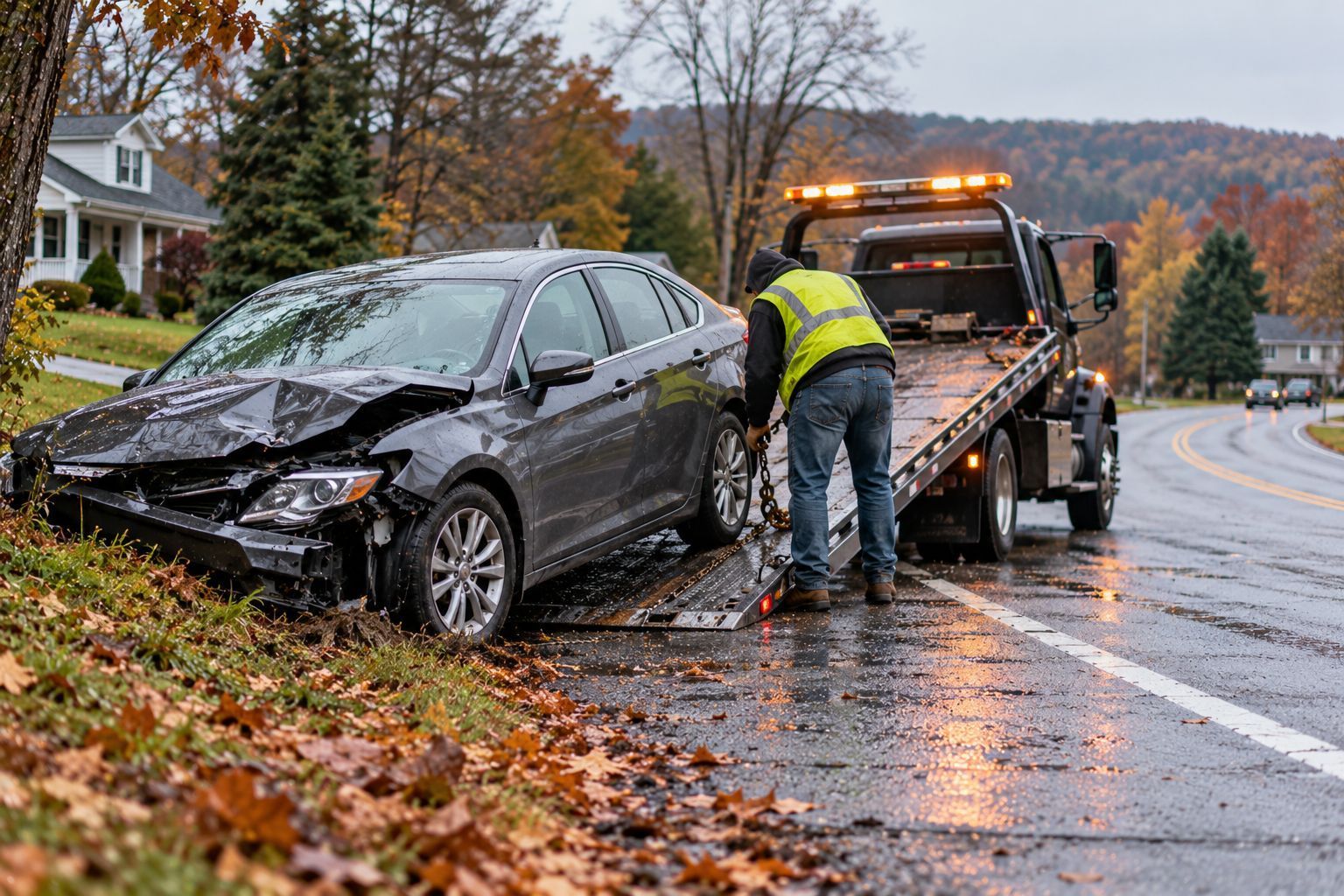
- Emergency roadside service (sometimes called towing and labor) covers breakdowns: dead batteries on a zero-degree morning, flat tires, lockouts, or a winch-out when you've slid into a snowbank without damaging the car. It typically has a per-incident limit and is a low-cost add-on.
- Collision towing is part of your collision claim. When your car is damaged in a crash, the tow to a shop and reasonable storage are usually paid as part of the loss, subject to your deductible.
- Comprehensive can cover towing tied to non-collision losses, such as a tree limb crushing your hood during an ice storm.
A common mistake is assuming roadside service covers a crash tow, or that collision covers a simple winch-out. Check which one applies before you call, especially if you belong to an auto club as well.
Common Questions About Ohio Deer Accident Claims
OSHIIP, the Ohio Senior Health Insurance Information Program, is the state's free Medicare counseling service, generally offered through the Ohio Department of Insurance. Counselors provide free, unbiased, and objective Medicare guidance to residents across the state, and they don't sell insurance.
OSHIIP is a great resource for understanding how Medicare works, sorting out billing disputes, checking eligibility for help with drug costs, and comparing Part D options. Many people use it to get grounded before they talk to an agent, which makes those conversations far more productive.
The Ohio Department of Insurance puts it plainly: "With Medicare plans changing each year, Ohioans should review benefits, costs, and coverage details carefully." We agree. An annual review, whether with OSHIIP, an independent agent, or both, is one of the simplest ways to avoid overpaying.
Think of it this way: OSHIIP explains the rules, and an independent agency like MVP Insurance shops actual policies and premiums from multiple carriers on your behalf. Using both is a smart move.

Pennsylvania Medicare Advantage plans come in two main flavors around Pittsburgh: HMOs, which keep you inside one network for lower costs, and PPOs, which let you see out-of-network doctors for a higher price. You choose or switch during fall enrollment, compare drug coverage carefully, and consider a Medicare Supplement if predictability matters most.
That's the short version. The longer version depends on which hospitals you trust, which prescriptions you fill every month, and how much financial surprise you can tolerate in a bad year. Western Pennsylvania adds its own wrinkle, because the region's two big health systems shape almost every plan decision people make here.
Pennsylvania Medicare Advantage Plans and the Annual Enrollment Period
The Annual Enrollment Period typically runs from October 15 to December 7 each year, and it's the main window for seniors to join, drop, or switch coverage. For 2027 plans, that means enrollment runs October 15, 2026, through December 7, 2026. Changes you make take effect January 1.
This window matters because plans change every year. Networks shrink, drug formularies get reshuffled, and copays creep up. Each fall your current plan sends an Annual Notice of Change, and the most common mistake we see is people tossing it unread, then discovering in February that their cardiologist or their blood thinner moved tiers.
There's a second, smaller chance to fix things. If you're already in a Medicare Advantage plan, you generally get one switch between January 1 and March 31, 2027, during the Medicare Advantage Open Enrollment Period. It's useful, but it's a safety net, not a strategy.
Quality ratings deserve a look too. Nationally,
the number of 5-star Medicare Advantage plans dropped from 22 in 2026 to 15 in 2027, so a plan's rating from two years ago may not reflect where it stands now. If you're also reviewing home and auto coverage this fall, our overview of
personal insurance in Pennsylvania covers the rest of your household policies.
Comparing HMO vs PPO Networks Around Pittsburgh Health Systems
In western Pennsylvania, the right plan usually comes down to whether it includes UPMC, Allegheny Health Network (AHN), or both. Network access across these two systems generally drives most Medicare decisions in the Pittsburgh area, from Butler and Cranberry down to Washington County.
Here's the tension. Many local plans lean toward one system, and a plan that looks affordable on paper can become expensive if your oncologist, orthopedist, or preferred hospital sits on the other side of that line. As of this writing, network arrangements in the region can shift from year to year, so last year's coverage is no guarantee for next year.
Network Access and Provider Flexibility
An HMO typically requires you to use doctors and hospitals within its network, except in emergencies. Most HMOs also ask you to pick a primary care doctor and get referrals before seeing specialists. If your entire care team is already inside one system and you rarely travel, an HMO can work well and usually carries lower premiums and copays.
A PPO gives you more room. You can see providers outside the network, usually without a referral, but you'll pay more when you do. That flexibility matters for a few common situations:
- Split loyalties: your primary doctor is with AHN but your heart specialist practices at a UPMC facility.
- Snowbirds: you spend winters out of state and want routine care there.
- Ongoing treatment: you're mid-course with a specialist and can't risk a network change.
One caution: "out-of-network coverage" on a PPO doesn't mean every provider will accept the plan. Call the doctor's billing office before you enroll.
Prescription Drug Coverage and Plan Benefits
Most Medicare Advantage plans bundle Part D drug coverage, and the 2027 federal rules put a firm ceiling on what you'll spend on covered drugs. For the 2027 coverage year, your Part D out-of-pocket costs are capped at $2,400, and the maximum Part D deductible is $700.
That cap is real protection, but it applies only to drugs on your plan's formulary. If a medication isn't covered, those costs don't count toward the limit. Always enter your exact prescriptions, doses included, when comparing plans.
| Feature | HMO | PPO | Medicare Supplement + Part D |
|---|---|---|---|
| Monthly premium | Often low or $0 | Usually higher than HMO | Higher, paid separately |
| Doctor visits | Fixed copays in network | Copays; more out of network | Little or nothing, depending on plan letter |
| Medical out-of-pocket limit | Yes, set by plan | Yes, with a higher out-of-network limit | No cap needed on most plans; costs stay low |
| Drug coverage | Usually built in | Usually built in | Separate Part D plan |
| Drug tiers | Generics cheapest tier, specialty highest | Same tier structure | Depends on Part D plan chosen |
| Referrals | Usually required | Usually not required | Not required |
Tiers trip people up. A drug on Tier 1 might cost a few dollars, while the same class of medication on Tier 4 or 5 can cost a percentage of the drug's price. Highmark-style messaging around "stability and affordability" for 2027 reflects how much insurers are adjusting benefits as medical costs rise, which is one more reason to review your formulary yearly.
When a Medicare Supplement Fits Better Than an Advantage Plan
A Medicare Supplement (Medigap) fits better when you'd rather pay a higher monthly premium in exchange for predictable costs and the freedom to see any doctor who accepts Medicare. Supplements work alongside Original Medicare instead of replacing it, so there are no networks to manage.
In Pennsylvania,
Medigap plans are standardized by letter, A through N, meaning a Plan G from one insurer has the same benefits as a Plan G from another. Only price and service differ. The market has shifted, too: as of January 1, 2026, one major eastern Pennsylvania insurer stopped selling new Medigap policies, though existing members can keep theirs. You can compare options on our page about
Medicare Supplement plans in Pennsylvania.
Cost Predictability and Specialist Access
Timing is everything with a supplement. The strongest position is the six-month Medigap Open Enrollment Period that starts when you're 65 or older and enrolled in Part B. During that stretch, insurers generally can't deny you or charge more for health conditions. Wait several years, then try to leave an Advantage plan after a cancer diagnosis, and medical underwriting may block the move.
A supplement tends to make sense if you:
- Want to see specialists at both UPMC and AHN without worrying about networks
- Have a chronic condition with frequent appointments
- Travel or split time between states
- Prefer a steady monthly bill over copays that pile up in a rough year
MVP Insurance was founded in 2008 by Josh Medure and David Varrati, with offices in Zelienople, PA and New Springfield, OH, and we help clients weigh these tradeoffs without pushing one answer.
Frequently Asked Questions About Medicare in Pennsylvania
When can I change my Medicare Advantage plan in Pennsylvania? The Annual Enrollment Period runs October 15 to December 7. Current Advantage members also generally get one switch between January 1 and March 31.
Do Pittsburgh Medicare Advantage plans cover both UPMC and AHN? Some do and some lean toward one system. Network arrangements can change each year, so confirm your doctors are included before you enroll.
Is an HMO or PPO better for seniors near Pittsburgh? An HMO usually costs less if all your doctors are in one network. A PPO costs more but lets you go out of network.
What's the most I'll pay for prescriptions in 2027? Covered Part D drug costs are capped at $2,400 for the year. Drugs your plan doesn't cover don't count toward that limit.
Can I switch from Medicare Advantage to a Medigap plan later? You can try, but outside your initial Medigap enrollment window, insurers may review your health and could decline you.
Are Medigap plans the same from every insurer? Yes, benefits are standardized by letter in Pennsylvania. Prices and customer service are what differ.
Choosing among Pennsylvania Medicare Advantage options really comes down to three questions: which hospital system you rely on, what your prescriptions cost under each formulary, and how much uncertainty you can live with. Answer those honestly and the HMO, PPO, or supplement choice usually becomes obvious.
As an independent agency, MVP Insurance compares options from multiple carriers so you don't have to sort through plan documents alone. If you'd like a second set of eyes before December 7, start your quote or call our Zelienople office at (724) 453-1122 or New Springfield office at (330) 707-9055. MVP Insurance is licensed in Ohio (#37714) and Pennsylvania (#519263), NPN 10588293.
Search
Recent Posts


MVP Insurance is a local, independent agency, licensed to serve individuals and businesses across Ohio and Pennsylvania.
We serve clients from our offices in New Springfield, Ohio and Zelienople, Pennsylvania and throughout Northeast Ohio and Western Pennsylvania, working with multiple carriers to help contractors, landlords and real estate investors, restaurants, retail shops, auto repair shops, professional offices and many other personal and commercial clients find coverage that fits.
Our Owners
Two friends who started an agency
Owner
Joshua Medure
I am a Penn State marketing graduate with more than ten years in insurance. My childhood friend David and I started MVP Insurance in Northeast Ohio because we wanted the people around us to have an agency that gives honest advice, real choices and someone who picks up the phone. I lead the agency’s insurance strategy, which means I read the policies so our clients do not have to. Away from the office, I coach youth football.


About the Author
David Varrati
Owner, MVP Insurance
I started MVP Insurance with my childhood friend Josh because we wanted people in Northeast Ohio and Western Pennsylvania to have an agency that explains things plainly and picks up the phone. I studied Political Science at Slippery Rock University and have spent more than ten years helping families and individuals protect what matters to them. When I am not in the office, you will find me coaching youth sports.