

Frequently Asked Questions About Mine Subsidence
Raising your deductible is the fastest lever you have. Moving a standard deductible from $500 to $1,000 or $2,500 can reduce your premium by up to 25%. On a $1,600 annual premium, that could mean saving a few hundred dollars a year.
The trade-off is simple: you take on more of the small losses. Before raising it, ask yourself whether you could write a check for the new deductible tomorrow without touching credit cards. If yes, a higher deductible usually pays off within a few claim-free years. Also check whether your policy has a separate wind or hail deductible, sometimes set as a percentage of dwelling coverage, since that can be much larger than the flat amount you remember choosing.
How does credit score affect my PA rate?
Pennsylvania allows insurers to use a credit-based insurance score when setting rates, and stronger credit generally means a lower premium. Paying bills on time and keeping balances low can help your rate over time.
Does my location near a fire station matter?
Yes. Homes closer to a staffed fire station and a working hydrant usually get better pricing because fire damage tends to be less severe when help arrives quickly.
How often should I review my policy limits?
Review them at every renewal and any time you renovate, add a big purchase, or finish a basement. With rebuilding costs rising, a limit that fit three years ago may now fall short.
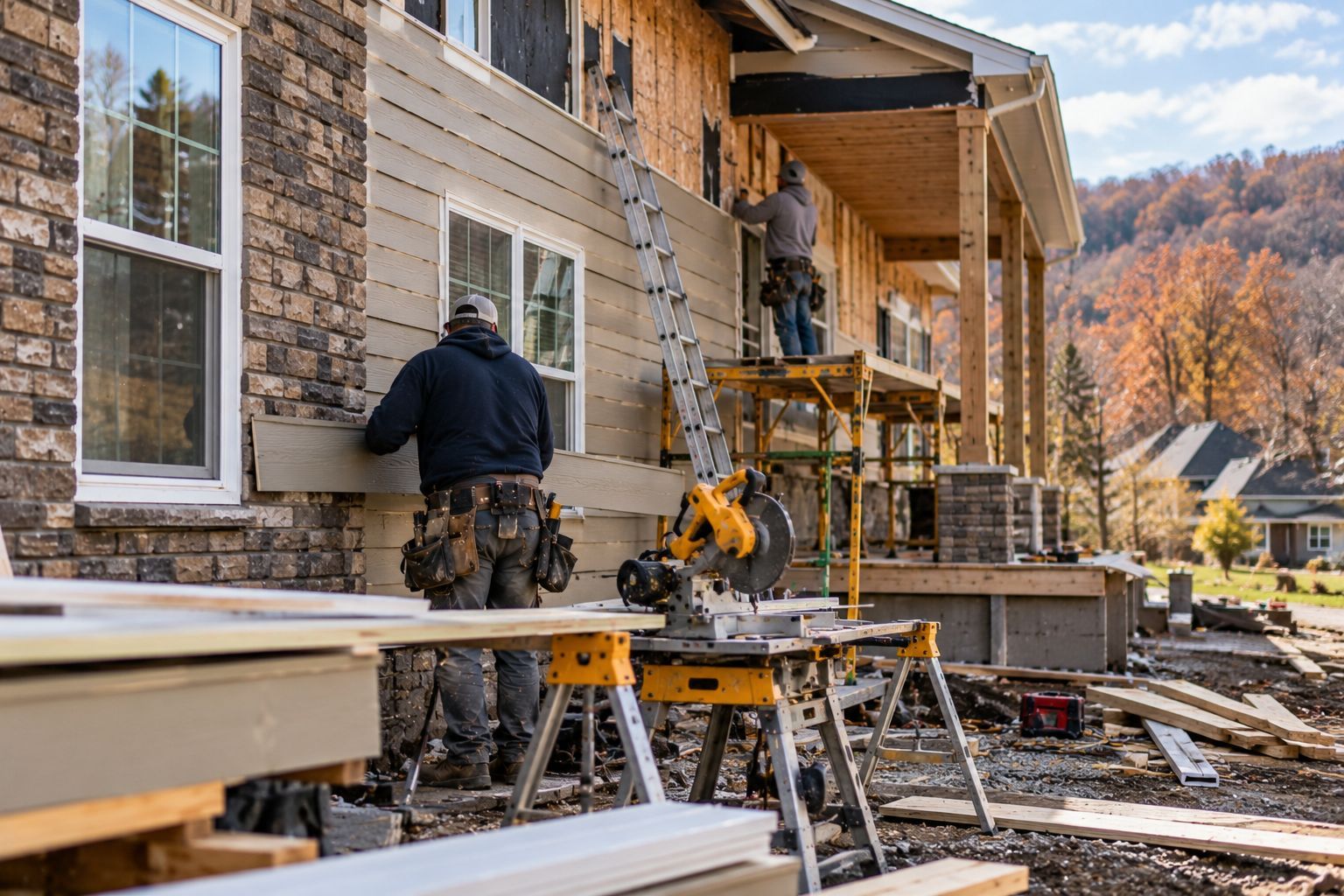
Any contractor who performs $5,000 or more in home improvement work in a year must register with the Pennsylvania Office of Attorney General, show proof of at least $50,000 in personal injury and $50,000 in property damage liability coverage, and display a valid registration number. Working without one exposes you to fines, criminal charges, and contracts you may not be able to enforce.
That's the short version of Pennsylvania home improvement contractor registration. The longer version matters more than it used to. After a 2025 cybersecurity incident took the old system offline, the state rebuilt the process, raised the fee, and started checking criminal dockets automatically. Contractors who used to treat registration as a one-time chore now have new rules to follow, and homeowners now have a tool to check up on them. Here's what you need to know, whether you're a two-person roofing crew in Butler County or a growing remodeling company outside Pittsburgh.
Who Must Register With the Attorney General
If you do $5,000 or more in residential home improvement work per year, you must register with the Attorney General under the Home Improvement Consumer Protection Act (HICPA). The state sets that annual threshold for home improvement contractors, and it applies whether you work alone, run a crew, or subcontract.
The definition of "home improvement" is broader than many people expect. It covers repairs, remodeling, installations, and even jobs like sandblasting and demolition on private residences when the total cash price exceeds $500. So a painter, a deck builder, a window installer, and a handyman doing kitchen backsplashes may all fall under the law.
A few groups sit outside the requirement. Large retailers with a net worth exceeding $50 million are exempt, for example. Most small and mid-sized trades, though, need a number.
The system itself changed recently. A new PA-HICRS platform with automated criminal docket checks became fully operational on April 24, 2026. Contractors who missed registration during the outage had until a grace period ending June 8, 2026 to get fully compliant. That window has closed, so anyone still unregistered is now plainly out of compliance.
Proof of Liability Insurance Requirements
You can't complete registration without proof of commercial general liability insurance. Pennsylvania requires minimum limits of $50,000 for personal injury and $50,000 for property damage, and you need to keep that coverage in force for as long as you're registered.
In practice, your agent provides a certificate of insurance showing your carrier, policy number, effective dates, and limits. The mistake we see most often is a lapse: a contractor misses a renewal payment, the policy cancels, and suddenly the registration rests on coverage that no longer exists. Another common gap is a business name mismatch, where the policy lists "Mike's Roofing" but the registration says "M. Smith Contracting LLC." Line those up before you file.
MVP Insurance is an independent agency that works with carriers like Erie, Westfield, and Frederick Mutual to help contractors find pennsylvania contractors insurance that meets the state minimum and fits the real risks of the work.
Registration Minimums vs. Recommended Coverage
The $50,000 floor gets you registered. It rarely covers a serious claim. Picture a tile setter whose wet saw cord trips a homeowner down the basement stairs, or a roofer whose tarp blows off and lets rain ruin a finished ceiling and hardwood floors. Medical bills or a full interior restoration can blow past $50,000 quickly, and anything over your limit comes out of your business or personal assets.
Many general contractors, property managers, and larger homeowners also ask subs for higher limits before they'll hand over a job. Carrying the minimum can quietly cost you work.
PA Registration Fee and Coverage Comparison
As of this writing, the biennial registration fee increased to $100 effective March 2, 2026. That covers a two-year registration period. The insurance side usually costs more than the fee, so it helps to see where the state minimum sits compared with what the market typically expects.
| Coverage Item | PA Registration Minimum | Common Industry Standard |
|---|---|---|
| Personal injury (bodily injury) liability | $50,000 | Typically $1,000,000 per occurrence |
| Property damage liability | $50,000 | Often combined in the $1,000,000 per occurrence limit |
| General aggregate | Not specified | Typically $2,000,000 |
| Completed operations | Not specified | Usually included, often matching aggregate |
| Registration fee | $100 every two years | Same for all registrants |
The gap between the left and right columns is where most uncomfortable phone calls start. A contractor who bought the minimum years ago to "get the number" often doesn't realize it until a GC requests a certificate showing $1 million limits, or until a claim exceeds the policy.
Completed operations coverage deserves its own mention. It responds to damage that shows up after you finish, like a water heater connection that leaks three weeks later. The state doesn't require it, but for plumbers, roofers, and anyone touching water or structure, it's one of the most valuable parts of a general liability policy.
Penalties for Working Unregistered in Pennsylvania
Working without a valid HICPA number can lead to criminal penalties, civil fines, and the loss of your ability to collect what you're owed. Unregistered contractors are strictly prohibited from offering or performing home improvement services, which means even advertising the work is a violation.
Here's what's on the table:
- Civil penalties: HICPA violations carry civil penalties starting at $1,000 per violation. Each job, ad, or contract can count separately.
- Criminal charges: Performing work without registration, especially combined with taking deposits and not finishing, can be prosecuted criminally under the Act.
- Unenforceable contracts: Contracts from unregistered contractors, or contracts that don't meet HICPA standards, may be deemed voidable and unenforceable. If the homeowner stops paying, you may have little legal footing.
- Lost lien rights: Without a valid registration, you can lose the practical ability to file a mechanic's lien to secure payment.
The Attorney General's office has been aggressive lately. In an August 2026 settlement, the office said it "permanently prohibits bad actors from owning and operating a home improvement business in Pennsylvania."
Registration also brings ongoing obligations. Your number must appear on advertisements, business vehicles, contracts, and estimates, and many contractors add it to their websites and proposals. Jobs over $500 need a written contract that includes the registration number and a three-day right of rescission notice. Homeowners can cancel within three business days through any medium, including verbal notice, so don't order custom materials on day one.
Common Questions About PA Contractor Registration
How do I look up a PA contractor registration?
Homeowners and contractors can search registrations through the state's online contractor registration portal. Enter the contractor's name or PA-HIC number to confirm the registration is active before signing anything.
Does a PA HICPA registration expire?
Yes. Registration runs on a two-year cycle, and as of this writing the renewal fee is typically $100. Your liability insurance must stay active the whole time, so a cancelled policy can cause problems even mid-cycle.
Is workers compensation required for registration?
If you have employees, you'll generally need to show proof of workers' compensation insurance or a valid exemption to maintain registration. Sole proprietors with no employees usually file the exemption instead.
Search
Recent Posts


MVP Insurance is a local, independent agency, licensed to serve individuals and businesses across Ohio and Pennsylvania.
We serve clients from our offices in New Springfield, Ohio and Zelienople, Pennsylvania and throughout Northeast Ohio and Western Pennsylvania, working with multiple carriers to help contractors, landlords and real estate investors, restaurants, retail shops, auto repair shops, professional offices and many other personal and commercial clients find coverage that fits.
Our Owners
Two friends who started an agency
Owner
Joshua Medure
I am a Penn State marketing graduate with more than ten years in insurance. My childhood friend David and I started MVP Insurance in Northeast Ohio because we wanted the people around us to have an agency that gives honest advice, real choices and someone who picks up the phone. I lead the agency’s insurance strategy, which means I read the policies so our clients do not have to. Away from the office, I coach youth football.


About the Author
David Varrati
Owner, MVP Insurance
I started MVP Insurance with my childhood friend Josh because we wanted people in Northeast Ohio and Western Pennsylvania to have an agency that explains things plainly and picks up the phone. I studied Political Science at Slippery Rock University and have spent more than ten years helping families and individuals protect what matters to them. When I am not in the office, you will find me coaching youth sports.