
Every Pennsylvania driver chooses between limited tort and full tort, and that choice affects your right to sue after an accident. It is one of the most misunderstood checkboxes on the application.
With limited tort, you can still recover medical bills and lost wages from an at-fault driver. What you give up is the right to sue for pain and suffering unless your injury meets the state's definition of a serious injury. Limited tort usually costs less, which is why many people choose it without realizing what they waived.
Full tort lets you seek compensation for pain and suffering without meeting a specific injury threshold. That matters for injuries like whiplash, a broken wrist, or a concussion that heals but disrupts your life for months. These injuries often fall short of "serious" under limited tort rules.
A quick comparison:
- Limited tort: lower premium, pain and suffering claims only for serious injuries
- Full tort: higher premium, full right to sue for pain and suffering
- Who chooses it: the selection usually applies to everyone covered under your policy, including family members
If you aren't sure which one you picked, look at your declarations page. People are often surprised to find limited tort selected years ago by default.
| Coverage | What It Pays For | Typical PA Limit Example |
|---|---|---|
| Dwelling (A) | Rebuilding the house itself | $300,000 (full rebuild cost) |
| Other Structures (B) | Detached garage, fence, shed | 10% of dwelling: $30,000 |
| Personal Property (C) | Furniture, clothes, electronics | 50% to 70% of dwelling: $150,000 to $210,000 |
| Loss of Use (D) | Hotel and meals while displaced | 20% to 30% of dwelling: $60,000 to $90,000 |
| Personal Liability (E) | Injuries or damage you cause others | $300,000 to $500,000 |
| Medical Payments (F) | Minor guest injuries, regardless of fault | $1,000 to $5,000 |
Every carrier licensed in Pennsylvania must meet the same 15/30/5 liability and $5,000 first party benefit minimums, but they differ in how they price coverage, package options, and handle tort selection. That's why comparing carriers matters more than comparing the minimum itself.
Erie has deep roots in Pennsylvania and tends to bundle auto with home coverage in ways that appeal to families. Progressive offers a wide range of options and is often a fit for drivers with a varied record or those who want to adjust coverage online. Westfield, a regional carrier, works through independent agents and frequently fits households looking for solid auto and home packages. None is right for everyone. Your driving history, vehicle, zip code, and credit-based insurance factors all shift which carrier comes in more favorably.
MVP Insurance's independent agents work with carriers like Erie, Progressive, and Westfield to find policies that meet Pennsylvania's state mandates and fit your situation. As an independent agency, MVP works with these carriers on your behalf rather than acting as the carrier itself. That means one conversation can produce several quotes to compare side by side, including how each handles first party benefits, tort options, and higher liability limits.
A few things worth asking any agent when you review quotes:
- What does it cost to raise liability to 100/300/100 compared with the minimum?
- How much more is full tort on this policy?
- What would $25,000 in first party benefits add?
- Does the carrier offer uninsured and underinsured motorist coverage at matching limits?
That last question is important. Plenty of drivers on Pennsylvania roads carry only the minimum, or nothing at all. Uninsured and underinsured motorist coverage protects you when the other driver can't pay. For a deeper look at coverage options across the state, see our guide to pennsylvania car insurance.
Meeting the state's minimum car insurance requirements is the starting line, not the finish. Liability at 15/30/5, $5,000 in medical benefits, a current ID card, and no lapses will keep you legal. Whether that is enough protection is a separate question, and for most households with a home, savings, or a steady paycheck, the answer is no.
If you'd like a second set of eyes on your current policy or want to compare options from several carriers at once, you can start your quote here with MVP Insurance. The team has offices in Zelienople, PA and New Springfield, OH, and serves drivers across both states. MVP Insurance is licensed in Ohio (license #37714) and Pennsylvania (license #519263), NPN 10588293.
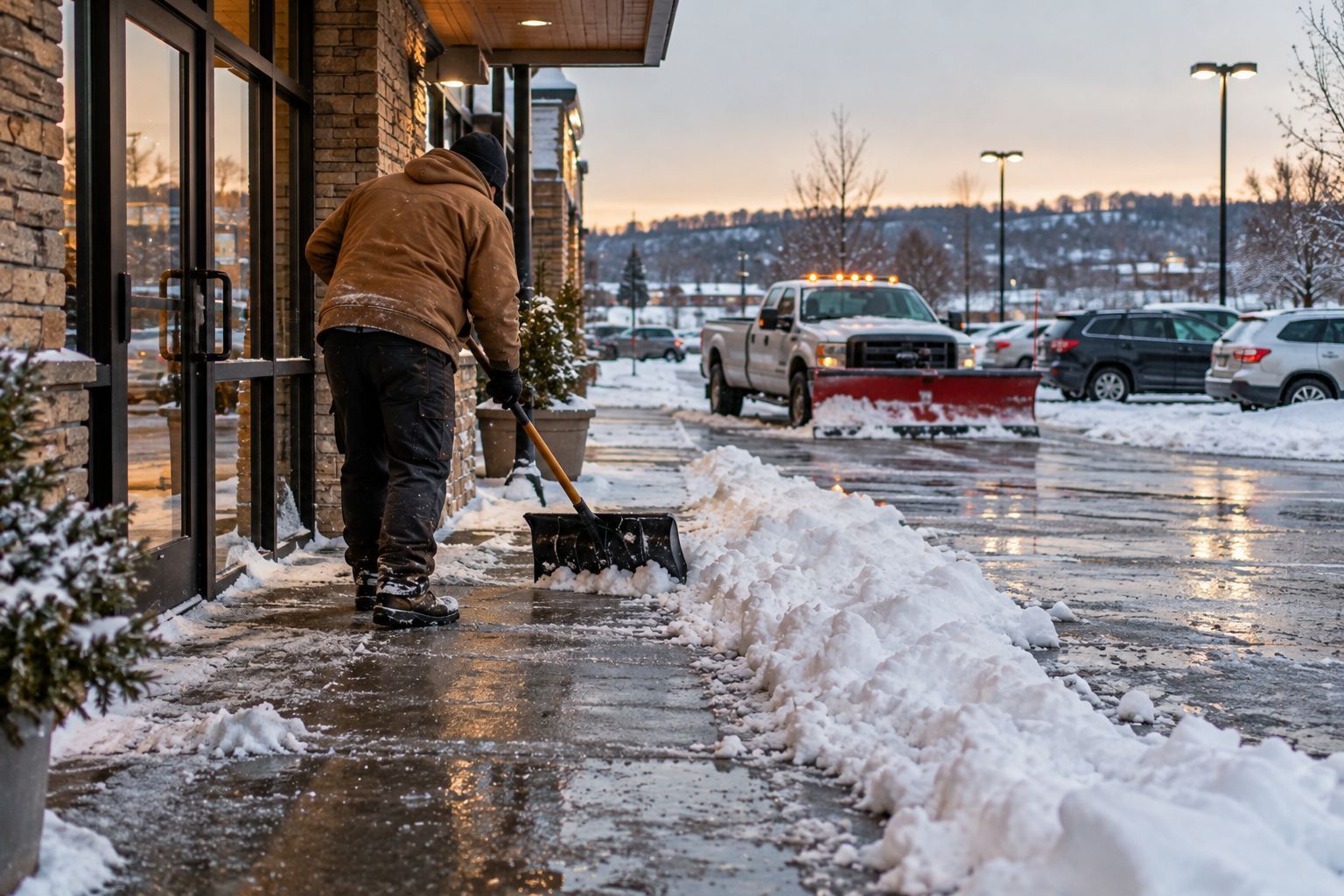
If a customer slips on ice at your Pennsylvania business, the property owner is usually the first party sued. The plowing contractor can end up paying instead when a written contract shifts that duty. Whether anyone pays at all depends on how long the ice sat, whether it formed hills or ridges, and what the snow removal agreement says.
That is the short answer. The longer one matters because winter slip claims are among the most common liability losses for Pennsylvania storefronts, restaurants, medical offices and landlords. They also get expensive fast. In October 2026, a Philadelphia victim recovered $350,000 after slipping on an untreated, unshoveled pile of snow in a commercial parking lot.
Business owners in Butler, Allegheny, Beaver and Lawrence counties often assume their plow guy "has it covered." Sometimes that's true. Often it isn't, and the gap only shows up after an injured customer hires a lawyer. The sections below walk through the law, the contracts and the insurance that decide who writes the check.
Who Pays When a Customer Slips on Ice at a Pennsylvania Business?
In most cases, the property owner or the snow removal contractor pays. Which one depends on the storm conditions at the time of the fall and the wording of the maintenance agreement. The injured person typically names everyone with any connection to the property: owner, tenant, property manager and plowing company. The insurers then argue over who carries the loss.
Here is how responsibility usually breaks down in real claims:
- Owner-occupied building, no contractor: The owner and the owner's liability policy handle the claim.
- Tenant in a leased space: The lease decides. Many commercial leases make the tenant responsible for sidewalks and entrances, while the landlord keeps the parking lot.
- Contractor hired with a strong contract: The contractor's insurer may defend and pay the owner's share through indemnity and additional insured provisions.
- Contractor hired on a handshake: The owner usually pays first and may try to recover from the contractor later, which is slow and uncertain.
The policy that responds first for most business owners is commercial general liability. If you're reviewing your limits before winter, our page on pennsylvania general liability insurance explains how that coverage handles premises injuries like slip and falls.
One mistake comes up again and again. A business owner sees the plow truck arrive at 4 a.m. and figures liability transferred the moment the truck pulled in. Liability doesn't move because someone shows up with a blade. It moves because a contract says so, and because the right insurance backs up that contract.
Pennsylvania Snow Removal Duties for Property Owners
Pennsylvania business owners have a duty to keep their premises reasonably safe for customers. That includes clearing snow and ice within a reasonable time after a storm ends. The duty doesn't require a bare, dry surface every minute of every winter day. It requires reasonable action, and courts judge "reasonable" against the weather, the type of business and local ordinances.
The Duty of Care Owed to Business Invitees
Customers are "business invitees" under Pennsylvania law, and they receive the highest duty of care a property owner owes. You must inspect for hazards, fix the ones you know about or should know about, and warn people about dangers you haven't fixed yet. A grocery store with heavy foot traffic gets judged differently from a rural warehouse that sees three visitors a day.
In practice, this means someone should check entrances, walkways, ramps and the parking lot on a schedule. Melt-and-refreeze conditions are the classic trap. A lot cleared at noon can turn into a sheet of black ice by 6 p.m. when meltwater from a snow pile runs across the pavement and freezes. Courts often treat that refreeze hazard as something the owner should have anticipated.
Reasonable Timeframes for Ice Remediation
Pennsylvania has no single statewide deadline for clearing commercial property. Municipal ordinances fill that gap. In Philadelphia, property owners typically must clear a 36-inch path on sidewalks within 6 hours of snowfall ending or face fines of $50 to $300 per day, as of this writing. Many boroughs and townships set their own windows, so check your local code.
Breaking a local ordinance doesn't automatically make you liable for an injury. It does give a plaintiff's attorney a powerful argument that you acted unreasonably. If your business has vehicles, keep Christine's Law in mind too. It requires drivers and commercial fleets to clear snow from vehicle roofs within 24 hours or face fines up to $1,500 if dislodged ice causes injury.
The Hills and Ridges Doctrine Explained
The hills and ridges doctrine protects Pennsylvania property owners from liability for generally slippery conditions during an active storm or shortly after it. To win, an injured customer usually has to prove three things. Snow or ice had built up into ridges or elevations, those ridges were large enough to be dangerous, and the owner let them stay for an unreasonable length of time.
The logic is practical. Nobody can keep a parking lot perfectly clear while freezing rain is still coming down. Pennsylvania courts recognize that a smooth glaze of ice across a whole town during a storm is a natural condition, not a failure by any one business. The law asks owners to respond after the weather settles, not to work miracles mid-storm.
Picture a customer who walks into a Cranberry Township pharmacy at 8 a.m. while sleet is still falling and slips on a thin, even coat of ice. The hills and ridges defense often defeats that claim. Now picture the same customer at 2 p.m. the next day, tripping over a frozen, rutted mound left where the plow piled snow at the end of a parking row. That claim looks very different.
Defense attorneys like this doctrine because it can end a lawsuit early, sometimes at summary judgment. Weather records, the timing of the fall and witness statements about conditions decide whether it applies. That's one reason documentation matters so much, which we'll get to below.
Exceptions to the Hills and Ridges Defense
The doctrine has limits, and plaintiffs' lawyers know them well. It generally doesn't apply in these situations:
- Localized ice, not general conditions: If the rest of town was dry but your entrance was icy, perhaps from a leaking gutter or a downspout draining across the sidewalk, the defense usually fails.
- Owner-created hazards: Ice that forms because of how you plowed, piled snow or drained meltwater can count as your own negligence.
- Isolated patches after the storm: Once the storm ends and conditions improve elsewhere, a lingering slick spot can create liability even without dramatic ridges.
- Ignored known hazards: If employees saw the problem and did nothing, the "unreasonable time" element becomes much easier to prove.
The gutter and downspout exception catches a lot of small business owners. It isn't really a snow problem. It's a building maintenance problem that winter happens to reveal.
How Plowing Contracts Shift Liability
Snow removal contracts shift liability mainly through indemnity clauses and hold harmless agreements. An indemnity clause says the contractor will cover losses tied to its work. A hold harmless agreement says the contractor won't pursue the owner for those same losses. Together, they decide whether the claim lands on the business owner's insurance or the plowing company's.
The wording matters enormously. A narrow clause might only cover injuries caused by the contractor's negligence. A broad clause might try to make the contractor responsible for nearly any winter injury on the property, including ones partly caused by the owner. Pennsylvania doesn't enforce every broad clause, though. State law voids contract provisions requiring a contractor to indemnify a property owner for the owner's own negligence if the owner directed the contractor not to perform services.
That rule targets a common cost-cutting habit. An owner tells the plow company to skip salting on a slow Sunday to save money, someone falls, and the owner then tries to push the claim back to the contractor. Pennsylvania law won't allow that. Lawmakers have kept looking at this area, too. As of September 28, 2026, HB 1541, which sought to further refine indemnification agreements in service contracts, was removed from the table in the PA House. Expect the rules to keep changing.
Insurers pay close attention here. Carriers like Erie, Westfield and Frederick Mutual often review snow removal contracts during underwriting or after a claim comes in. A missing or vague indemnity clause can affect how a claim gets handled, and sometimes how a renewal gets priced. Cities run into the same cost pressures. Pittsburgh
spent over $1.7 million on private contractors for snow removal after a single storm in late January 2026, which shows how much money rides on these service agreements.
Additional Insured Status for Snow Contractors
An indemnity clause is only a promise. Additional insured status is what puts real insurance money behind it. When your contractor adds your business as an additional insured on its general liability policy, its insurer can defend you directly when a customer sues, instead of you filing a claim and waiting for reimbursement.
Before the first snowfall, ask your contractor for a certificate of insurance and check these items:
- Your business is named as an additional insured, not just listed as a certificate holder.
- The policy dates cover the whole winter season.
- The policy doesn't exclude snow and ice operations, which some contractor policies do.
- The limits are high enough for a serious injury claim.
That third point causes real trouble. A landscaper who plows on the side may carry a policy written only for mowing and planting. If snow work is excluded, the certificate may not protect you.
Comparing Insurance Coverage for Slip and Fall Incidents
Three coverages usually respond to a customer slipping on ice: general liability, medical payments and an umbrella policy. Each plays a different role. General liability handles lawsuits and negligence claims. Medical payments covers smaller injury bills no matter who was at fault. An umbrella adds limits on top when a serious injury exhausts the primary policy.
| Feature | General Liability | Medical Payments | Umbrella |
|---|---|---|---|
| Main purpose | Defends and pays negligence claims | Pays minor injury bills quickly | Adds limits above primary policies |
| Fault required? | Yes, you must be legally liable | No | Follows underlying policy |
| Typical limit size | Per occurrence and aggregate limits | Small per-person limit | Large, sold in millions |
| Legal defense included | Yes | No | Often, once primary is exhausted |
| Requirement | Standalone policy | Usually part of GL or BOP | Requires underlying GL |
| Best fit for | Lawsuits, serious falls | Sprains, ER visits, goodwill | Severe injuries, big verdicts |
Medical payments coverage is underrated. When a customer twists an ankle in your lot and simply wants an urgent care bill handled, paying it quickly through med pay can keep a minor incident from turning into an attorney-driven claim. Many business owners don't realize they have it until after a lawsuit has already been filed.
Umbrella coverage matters more than most small business owners think. A fall that causes a broken hip, a head injury or a surgery can produce damages well beyond a standard general liability limit, and that Philadelphia recovery shows verdicts in this area aren't small. As an independent agency, MVP Insurance compares these coverages across carriers such as Erie, Westfield and Frederick Mutual so the layers fit together without gaps.
Evidence and Documentation in Pennsylvania Ice Claims
Documentation often decides who pays when a customer slips on ice at a Pennsylvania business, sometimes more than the fall itself. A business with dated snow logs, photos and weather records can often use the hills and ridges doctrine to end a claim. A business with nothing usually ends up negotiating a settlement. Claims adjusters and defense attorneys build their case almost entirely from what you recorded at the time.
Start a winter log before the first storm. Every entry should note the date, time, weather, who inspected, what was done (plowed, shoveled, salted, treated) and where. Pair it with timestamped phone photos of entrances and lots after each treatment. When a fall happens months later, those records answer the question every lawyer asks: what did you know, and when did you act?
After an incident, move quickly:
- Photograph the exact spot from several angles, including wide shots that show the surrounding conditions.
- Write down the weather, and save weather reports or service records for the hours before the fall.
- Get names and contact details for the injured person and any witnesses.
- Preserve video footage before your system records over it, which can happen within days.
- Pull the contractor's service records showing when they plowed and salted.
- Report the claim promptly to your insurer and notify your contractor in writing.
Don't admit fault or promise to pay at the scene. Be kind, call for help if it's needed, and document everything. The worst position is a business owner who learns about a fall from a lawsuit eight months later and has no idea what the parking lot looked like that morning.
Video footage is especially valuable for the hills and ridges defense. It can show sleet still falling, or it can show the frozen ridge a plaintiff claims caused the fall. Either way, it beats memory.
Frequently Asked Questions About Winter Slip and Falls
How long do I have to clear snow in PA?
Pennsylvania has no single statewide deadline, so local ordinances control. Philadelphia typically requires sidewalks to be cleared within 6 hours after snowfall ends, and other municipalities set their own rules.
Does the business always pay for a slip on ice?
No. The hills and ridges doctrine can protect you during or right after a storm, and a well-written plowing contract can shift the claim to your contractor's insurer.
What if the ice was hidden by new snow?
Fresh snow covering ice during an active storm usually counts as a general slippery condition, which favors the owner. If the hidden ice was old, rutted or left untreated for a long time before the new snow fell, the owner may still be liable.
Winter liability in Pennsylvania comes down to three questions: was the storm still active, did the ice form dangerous ridges, and does your contract put real insurance behind the promises in it. If you can't answer all three confidently, the right time to fix that is before the first flakes fall. MVP Insurance, an independent agency with offices in Zelienople, PA and New Springfield, OH, can review your contracts and coverage side by side.
Start your quote and get a clear picture of who pays before anyone slips. MVP Insurance is licensed in Ohio (#37714) and Pennsylvania (#519263), NPN 10588293.
Search
Recent Posts
MVP Insurance is a local, independent agency, licensed to serve individuals and businesses across Ohio and Pennsylvania.
We serve clients from our offices in New Springfield, Ohio and Zelienople, Pennsylvania and throughout Northeast Ohio and Western Pennsylvania, working with multiple carriers to help contractors, landlords and real estate investors, restaurants, retail shops, auto repair shops, professional offices and many other personal and commercial clients find coverage that fits.
Our Owners
Two friends who started an agency
Owner
Joshua Medure
I am a Penn State marketing graduate with more than ten years in insurance. My childhood friend David and I started MVP Insurance in Northeast Ohio because we wanted the people around us to have an agency that gives honest advice, real choices and someone who picks up the phone. I lead the agency’s insurance strategy, which means I read the policies so our clients do not have to. Away from the office, I coach youth football.


About the Author
David Varrati
Owner, MVP Insurance
I started MVP Insurance with my childhood friend Josh because we wanted people in Northeast Ohio and Western Pennsylvania to have an agency that explains things plainly and picks up the phone. I studied Political Science at Slippery Rock University and have spent more than ten years helping families and individuals protect what matters to them. When I am not in the office, you will find me coaching youth sports.