

The Ohio Valley sits in a corridor where warm, humid air from the south meets colder systems from the west. The result is a steady run of thunderstorms, straight-line winds, hail, and heavy downpours that overwhelm older storm drains. For homeowners, that translates into very specific claims: shingles peeled off in a wind event, siding dented by hail, trees through the roof, and basements flooded by sewer backup.
Sewer backup is a gap we see catch people off guard constantly. A standard policy usually excludes water that backs up through drains unless you've added a specific endorsement, and in a hillside neighborhood with aging municipal lines, one heavy storm can leave several inches of water in a finished basement. Carriers have watched these losses pile up across the region and priced accordingly.
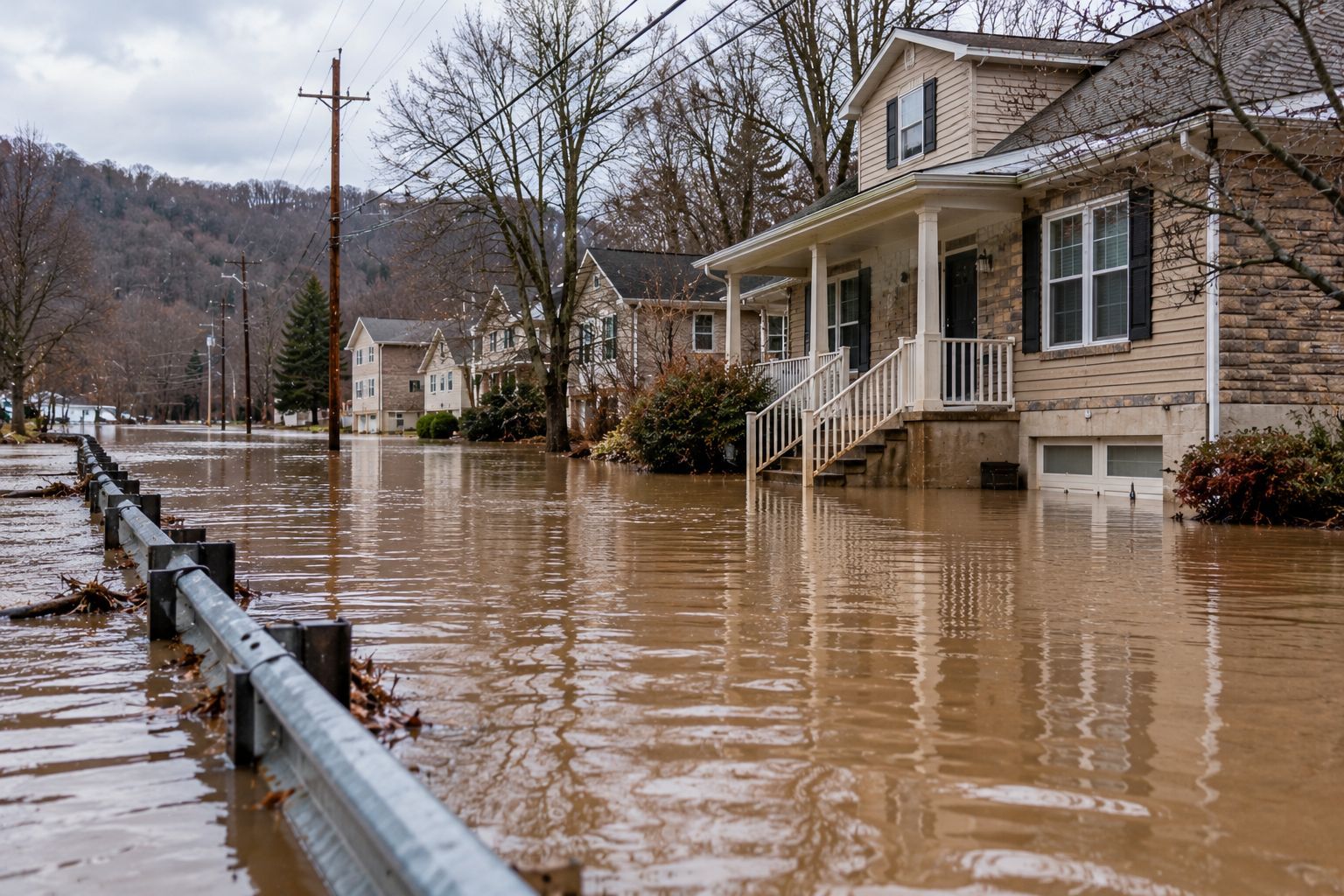
Flood is the most misunderstood line on a Pennsylvania homeowner's insurance checklist. People assume their homeowners policy covers it (it doesn't), or that their lender would have said something if it mattered. Here are the rules and the gaps.
Is Flood Insurance Required in Pennsylvania?
Pennsylvania state law does not require flood insurance. Federal law does, though, if your home sits in a FEMA-designated Special Flood Hazard Area and you carry a mortgage from a federally regulated or federally insured lender, including FHA, VA and USDA loans. If you own your home outright or live outside a high-risk zone, coverage is optional.
That's the short version of whether flood insurance is required in Pennsylvania. The longer version matters more, because "optional" and "unnecessary" are not the same thing. The mandate covers a narrow slice of homeowners. It is driven by your flood zone and your loan, not by how close you live to a creek or how often your street ponds after a summer thunderstorm.
A few situations come up again and again:
- Cash buyers in a high-risk zone: No federal requirement applies, but the risk to the property is identical.
- Homeowners who paid off their mortgage: The requirement ends with the loan. Many people drop coverage at that point and regret it later.
- Borrowers whose zone changed after a map update: A lender can require coverage partway through a loan if new FEMA maps pull the property into a Special Flood Hazard Area.
- Renters: No mandate, but a separate contents-only flood policy can protect furniture, electronics and clothing.
Standard homeowners policies from carriers like Erie, Westfield or Liberty Mutual exclude damage from rising surface water. A sewer backup endorsement doesn't fill that hole either. If water comes in from outside and from the ground up, you need a separate flood policy, whether the government requires one or not.
Lender Rules in Special Flood Hazard Areas
If your property falls inside a high-risk zone on the National Flood Insurance Program maps, your lender will require flood coverage before closing and for the life of the loan. Lenders don't get discretion on this. Federal rules require them to perform flood zone determinations, and institutions that fail to enforce insurance requirements face significant federal fines.
High-risk zones usually carry labels starting with "A" or "V" on FEMA's Flood Insurance Rate Maps. In Pennsylvania you'll mostly see A zones along rivers and streams: the Susquehanna, the Juniata, the Allegheny, the Ohio, the Delaware and the countless smaller creeks feeding them. During underwriting, the lender orders a Standard Flood Hazard Determination form. If that form says "yes," you'll need proof of a flood policy at closing.
Lenders typically require coverage at least equal to the lesser of the outstanding loan balance, the replacement cost of the building, or the maximum available under the NFIP. Pay attention to that first one. Many buyers request coverage that only matches the loan, not what it would cost to rebuild. The policy might satisfy the bank, but it can leave you underinsured if the house is worth far more than you borrowed.
Here are some common mistakes we see with lender-required flood coverage:
- Letting the policy lapse after escrow changes. If your loan gets sold and the new servicer doesn't pay the premium, you're still responsible.
- Ignoring force-placed insurance notices. If you don't show proof of coverage, the lender can buy a policy for you. These policies tend to cost more and often protect only the lender's interest.
- Assuming a Letter of Map Amendment is automatic. If you believe your home sits above the base flood elevation, you can apply to FEMA to have it removed from the zone. That takes an elevation certificate and some patience.
MVP Insurance, founded by Josh Medure and David Varrati, helps residents across western Pennsylvania and Ohio work through these requirements. That includes reading the zone determination, comparing what the lender demands against what the home actually needs, and matching coverage to both.
The 30-Day Wait for Flood Insurance Policies
Most new NFIP flood policies don't take effect until 30 days after purchase. The rule exists for a simple reason: without it, people would buy coverage only when a named storm shows up on the forecast. The Pennsylvania Insurance Department notes that most new NFIP policies carry a 30-day waiting period to prevent last-minute purchases ahead of a storm.
Here's how that plays out in practice. Say a homeowner in Bucks County watches a tropical system track up the coast and calls on a Monday. A storm that arrives Thursday will hit a house with no flood coverage in force. Rain in the forecast doesn't change anything. If you wait until you're worried, you've waited too long.
There are a few standard exceptions to the 30-day wait:
- Mortgage transactions: No waiting period applies when the policy is purchased in connection with making, increasing, extending or renewing a mortgage loan. That's why buyers can close with coverage active on day one.
- Map revisions: If a FEMA map update newly places your property in a high-risk zone, a shortened waiting period may apply when you buy within a set window after the change.
- Post-wildfire flooding: Certain properties affected by flooding on burned federal land may qualify for an exception, though this rarely applies in Pennsylvania.
Private flood carriers write their own rules. Franklin Flood, American Bankers and other private markets may offer shorter waiting periods, sometimes as brief as a couple of weeks or less, depending on the product and the property. Terms vary, and some carriers restrict new business when a storm is already approaching. An agent can confirm the exact effective date before you sign anything.
Timing matters with renewals too. Let an NFIP policy lapse, and you could face a fresh waiting period and lose any rating benefits you had built up.
Why Homes Outside the Zone Still Flood
Living outside a Special Flood Hazard Area means your risk is lower. It doesn't mean your risk is zero. The state's own insurance regulators put it bluntly: "Pennsylvania remains vulnerable to flooding well beyond traditional high-risk flood zones." In our part of the country, the reasons are easy to see.
The first is topography. Pennsylvania is a state of hills and hollows. Water runs downhill fast, and narrow valleys funnel it into neighborhoods that never appear on a high-risk map. A stalled thunderstorm over Butler or Allegheny County can dump several inches in a few hours. Small tributaries that are dry in August can rise several feet overnight, and flash flooding like that doesn't care where FEMA drew a line years ago.
The second is infrastructure. Many older Pennsylvania boroughs run on stormwater systems built decades before today's development patterns and rainfall intensities. When culverts clog with debris and storm drains back up, water collects in basements and low streets far from any river. Every new parking lot and subdivision adds hard surfaces that send more runoff downstream.
The third is outdated maps. Flood maps are snapshots in time. Some Pennsylvania communities are working with maps that don't reflect recent construction or changing weather. Those maps can lag years behind what's actually happening on the ground.
The financial result is sobering. Pennsylvania has the second-largest flood insurance protection gap in the U.S., with an estimated $2.78 billion in uninsured annual average losses. A big share of that falls on homeowners who thought they didn't need coverage. Federal disaster aid, when it's declared at all, usually arrives as a loan you have to repay.
Lower-risk zones also tend to come with lower premiums, which makes the decision easier. If you want to see how coverage works for your address, our page on pennsylvania flood insurance walks through the options in more detail.
Private vs. NFIP Flood Coverage Options
Pennsylvania homeowners have two broad paths: a policy through the National Flood Insurance Program or a policy from a private flood carrier. Both satisfy most lender requirements, but they differ in limits, flexibility and price. Neither one wins in every case. The right fit depends on your home's value, its location and what you need covered.
| Feature | NFIP Policy | Private Flood Policy |
|---|---|---|
| Building limit (residential) | Capped by federal law, typically $250,000 | Varies by carrier; higher limits often available |
| Contents limit | Capped, typically $100,000 | Varies; often higher |
| Waiting period | Usually 30 days | Often shorter, depends on carrier |
| Basement coverage | Very limited | Broader on some products |
| Loss of use / living expenses | Not included | Available on many products |
| Pricing basis | Risk Rating 2.0 formula | Carrier's own underwriting |
As of this writing, the typical yearly NFIP cost for a single-family home in Pennsylvania runs about $1,210. Premiums for high-risk properties near rivers or streams can exceed $4,000 a year under Risk Rating 2.0.
NFIP Limitations and Residential Caps
The NFIP's biggest drawback is its caps. Rebuilding a larger home in Sewickley or Chester County can easily cost more than the federal building limit, and the difference comes out of your pocket unless you add excess flood coverage. Basements are another sore spot. NFIP policies cover essentials like furnaces, water heaters and electrical panels below grade, but generally exclude finished walls, carpeting and most belongings stored there. For Pennsylvania homes with finished basements, that's a painful surprise after a claim.
There's also a policy-stability question. Congress has to reauthorize the program periodically. As of this writing, the NFIP is authorized through December 11, 2026. Past lapses have briefly halted new policy sales, and FEMA tracks the program's congressional reauthorization history for anyone who wants the details.
Private Market Flexibility in Pennsylvania
Private flood products fill many of the NFIP's gaps: higher limits, additional living expenses if you're displaced, and sometimes replacement cost on contents. In lower-risk areas, a private policy may also come in under the NFIP price. Franklin Flood and American Bankers write flood coverage, and carriers like Erie, Westfield and Progressive are part of the broader mix an independent agent can access when building a full home insurance program. Coverage availability varies by carrier and address.
As an independent agent, MVP works with these carriers rather than for any one of them. That means comparing NFIP and private quotes side by side instead of defaulting to whichever product is easiest to write.
Common Pennsylvania Flood Insurance Questions
The decision usually comes down to three things: whether your lender requires coverage, whether you can wait 30 days, and whether you can absorb a flood loss without help. Here are the questions new buyers ask most.
Does my homeowners insurance cover flooding in Pennsylvania? No. Standard homeowners policies exclude damage from surface water and rising water. You need a separate flood policy through the NFIP or a private carrier.
Do I need flood insurance if I'm not in a flood zone? It isn't required, but it's often a smart move. Many Pennsylvania flood claims come from outside high-risk zones, and coverage in lower-risk areas usually costs less.
How long does it take for flood insurance to start? Most NFIP policies take effect after a 30-day wait, unless you buy the policy as part of a mortgage closing. Some private carriers offer shorter waiting periods.
Flood coverage is easy to put off until the forecast turns ugly, and by then the waiting period has already closed the door. The state's insurance department calls coverage for all disaster types, including flooding, one of the most important steps you can take to protect your family's financial security, and FEMA's flood insurance overview is a solid place to start your own reading.
If you'd like someone to compare NFIP and private options for your address, you can start a quote with MVP Insurance. We're an independent agency with offices in Zelienople, PA and New Springfield, OH. MVP Insurance is licensed in Ohio (#37714) and Pennsylvania (#519263), NPN 10588293.
Search
Recent Posts

MVP Insurance is a local, independent agency, licensed to serve individuals and businesses across Ohio and Pennsylvania.
We serve clients from our offices in New Springfield, Ohio and Zelienople, Pennsylvania and throughout Northeast Ohio and Western Pennsylvania, working with multiple carriers to help contractors, landlords and real estate investors, restaurants, retail shops, auto repair shops, professional offices and many other personal and commercial clients find coverage that fits.
Our Owners
Two friends who started an agency
Owner
Joshua Medure
I am a Penn State marketing graduate with more than ten years in insurance. My childhood friend David and I started MVP Insurance in Northeast Ohio because we wanted the people around us to have an agency that gives honest advice, real choices and someone who picks up the phone. I lead the agency’s insurance strategy, which means I read the policies so our clients do not have to. Away from the office, I coach youth football.


About the Author
David Varrati
Owner, MVP Insurance
I started MVP Insurance with my childhood friend Josh because we wanted people in Northeast Ohio and Western Pennsylvania to have an agency that explains things plainly and picks up the phone. I studied Political Science at Slippery Rock University and have spent more than ten years helping families and individuals protect what matters to them. When I am not in the office, you will find me coaching youth sports.