

Raising your deductible is the fastest lever you have. Moving a standard deductible from $500 to $1,000 or $2,500 can reduce your premium by up to 25%. On a $1,600 annual premium, that could mean saving a few hundred dollars a year.
The trade-off is simple: you take on more of the small losses. Before raising it, ask yourself whether you could write a check for the new deductible tomorrow without touching credit cards. If yes, a higher deductible usually pays off within a few claim-free years. Also check whether your policy has a separate wind or hail deductible, sometimes set as a percentage of dwelling coverage, since that can be much larger than the flat amount you remember choosing.
How does credit score affect my PA rate?
Pennsylvania allows insurers to use a credit-based insurance score when setting rates, and stronger credit generally means a lower premium. Paying bills on time and keeping balances low can help your rate over time.
Does my location near a fire station matter?
Yes. Homes closer to a staffed fire station and a working hydrant usually get better pricing because fire damage tends to be less severe when help arrives quickly.
How often should I review my policy limits?
Review them at every renewal and any time you renovate, add a big purchase, or finish a basement. With rebuilding costs rising, a limit that fit three years ago may now fall short.
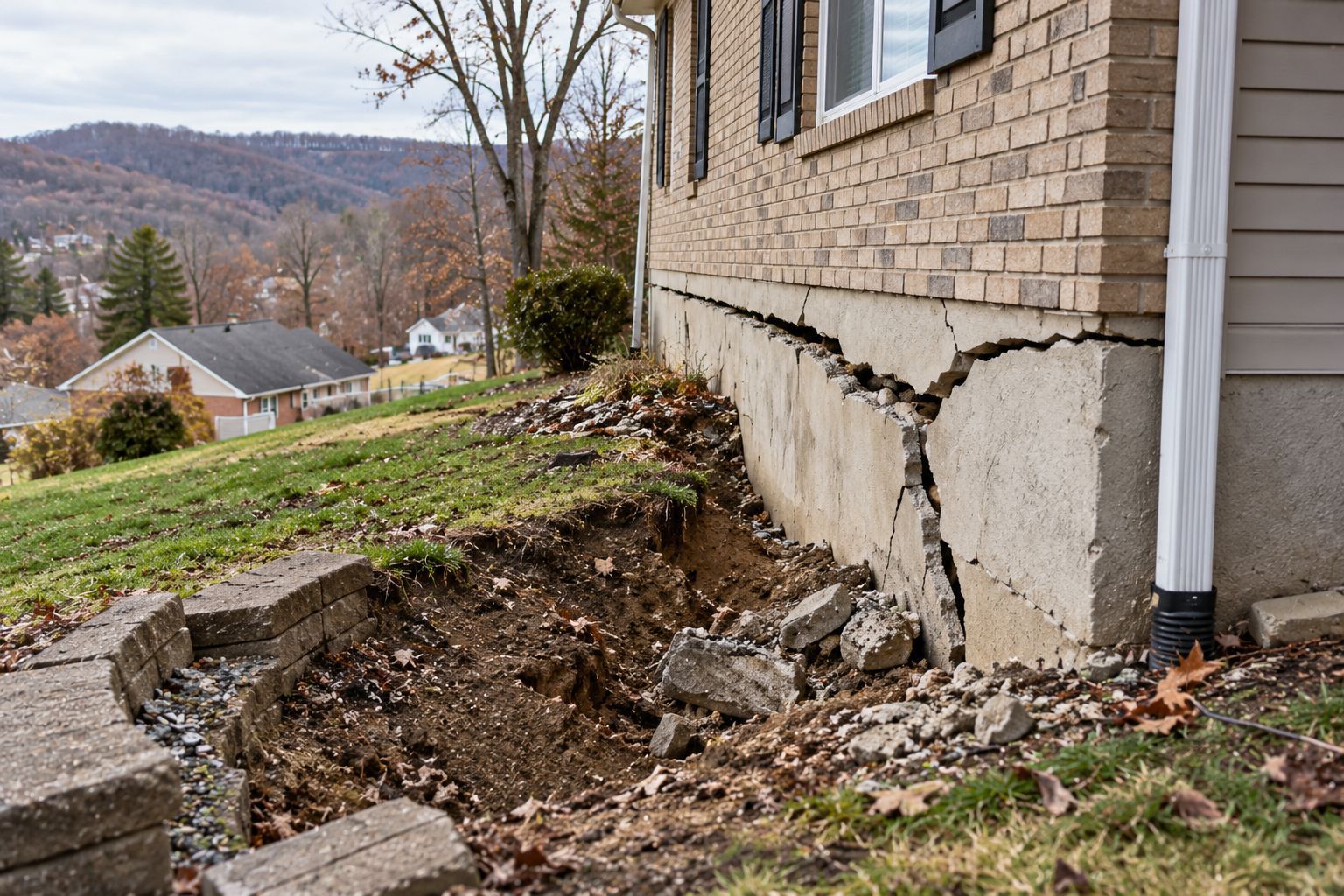
If you own a home in western Pennsylvania, there's a decent chance it sits above a coal seam that was dug out generations ago. Most people never think about it until a crack runs diagonally across the basement wall, a door suddenly won't latch, or a neighbor's driveway sinks six inches overnight. By then, the coverage question has already been answered, and usually not in the homeowner's favor.
Mine subsidence is one of those risks that feels abstract until it isn't. It doesn't make the news like floods or windstorms. It also shows up in places people don't expect: suburban cul-de-sacs, older borough neighborhoods, and farmland that hasn't seen a mine portal in eighty years. The coverage that addresses it is surprisingly affordable and run largely through the state.
This guide walks through how Pennsylvania's program actually works, where the exposure is concentrated, what homeowners typically pay, and the practical steps to get it in place.
What is Mine Subsidence Insurance in Pennsylvania?
Mine subsidence insurance in Pennsylvania covers damage to your home when the ground beneath it sinks or shifts because an underground coal or clay mine collapses. Standard homeowners policies typically exclude this type of earth movement. The coverage is offered mainly through a state-run fund and costs relatively little each year.
That exclusion is the part most people miss. A typical policy for pennsylvania homeowners insurance is written to handle sudden events like fire, wind, hail, theft, and burst pipes, but "earth movement" sits on the excluded list in most forms. Mine collapse falls under that umbrella, so a cracked foundation caused by an old mine void is usually your problem alone unless you've added separate protection. Repairs to a foundation, structural framing, and utility lines after a subsidence event can easily run well past what most families have in savings.
How the Pennsylvania Mine Subsidence Insurance Fund Works
The Pennsylvania Mine Subsidence Insurance (MSI) Fund is a non-profit, state-run program that pays for structural damage caused by ground movement over abandoned coal or clay mines. It operates through the Department of Environmental Protection rather than a private insurance company, and its goal is to keep coverage available and affordable for property owners in mining regions.
The program has been around a long time. Since it began in 1961, the fund has paid out more than $47 million in homeowner claims, which tells you two things: subsidence damage is real and recurring, and the fund has a long track record of actually paying. The Coal and Clay Mine Subsidence Insurance Fund is administered by DEP under the oversight of a board that includes the DEP Secretary, the State Treasurer, and the Insurance Commissioner. That structure is part of why rates stay low: there are no shareholders to pay, and the program exists to serve property owners rather than turn a profit.
Here's how the basic mechanics play out:
- What it covers: Physical damage to the insured structure from mine subsidence, such as foundation failure, wall cracking, and settling tied to a collapsed mine void.
- What it doesn't cover: Damage from ordinary settling, poor construction, expansive soils, sinkholes in limestone, or landslides that aren't mine-related.
- Who can buy it: Owners of homes and other structures in Pennsylvania. You don't need to prove a mine exists under your property to apply.
- How claims work: The fund sends investigators to determine whether mining caused the damage. If it did, the fund pays for repairs up to your coverage limit.
One nuance worth understanding is causation. Plenty of claims get denied not because the homeowner lacked coverage, but because the investigation tied the cracks to something other than a mine, such as poor drainage or soil movement. Documenting your home's condition with dated photos when you buy coverage makes it much easier to show what changed later.
There's also some public debate about how mining damage is monitored in the state. In July 2026, the Citizens Coal Council released a report arguing that mining damage to homes is being under-reported and criticizing DEP's shift away from independent university-led research. Whatever your take on that argument, it reinforces a simple point: homeowners can't count on someone else flagging their risk for them.
Which Counties Carry the Most Risk for Mine Subsidence?
The highest mine subsidence risk in Pennsylvania is concentrated in the southwestern coal counties, especially Allegheny, Washington, Fayette, and Westmoreland. These areas were mined heavily for the Pittsburgh coal seam for well over a century, and much of that mining happened long before anyone kept reliable maps or planned for what would be built on top.
The scale is bigger than most people realize. An estimated 1 million homes across Pennsylvania sit directly above abandoned underground mines, and once you add garages, barns, and commercial buildings, the number of structures exposed climbs past that. That isn't a rural-only problem. Large parts of suburban Allegheny County, including many communities built up after World War II, were developed right over old room-and-pillar workings.
A quick look at how the risk breaks down across the state:
- Allegheny County: Dense housing over extensive historic mining makes this one of the most exposed counties by sheer number of homes.
- Washington County: Both older abandoned workings and more modern mining activity contribute to subsidence concerns.
- Fayette County: Deep coal history, plenty of older housing stock, and many patch towns built for miners.
- Westmoreland County: Widespread abandoned mines underlie boroughs and growing suburbs alike.
- Other areas: Greene, Cambria, Indiana, and Somerset in the west, plus the anthracite region in the northeast (Lackawanna, Luzerne, Schuylkill, and Northumberland), also carry meaningful exposure.
Butler and Beaver counties deserve a mention too, since smaller coal and clay operations dotted those areas. Clay mining is easy to overlook, but the state fund specifically covers clay mine subsidence for that reason.
The tricky part is timing. Homeowners often assume that because nothing has moved in 50 years, nothing will. Local officials warn that abandoned mine shafts can deteriorate and collapse at any time, even after decades of stability. Pillars of coal left to hold up the roof weaken slowly, and water infiltration speeds that process up. A home that's been fine since 1965 isn't necessarily safe, it may just be early.
What It Costs to Insure a Home Against Subsidence
Mine subsidence coverage through the state fund typically costs well under $100 per year, even for a sizable home. As of this writing, a policy with $150,000 in coverage costs approximately $41.25 per year (https://www.pa.gov/services/dep/apply-for-department-of-environmental-protection-mine-subsidence-insurance), which makes it one of the lowest-cost add-ons a Pennsylvania homeowner can buy.
For a smaller home, the price drops further. Based on the state's published rates, $150,000 of residential coverage costs approximately $41.25 per year as of 2026. That works out to less than four dollars a month. Compare that to the cost of underpinning a foundation, rebuilding a basement wall, or replacing cracked sewer laterals, and the math isn't close.
A few factors shape what you'll actually pay:
- Coverage amount: Premiums scale with the dollar limit you choose, so a $300,000 home costs more to insure than a $150,000 one.
- Type of structure: Residential and commercial properties are rated differently.
- Where you buy it: Going directly through the state fund versus adding it through a carrier endorsement can affect the price and how it's billed.
The most common mistake we see isn't overpaying. It's underinsuring. People pick a coverage amount based on what they paid for the house in 1998, or on the land-plus-building market value, when what matters is what it would cost to repair or rebuild the structure today. Construction costs have climbed sharply over the past several years, and a subsidence claim on a home insured at half its rebuild cost will leave a painful gap. Since each additional block of coverage costs so little, it rarely makes sense to trim the limit to save a few dollars.
How to Add It to a Homeowners Policy
You can add mine subsidence protection in two main ways: through an independent agent who works with carriers such as Erie, Westfield, or Municipal Mutual, or by applying directly to the state's MSI Fund. Either route gets you covered. The difference is mostly about convenience, billing, and how the coverage fits with the rest of your insurance.
If you're going through an agent, the process usually looks like this:
- Review your current policy. Confirm the earth movement exclusion and check whether any mine subsidence coverage already exists. Some homeowners assume it's included when it isn't.
- Settle on a coverage amount. Base this on current rebuild cost, not purchase price or tax assessment.
- Ask about available options. Depending on the carrier and location, your agent may add a mine subsidence endorsement to your existing policy or help you apply to the state fund alongside your homeowners coverage.
- Document the property. Take dated photos of the foundation, basement walls, and any existing cracks before coverage starts.
- Calendar your renewal. If the coverage is separate from your homeowners policy, it renews on its own schedule, and letting it lapse is an easy mistake.
Applying directly to the state is straightforward too. DEP accepts applications online and by paper, and you'll provide basic property information along with your coverage selection. Homeowners with a mortgage should know that lenders in mining areas sometimes ask for proof of subsidence coverage, so having the declarations page handy saves a headache at closing.
Comparing State Fund vs. Private Carrier Endorsements
The state fund is the backbone of subsidence coverage in Pennsylvania. It's purpose-built for this one risk, priced low, and its claims investigators deal with mine-related damage all the time. The tradeoff is that it's a standalone policy with its own paperwork, billing, and renewal date.
A carrier endorsement, where one is available, folds the coverage into your existing homeowners policy. That means one bill and one renewal, and fewer chances to forget about it. Endorsement terms vary by company, so limits, deductibles, and exactly what counts as subsidence damage can differ from the state's version. An independent agent can lay those differences side by side so you're choosing based on the actual wording, not just the price.
For many families, the right answer is whichever option they'll actually keep in force. Coverage that lapses because nobody remembered a separate bill protects no one.
Comparison of Coverage Limits and State Requirements
The state fund and private endorsements differ mainly in who sets the terms, how deductibles work, and who qualifies. Neither is required by Pennsylvania law for homeowners, though mortgage lenders in mining areas may request it.
| Feature | PA MSI Fund | Private Carrier Endorsement |
|---|---|---|
| Who runs it | PA Department of Environmental Protection | Your homeowners insurance company |
| Coverage limits | Set by the fund's rate schedule, chosen in blocks | Set by the carrier, often tied to dwelling limit |
| Deductible | Fixed by the fund's program terms | Varies by carrier and policy |
| Eligibility | PA structures; no proof of a mine needed | Must hold an active policy with that carrier |
| Billing | Separate policy and renewal | Added to homeowners premium |
| Claim investigation | State-appointed subsidence investigators | Carrier adjusters, sometimes with engineers |
| Required by law? | No | No |
| Lender requirement | Possible in mining regions | Possible in mining regions |
A few notes on reading this table. First, "eligibility" is broader on the state side, since you don't have to be insured with any particular company to buy it. Second, the deductible line deserves a close look whichever route you pick, because a high deductible on a modest claim, like repairing a single cracked wall, can mean the policy pays little or nothing for minor damage.
The other thing to watch is how each option defines covered damage. Subsidence policies hinge on causation, and wording that's narrower about what counts as mine-related movement can make the difference between a paid claim and a denial. This is exactly where comparing the actual policy language, not just the premium, pays off.
Pulling it together: mine subsidence coverage is one of the few insurance decisions where the cost is small and the potential loss is enormous. If your home is anywhere in the southwestern coal counties or the anthracite region, adding it costs less than a couple of pizzas a year. The bigger risks are choosing too low a limit or letting a separate policy lapse.
If you'd like help sorting out whether a state fund policy or a carrier endorsement fits your situation, MVP Insurance can compare options across the carriers we work with as an independent agency, from our offices in Zelienople, PA and New Springfield, OH. When you're ready, you can start your quote here and we'll handle the comparison legwork. MVP Insurance is licensed in Ohio (license #37714) and Pennsylvania (license #519263), NPN 10588293.
Frequently Asked Questions About Mine Subsidence
Does my standard policy cover mine collapse?
Usually not. Most standard homeowners policies exclude earth movement, and damage from a collapsed mine falls under that exclusion. You need a separate mine subsidence policy or an endorsement to be covered.
How do I know if my home is over a mine?
Pennsylvania DEP maintains mine maps and can tell you whether your property sits over or near known workings, and the MSI program offers resources to check your address. Keep in mind that many older mines were never fully mapped, so living outside a mapped area doesn't guarantee there's nothing below.
Is there a waiting period for new coverage?
Yes, new subsidence coverage typically doesn't take effect immediately, and damage from movement that started before your policy began generally isn't covered. That's why it pays to buy coverage while your home is stable rather than after you spot new cracks.
Search
Recent Posts


MVP Insurance is a local, independent agency, licensed to serve individuals and businesses across Ohio and Pennsylvania.
We serve clients from our offices in New Springfield, Ohio and Zelienople, Pennsylvania and throughout Northeast Ohio and Western Pennsylvania, working with multiple carriers to help contractors, landlords and real estate investors, restaurants, retail shops, auto repair shops, professional offices and many other personal and commercial clients find coverage that fits.
Our Owners
Two friends who started an agency
Owner
Joshua Medure
I am a Penn State marketing graduate with more than ten years in insurance. My childhood friend David and I started MVP Insurance in Northeast Ohio because we wanted the people around us to have an agency that gives honest advice, real choices and someone who picks up the phone. I lead the agency’s insurance strategy, which means I read the policies so our clients do not have to. Away from the office, I coach youth football.


About the Author
David Varrati
Owner, MVP Insurance
I started MVP Insurance with my childhood friend Josh because we wanted people in Northeast Ohio and Western Pennsylvania to have an agency that explains things plainly and picks up the phone. I studied Political Science at Slippery Rock University and have spent more than ten years helping families and individuals protect what matters to them. When I am not in the office, you will find me coaching youth sports.