
Frequently Asked Questions About Mine Subsidence
Raising your deductible is the fastest lever you have. Moving a standard deductible from $500 to $1,000 or $2,500 can reduce your premium by up to 25%. On a $1,600 annual premium, that could mean saving a few hundred dollars a year.
The trade-off is simple: you take on more of the small losses. Before raising it, ask yourself whether you could write a check for the new deductible tomorrow without touching credit cards. If yes, a higher deductible usually pays off within a few claim-free years. Also check whether your policy has a separate wind or hail deductible, sometimes set as a percentage of dwelling coverage, since that can be much larger than the flat amount you remember choosing.
How does credit score affect my PA rate?
Pennsylvania allows insurers to use a credit-based insurance score when setting rates, and stronger credit generally means a lower premium. Paying bills on time and keeping balances low can help your rate over time.
Does my location near a fire station matter?
Yes. Homes closer to a staffed fire station and a working hydrant usually get better pricing because fire damage tends to be less severe when help arrives quickly.
How often should I review my policy limits?
Review them at every renewal and any time you renovate, add a big purchase, or finish a basement. With rebuilding costs rising, a limit that fit three years ago may now fall short.
Coverage through the association is not unlimited. As of this writing, most property and casualty claims are typically capped at $300,000 per claim [https://govt.westlaw.com/pac/Document/N92524E00342611DA8A989F4EECDB8638?viewType=FullText&originationContext=documenttoc&transitionType=CategoryPageItem&contextData=(sc.Default)]. Workers' compensation is the big exception, with no cap on covered benefits.
That $300,000 figure catches people off guard [https://govt.westlaw.com/pac/Document/N92524E00342611DA8A989F4EECDB8638?viewType=FullText&originationContext=documenttoc&transitionType=CategoryPageItem&contextData=(sc.Default)]. Picture a homeowner with a $550,000 dwelling limit whose house burns down a week after their insurer is ordered into liquidation. Their policy promised more than half a million dollars, but the guaranty association will typically pay up to its cap. The rest becomes a claim against the failed insurer's estate, which may pay a portion years later, or nothing.
A few other rules shape what you'll actually receive:
- Unearned premium refunds are limited. If you prepaid for months of coverage you never got, the return of that premium is capped at $10,000 per policy.
- Large businesses face exclusions. PPCIGA excludes first-party claims from any insured whose net worth exceeded $25 million as of December 31 of the year before the insolvency. Bigger companies are expected to absorb losses themselves.
- Duplicate recovery isn't allowed. If another policy covers the same loss, you generally have to pursue that coverage first.
For most families, the cap is high enough to handle a typical auto accident or a burst pipe claim. The pain shows up with total losses on higher-value homes, serious injury liability claims, and commercial property losses.
One detail deserves extra attention. Sinkhole endorsements typically cover structures and personal property, not the land itself. Stabilizing the void, grouting, or filling the hole may remain your expense even after a claim is approved.
There's also movement at the state level. House Bill 589 would create a state-run program offering up to $150,000 in coverage for natural sinkholes and landslides, started with a $10 million General Fund appropriation and intended to become self-sustaining through premiums. As of this writing, the bill remained under consideration in the Senate after passing the House in September 2025. Supporters described it as recognizing that the commercial insurance industry is not stepping up to cover these costs, and the proposal would offer premium credits to communities that adopt mitigation practices.
| Requirement | Motorized Boats & PWCs | Non-Motorized (Kayak, Canoe, SUP) | Insurance Impact |
|---|---|---|---|
| Registration | Required for all | Required at PFBC or state park access (or launch permit) | Proof often needed to bind a policy |
| Safety Certificate | Required for PWCs; motorboats over 25 hp if born 1982 or later | Not required | Can help eligibility and may earn credits |
| Age Limits | No PWC or 25+ hp boat at 11 or younger | No state minimum | Underage operation can complicate claims |
| BAC Limit | 0.08% (0.02% under 21) | Same limits apply | BUI can lead to cancellation or non-renewal |
| Accident Reporting | 48 hours for injury/death; 10 days for $2,000+ damage | Same rules apply | Late reporting can weaken your claim |
| Typical Coverage Need | Liability, physical damage, towing | Liability, theft | Lenders and marinas often require coverage |
| Coverage | State Minimum | Common Higher Choice |
|---|---|---|
| Bodily injury (per person) | Low required floor | Several times the minimum |
| Bodily injury (per accident) | Low required floor | Matched to your assets |
| Property damage | Very low floor | High enough to replace a newer vehicle |
| Medical benefits | Required | Higher limits often added |
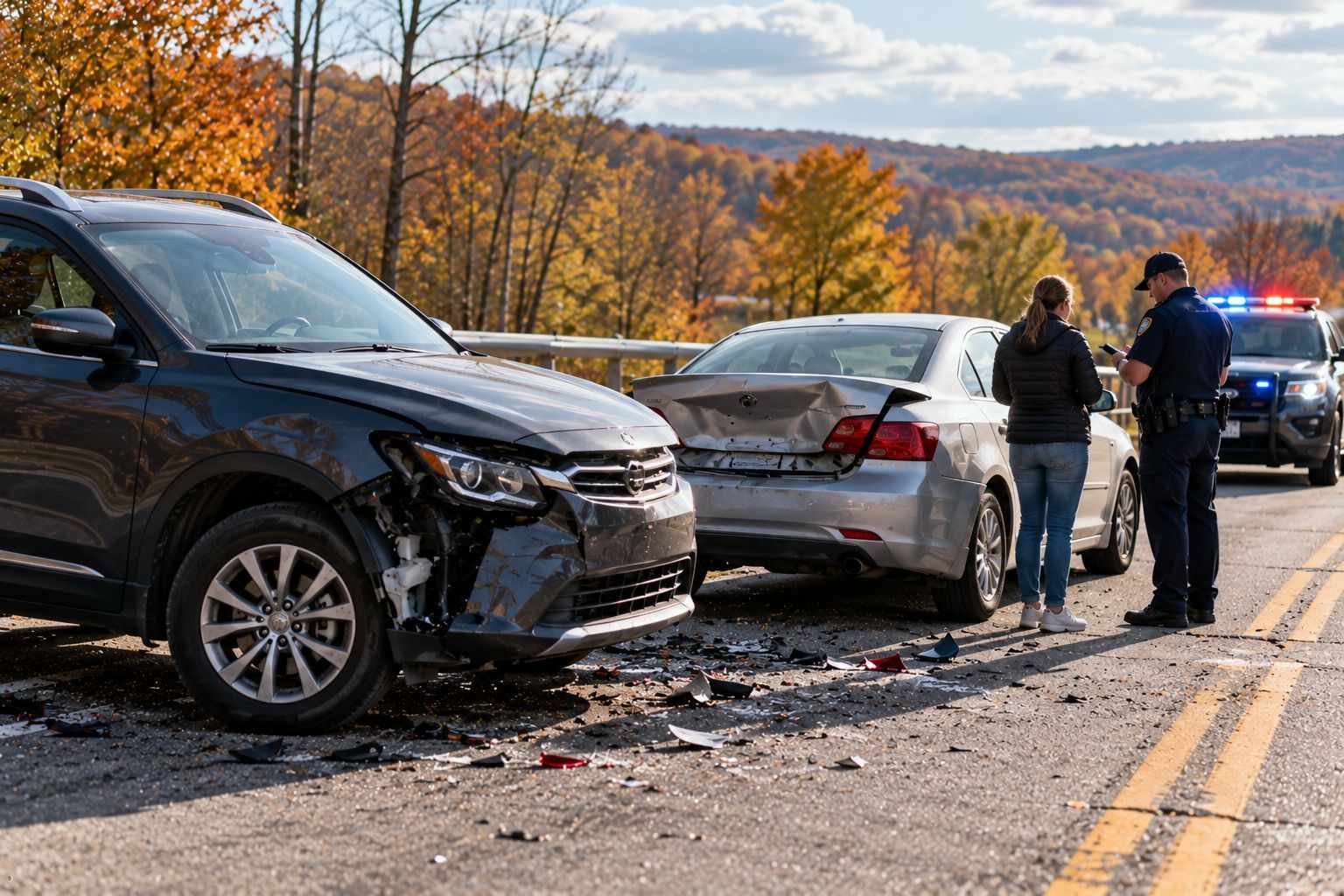
After a car accident in Pennsylvania, get to safety, call 911 if anyone is hurt or a car needs a tow, swap information, and photograph everything. Your own policy's First Party Benefits pay your medical bills first. Your tort option decides whether you can sue for pain and suffering. Most lawsuits must be filed within two years.
That's the short version. The longer version matters because most claim problems don't start with the crash itself. They start in the days and weeks afterward: a missed police call, a medical bill sent to the wrong insurer, or a Limited Tort choice someone made years ago to save a few dollars a month.
Pennsylvania roads have gotten safer. PennDOT recorded 1,047 traffic fatalities in 2025, the lowest count since record-keeping began in 1928. Still, thousands of drivers file claims every month, and the state's no-fault system works differently from what many people expect. If you've just been in a wreck, or you want to be ready before one happens, here's how the process actually unfolds.
What to Do Immediately Following a Car Accident in Pennsylvania
Your first job is safety, then documentation. If your car can move and nobody is seriously hurt, pull onto the shoulder or into a nearby lot, turn on your hazards, and call 911. Pennsylvania law requires drivers to immediately notify police when a crash involves injury, death, or a vehicle that has to be towed. Even in a minor fender-bender, a call often makes sense, because an officer's report makes the insurance side much smoother.
While you wait, work through this list:
- Check for injuries. Adrenaline hides pain. Neck and back injuries often show up a day or two later.
- Exchange information. Get each driver's name, phone number, address, license number, plate number, insurance company, and policy number.
- Photograph everything. Take wide shots of the scene, close-ups of every vehicle's damage, skid marks, traffic signals, road conditions, and the other driver's insurance card.
- Find witnesses. Get names and phone numbers before people drive off. Independent witnesses carry real weight when fault is disputed.
- Keep your statements short. Stick to facts. Saying "I'm sorry" or "I didn't see you" can be used against you later.
- Note the officer's name and badge number. You'll need this to request the crash report.
One more thing that trips people up: phones. Pennsylvania began enforcing its hands-free law on June 5, 2026, with a $50 fine plus court costs for handheld device use. If the other driver was holding a phone when they hit you, tell the officer. It can affect how fault is assigned.
The Role of Police Reports in PA Accident Claims
A police report is the closest thing to a neutral record of what happened. Adjusters at carriers like Erie and Progressive lean on it heavily when deciding fault for property damage and bodily injury claims. It isn't the final word, but a report that lists the other driver as cited for running a red light changes the tone of a claim quickly.
Without one, a claim often turns into your word against theirs. We've seen plenty of cases where both drivers agreed at the scene, then the other driver's story changed once their insurer called. A report locks in the details while they're fresh.
When is a Police Report Legally Required?
Under Pennsylvania's crash reporting statute, you must notify police right away if anyone is injured or killed, or if any vehicle is damaged badly enough to need a tow. In those situations, the investigating officer files the report with PennDOT.
If police don't come to the scene or don't investigate a reportable crash, the responsibility shifts to you. PennDOT's driver guidance on crash reporting explains that drivers in that situation need to submit their own report using the state's driver crash report form. For a parking lot scrape where both cars drive away and nobody is hurt, a police report usually isn't required, though notifying your insurer still is.
How to Obtain Your Pennsylvania Crash Report
Reports from state police and many local departments go to PennDOT, and you can request a copy through PennDOT's crash report request process. Local departments may also release reports directly, so call the non-emergency line of the agency that responded. Reports aren't instant; it usually takes several days to a few weeks for one to become available.
When you request it, have the date, county, and location of the crash ready, along with the incident number if the officer gave you one. Once you have it, read it carefully. Wrong plate numbers, misspelled names, or an incorrect diagram can slow a claim, and errors are easier to correct early.
How First Party Benefits Pay Medical Bills
Your own auto insurer pays your medical bills first, no matter who caused the crash. Pennsylvania is a no-fault state for medical payments, so if you carry a policy with Erie or Progressive, that company handles your treatment costs through First Party Benefits (FPB) without waiting for anyone to sort out liability.
This is the part that surprises people most. Someone rear-ends you at a red light, clearly at fault, and you assume their insurance pays your ER bill. It doesn't, at least not at first. You give your own auto claim number to the hospital, urgent care, chiropractor, or physical therapist, and they bill your auto carrier directly.
The upside is speed. Providers get paid promptly instead of waiting months for a fault decision. Pennsylvania also limits how much providers can charge an auto insurer for accident-related care, which helps your benefits stretch further.
Standard Medical Benefit Limits
State law requires every Pennsylvania auto policy to carry at least $5,000 in First Party Benefits for medical expenses. That sounds like a lot until you see an emergency room bill with imaging. A single ambulance ride, ER visit, and CT scan can eat most of it in one afternoon.
Many drivers choose higher medical limits, and some policies also offer income loss, funeral, and accidental death benefits as part of a larger FPB package. Once your FPB limit runs out, your health insurance typically becomes the next payer. That's a real coverage gap for anyone with a high-deductible health plan, because you could end up paying thousands out of pocket before your health coverage kicks in.
If nobody in your household has auto insurance and you're hurt as a passenger or pedestrian, the Pennsylvania Assigned Claims Plan may provide limited benefits. A lawsuit to recover benefits from that plan generally must be filed within four years of the accident.
Understanding Tort Option Effects on Your Claim
Your tort choice decides whether you can sue the at-fault driver for pain and suffering. Every Pennsylvania driver picks Full Tort or Limited Tort when buying a policy, and most people make that choice in about four seconds while signing paperwork. It's one of the most consequential decisions on the whole policy.
Limited Tort lowers your premium. In exchange, you give up the right to recover non-monetary damages (pain, suffering, emotional distress, loss of enjoyment of life) unless your injury meets the state's "serious injury" threshold. That threshold generally means death, serious permanent disfigurement, or serious impairment of a body function. A herniated disc that keeps you out of work for three months may or may not qualify, and that fight often ends up in front of a judge.
Limited Tort doesn't take away everything. You can still recover out-of-pocket costs like medical bills beyond your FPB and lost wages. There are also exceptions where Limited Tort drivers keep full rights, such as when the at-fault driver is convicted of DUI, is uninsured, or is driving a vehicle registered in another state.
Full Tort vs. Limited Tort Comparison
| Feature | Full Tort | Limited Tort |
|---|---|---|
| Premium | Higher | Lower |
| Sue for medical bills and lost wages | Yes | Yes |
| Sue for pain and suffering | Yes, any injury | Only if serious injury |
| Typical client regret | Rare | Common after a moderate injury |
Our honest take: the savings on Limited Tort are usually modest compared to what you give up. Families with kids who ride in other people's cars should look hard at Full Tort, since your tort choice typically follows household members too.
Comparison of Mandatory PA Insurance Coverage
Pennsylvania requires three coverages on every registered vehicle: bodily injury liability, property damage liability, and First Party Benefits. The table below shows what each one does and what the state requires. The minimums keep your car legal, but they rarely keep you financially safe after a serious crash.
| Coverage | What It Pays For | State Requirement |
|---|---|---|
| Bodily Injury Liability | Injuries you cause to others | Required, at state minimum per-person and per-accident limits |
| Property Damage Liability | Damage you cause to others' cars or property | Required, at state minimum limit |
| First Party Benefits | Your own medical bills | Required, at least $5,000 |
| Uninsured/Underinsured Motorist | Your injuries when the at-fault driver lacks coverage | Must be offered; can be rejected in writing |
| Collision and Comprehensive | Damage to your own vehicle | Optional (often required by lenders) |
Here's where minimum-limit policies hurt people. Property damage minimums haven't kept pace with what cars cost. Hit a new pickup truck or a luxury SUV, and you can blow past a minimum limit before the tow truck arrives. Anything above your limit becomes your personal responsibility.
There's some good news on the pricing side. State insurance officials have pointed to a stabilizing market that "will help keep more money in Pennsylvanians' pockets." And as of this writing, the accident surcharge threshold rose to $2,350 effective July 1, 2026, which means insurers can't raise your premium for a single accident with costs below that amount. Small claims shouldn't scare you away from reporting.
Pennsylvania Statute of Limitations and Claim Deadlines
You typically have two years from the date of the accident to file a personal injury lawsuit in Pennsylvania. Property damage claims generally follow the same two-year window. Miss that deadline, and a court will almost certainly throw out your case, no matter how strong it is.
Two years feels like plenty of time. It isn't, especially with injuries that need ongoing treatment. Many people wait to see how they recover, settlement talks drag, and suddenly the clock is down to weeks. Attorneys generally want time to gather records, consult doctors, and negotiate before filing, so don't treat the deadline as a target.
Insurance reporting deadlines are much shorter and much less forgiving. Your policy requires prompt notice of any accident, and carriers like Westfield and Liberty Mutual can push back on claims reported late, particularly if the delay made it harder to inspect the vehicle or interview witnesses. Call your insurer or agent the same day if you can, or the next morning at the latest.
A few other timelines worth keeping in mind:
- Assigned Claims Plan: A lawsuit to recover benefits generally must be filed within four years of the accident.
- Claims against government entities: Suing a city, township, or state agency involves special notice requirements, often due within months rather than years, and damage caps can apply.
- Minors: For injured children, the two-year period usually doesn't start running until they turn 18.
Keep a simple folder (paper or digital) with your claim number, the crash report, photos, medical bills, and every letter from an insurer. Dates matter, and organized records make it much harder for anyone to argue you missed one.
Working with Independent Agents for Accident Recovery
An independent agent works for you, not the insurance company, and that matters most after a crash. MVP Insurance is an independent agency that works with carriers like Frederick Mutual, Hagerty, Erie, and Progressive. When a claim gets complicated, we help clients make sense of their policy, file correctly, and push for answers when things stall.
Think about what a claim actually involves. You're dealing with your own carrier for FPB and collision, possibly the other driver's carrier for property damage, a body shop, a rental company, and medical providers who keep mailing bills to the wrong place. Most people do this once every several years and have no idea what's normal. An agent who handles claims regularly can spot a problem, like a provider billing health insurance instead of auto, before it turns into a collections notice.
We also see the mistakes that start long before the crash: Limited Tort chosen without understanding it, uninsured motorist coverage waived, FPB left at the $5,000 minimum. Reviewing your pennsylvania car insurance before you need it is far easier than discovering a gap during a claim. Because we compare multiple carriers, we can usually show how much Full Tort or higher medical limits really cost instead of guessing.
MVP Insurance has offices in Zelienople, PA and New Springfield, OH, and offers 24/7 claims support. We're licensed in Ohio (license #37714) and Pennsylvania (license #519263), NPN 10588293. If you'd like a second set of eyes on your coverage, you can start a quote and we'll compare options across carriers for you.
At its core, the agent's job during recovery is simple: bridge the gap between you and the insurance company, so you can focus on getting better while someone who knows the system keeps the claim moving.
Frequently Asked Questions About PA Car Accidents
Do I have to pay a deductible for medical bills?
Generally, no. Pennsylvania First Party Benefits pay your accident-related medical bills without a deductible, up to your policy limit. Deductibles usually apply to collision and comprehensive coverage for vehicle damage, not to FPB.
Can I change my tort option after an accident?
You can switch from Limited Tort to Full Tort at any time, but the change only applies going forward. It won't change your rights for a crash that already happened, which is why it pays to review your tort choice before you ever need it.
How long do I have to report an accident to my insurance?
Pennsylvania doesn't set one fixed number of days, but your policy requires prompt notice, and late reporting can lead to a denied or delayed claim. Report it within 24 hours whenever possible, even if you don't plan to file right away.
Search
Recent Posts


MVP Insurance is a local, independent agency, licensed to serve individuals and businesses across Ohio and Pennsylvania.
We serve clients from our offices in New Springfield, Ohio and Zelienople, Pennsylvania and throughout Northeast Ohio and Western Pennsylvania, working with multiple carriers to help contractors, landlords and real estate investors, restaurants, retail shops, auto repair shops, professional offices and many other personal and commercial clients find coverage that fits.
Our Owners
Two friends who started an agency
Owner
Joshua Medure
I am a Penn State marketing graduate with more than ten years in insurance. My childhood friend David and I started MVP Insurance in Northeast Ohio because we wanted the people around us to have an agency that gives honest advice, real choices and someone who picks up the phone. I lead the agency’s insurance strategy, which means I read the policies so our clients do not have to. Away from the office, I coach youth football.


About the Author
David Varrati
Owner, MVP Insurance
I started MVP Insurance with my childhood friend Josh because we wanted people in Northeast Ohio and Western Pennsylvania to have an agency that explains things plainly and picks up the phone. I studied Political Science at Slippery Rock University and have spent more than ten years helping families and individuals protect what matters to them. When I am not in the office, you will find me coaching youth sports.